• HOME
  • NEWS
  • EXPLORE
    • CAREER
      • Companies
      • Jobs
    • EVENTS
    • iGEM
      • News
      • Team
    • PHOTOS
    • VIDEO
    • WIKI
  • BLOG
  • COMMUNITY
    • FACEBOOK
    • INSTAGRAM
    • TWITTER
Sunday, December 21, 2025
BIOENGINEER.ORG
No Result
View All Result
  • Login
  • HOME
  • NEWS
  • EXPLORE
    • CAREER
      • Companies
      • Jobs
        • Lecturer
        • PhD Studentship
        • Postdoc
        • Research Assistant
    • EVENTS
    • iGEM
      • News
      • Team
    • PHOTOS
    • VIDEO
    • WIKI
  • BLOG
  • COMMUNITY
    • FACEBOOK
    • INSTAGRAM
    • TWITTER
  • HOME
  • NEWS
  • EXPLORE
    • CAREER
      • Companies
      • Jobs
        • Lecturer
        • PhD Studentship
        • Postdoc
        • Research Assistant
    • EVENTS
    • iGEM
      • News
      • Team
    • PHOTOS
    • VIDEO
    • WIKI
  • BLOG
  • COMMUNITY
    • FACEBOOK
    • INSTAGRAM
    • TWITTER
No Result
View All Result
Bioengineer.org
No Result
View All Result
Home NEWS Science News Chemistry

Chinese solar telescope reveals acceleration of magnetic reconnection

Bioengineer by Bioengineer
March 12, 2021
in Chemistry
Reading Time: 2 mins read
0
IMAGE
Share on FacebookShare on TwitterShare on LinkedinShare on RedditShare on Telegram

IMAGE

Credit: LI Leping

Magnetic reconnection refers to the reconfiguration of magnetic field geometry. It plays an elemental role in the rapid release of magnetic energy and its conversion to other forms of energy in magnetized plasma systems throughout the universe.

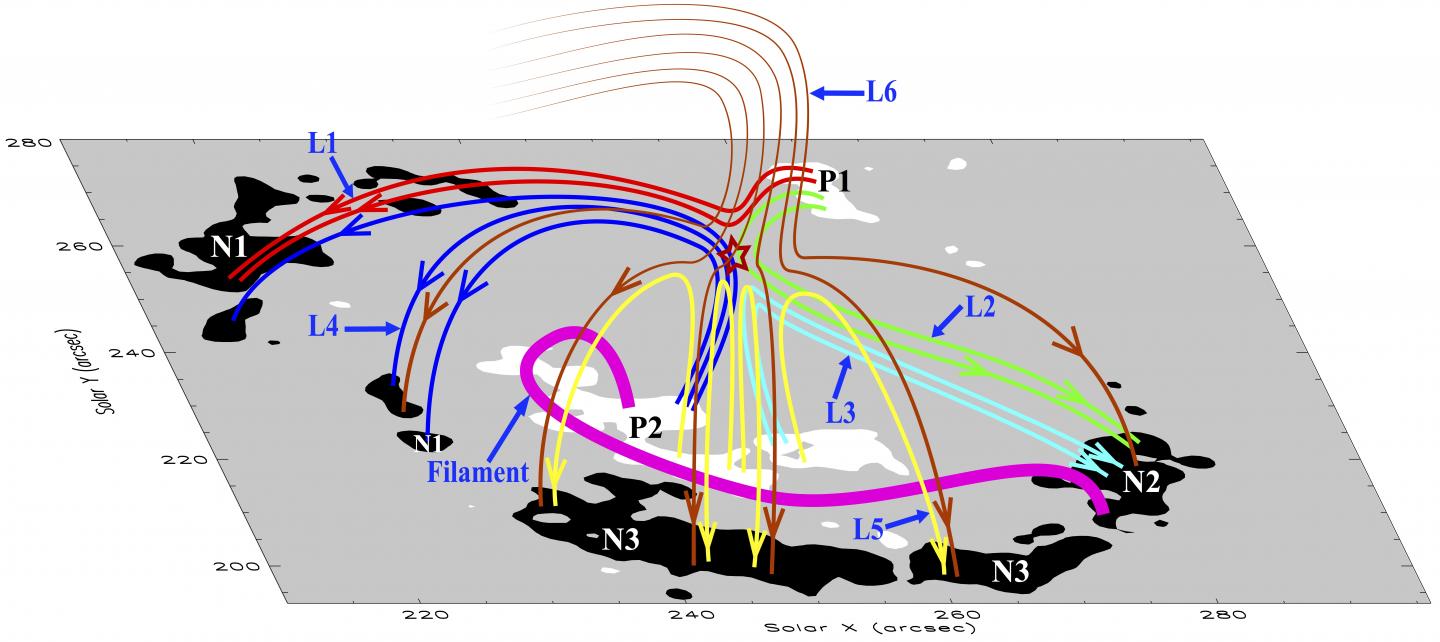
Researchers led by Dr. LI Leping from the National Astronomical Observatories of the Chinese Academy of Sciences (NAOC) analyzed the evolution of magnetic reconnection and its nearby filament. The result suggested that reconnection is significantly accelerated by the propagating disturbance caused by the adjacent filament eruption.

The study was published in The Astrophysical Journal on Feb. 25.

The New Vacuum Solar Telescope (NVST) is a 1-m ground-based solar telescope, located in the Fuxian Solar Observatory of the Yunnan Astronomical Observatories of the Chinese Academy of Sciences (YNAO). It provides observations of the solar fine structures and their evolution in the solar lower atmosphere.

The NVST observed the active region 11696 on March 15, 2013, in the Hα channel, centered at 6562.8 Å with a bandwidth of 0.25 Å.

Employing the NVST Hα images with higher spatial resolution, the researchers studied the evolution of magnetic loops and their nearby filament in the active region, combining the Atmospheric Imaging Assembly (AIA) extreme ultraviolet (EUV) images and Helioseismic and Magnetic Imager (HMI) line-of-sight magnetograms on board the Solar Dynamic Observatory (SDO).

In NVST Hα images, two groups of fibrils converged and interacted with each other. Two sets of newly formed fibrils then appeared and retracted from the interaction region.

“The result provides clear evidence of magnetic reconnection,” said Prof. Hardi Peter from the Max Planck Institute for Solar System Research (MPS), a co-author of the study. In AIA EUV images, the current sheet formed repeatedly in the reconnection region in the lower-temperature channels, and plasmoids appeared in the current sheet and propagated along it bidirectionally.

A filament was located to the southeast of the reconnection region. It erupted and pushed away the loops covering the reconnection region. “The filament eruption led to a disturbance propagating outward across the reconnection region,” said Dr. LI Leping, the first author of this study.

The current sheet subsequently became shorter and brighter, with a larger reconnection rate. It appeared in the AIA higher-temperature channels. In the current sheet, more and hotter plasmoids formed.

“Compared with the observations before the filament eruption during the same time intervals, more thermal and kinetic energy was converted through reconnection after the filament eruption,” said Dr. LI. “The reconnection was thus significantly accelerated by the propagating disturbance caused by the nearby filament eruption.”

###

Media Contact
XU Ang
[email protected]

Original Source

https://english.cas.cn/

Related Journal Article

http://dx.doi.org/10.3847/1538-4357/abd47e

Tags: AstronomyAstrophysicsSpace/Planetary Science
Share12Tweet8Share2ShareShareShare2

Related Posts

Cutting Electrolyte Reduction Boosts High-Energy Battery Performance

Cutting Electrolyte Reduction Boosts High-Energy Battery Performance

December 19, 2025
Microenvironment Shapes Gold-Catalysed CO2 Electroreduction

Microenvironment Shapes Gold-Catalysed CO2 Electroreduction

December 11, 2025

Photoswitchable Olefins Enable Controlled Polymerization

December 11, 2025

Cation Hydration Entropy Controls Chloride Ion Diffusion

December 10, 2025
Please login to join discussion

POPULAR NEWS

  • Nurses’ Views on Online Learning: Effects on Performance

    Nurses’ Views on Online Learning: Effects on Performance

    70 shares
    Share 28 Tweet 18
  • NSF funds machine-learning research at UNO and UNL to study energy requirements of walking in older adults

    71 shares
    Share 28 Tweet 18
  • Unraveling Levofloxacin’s Impact on Brain Function

    54 shares
    Share 22 Tweet 14
  • Exploring Audiology Accessibility in Johannesburg, South Africa

    51 shares
    Share 20 Tweet 13

About

We bring you the latest biotechnology news from best research centers and universities around the world. Check our website.

Follow us

Recent News

One Health Insights from Yersinia enterocolitica Pangenome Analysis

MINFLUX Reveals Cardiac Ryanodine Receptor Structure in 3D

Antisense Therapy Reverses Developmental Defects in SMA Organoids

Subscribe to Blog via Email

Enter your email address to subscribe to this blog and receive notifications of new posts by email.

Join 70 other subscribers
  • Contact Us

Bioengineer.org © Copyright 2023 All Rights Reserved.

Welcome Back!

Login to your account below

Forgotten Password?

Retrieve your password

Please enter your username or email address to reset your password.

Log In
No Result
View All Result
  • Homepages
    • Home Page 1
    • Home Page 2
  • News
  • National
  • Business
  • Health
  • Lifestyle
  • Science

Bioengineer.org © Copyright 2023 All Rights Reserved.