• HOME
  • NEWS
  • EXPLORE
    • CAREER
      • Companies
      • Jobs
    • EVENTS
    • iGEM
      • News
      • Team
    • PHOTOS
    • VIDEO
    • WIKI
  • BLOG
  • COMMUNITY
    • FACEBOOK
    • INSTAGRAM
    • TWITTER
Saturday, September 26, 2026
BIOENGINEER.ORG
No Result
View All Result
  • Login
  • HOME
  • NEWS
  • EXPLORE
    • CAREER
      • Companies
      • Jobs
        • Lecturer
        • PhD Studentship
        • Postdoc
        • Research Assistant
    • EVENTS
    • iGEM
      • News
      • Team
    • PHOTOS
    • VIDEO
    • WIKI
  • BLOG
  • COMMUNITY
    • FACEBOOK
    • INSTAGRAM
    • TWITTER
  • HOME
  • NEWS
  • EXPLORE
    • CAREER
      • Companies
      • Jobs
        • Lecturer
        • PhD Studentship
        • Postdoc
        • Research Assistant
    • EVENTS
    • iGEM
      • News
      • Team
    • PHOTOS
    • VIDEO
    • WIKI
  • BLOG
  • COMMUNITY
    • FACEBOOK
    • INSTAGRAM
    • TWITTER
No Result
View All Result
Bioengineer.org
No Result
View All Result
Home NEWS Science News Biology

Fossilized feeding frenzy

Bioengineer by Bioengineer
March 11, 2021
in Biology
Reading Time: 2 mins read
0
IMAGE
Share on FacebookShare on TwitterShare on LinkedinShare on RedditShare on Telegram

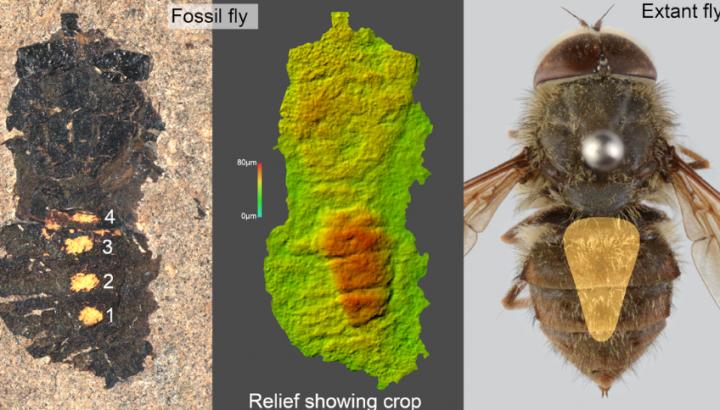
47 million year old fly found with a full belly
IMAGE

Credit: © Senckenberg

It was not the fly itself that caught the scientists’ attention, but its bulging abdomen suggesting it was still full with the fly’s last food intake. Surprisingly, analysis of the stomach content revealed it was full with pollen from different plants. The fossil pollen from the fly’s stomach was used to reconstruct the ancient environment inhabited by the fly, the biotic interactions between plant and fly, and the fly’s behaviour during feeding.

Flies as pollinators

Today, bees, butterflies and bumblebees are the typical pollinators, which are also known to feed on pollen. That flies also play an important role in pollination is rarely addressed. “The rich pollen content we discovered in the fly’s stomach suggests that flies were already feeding and transporting pollen 47 million years ago and shows it played an important role in the pollen dispersal of several plant taxa”, says Fridgeir Grímsson from the Department of Botany and Biodiversity Research of the University of Vienna. “Flies were major pollinators in ancient (sub-)tropical equivalent ecosystems and might even have outshined the bees”, the scientist concludes.

Short-distance flights for food

The extracted pollen was dominated by grains of Decodon (waterwillow) and Parthenocissus (virgin ivy). Today, the waterwillow is a sub-shrub growing in wetlands and the shallows of lakes, suggesting open low canopy habitat. The co-dominance of virgin ivy also suggests that the fly fed on plants growing at the forest margin surrounding the ancient Messel lake. “It is likely that the fly avoided long-distance flights between food sources and sought pollen from closely associated plants”, says Grímsson.

###

Publication in Current Biology:
S. Wedmann, T. Hörnschemeyer, M.S. Engel, R. Zetter, F. Grímsson. The last meal of an Eocene pollen-feeding fly. Current Biology (2021)
DOI: 10.1016/j.cub.2021.02.025

Media Contact
Dr. phil. habil. Fridgeir Grímsson
[email protected]

Related Journal Article

http://dx.doi.org/10.1016/j.cub.2021.02.025

Tags: BiodiversityBiologyEvolutionMicrobiologyPaleontologyPlant Sciences
Share12Tweet8Share2ShareShareShare2

Related Posts

Salt Marsh Microbes Hold Steady Through Day-Night Swings, Venice Lagoon Study Finds

Salt Marsh Microbes Hold Steady Through Day-Night Swings, Venice Lagoon Study Finds

September 26, 2026
Lanthanum Nanorods Deliver New Drug Candidate That Kills Parasitic Worms

Lanthanum Nanorods Deliver New Drug Candidate That Kills Parasitic Worms

September 26, 2026

Bumblebees and Flies Keep Pollination Networks Alive by Switching Teams All Season

September 26, 2026

High-Altitude Holsteins Reveal a Hidden RNA Code Behind Hypoxia Tolerance

September 26, 2026
Please login to join discussion

POPULAR NEWS

  • Rare-Earth Doping Turns Humble Perovskite Ceramic Into Water Purifier and Energy Storage Star

    29 shares
    Share 12 Tweet 7
  • Salt Marsh Microbes Hold Steady Through Day-Night Swings, Venice Lagoon Study Finds

    29 shares
    Share 12 Tweet 7
  • New Protocol Reveals Millions of Microplastic Clues Hidden in Greenhouse Soils

    29 shares
    Share 12 Tweet 7
  • Lanthanum Nanorods Deliver New Drug Candidate That Kills Parasitic Worms

    29 shares
    Share 12 Tweet 7

About

We bring you the latest biotechnology news from best research centers and universities around the world. Check our website.

Follow us

Recent News

Rare-Earth Doping Turns Humble Perovskite Ceramic Into Water Purifier and Energy Storage Star

Salt Marsh Microbes Hold Steady Through Day-Night Swings, Venice Lagoon Study Finds

New Protocol Reveals Millions of Microplastic Clues Hidden in Greenhouse Soils

Subscribe to Blog via Email

Enter your email address to subscribe to this blog and receive notifications of new posts by email.

Join 85 other subscribers
  • Contact Us

Bioengineer.org © Copyright 2023 All Rights Reserved.

Welcome Back!

Login to your account below

Forgotten Password?

Retrieve your password

Please enter your username or email address to reset your password.

Log In
No Result
View All Result
  • Homepages
    • Home Page 1
    • Home Page 2
  • News
  • National
  • Business
  • Health
  • Lifestyle
  • Science

Bioengineer.org © Copyright 2023 All Rights Reserved.