Credit: Maria H Park
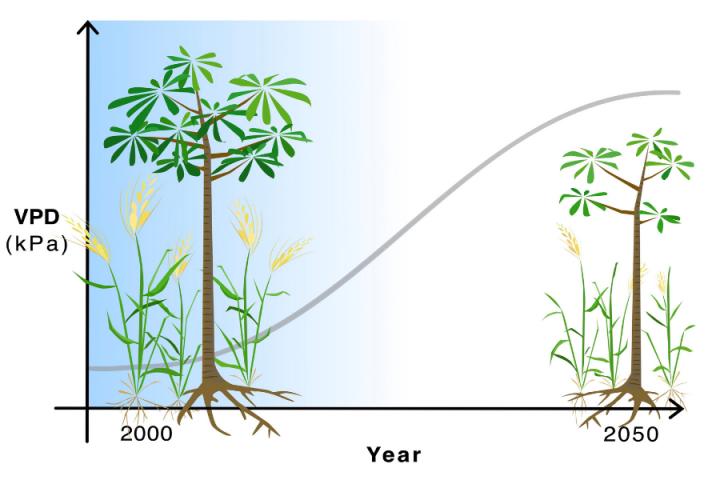
A global observation of an ongoing atmospheric drying — known by scientists as a rise in vapor pressure deficit — has been observed worldwide since the early 2000s. In recent years, this concerning phenomenon has been on the rise, and is predicted to amplify even more in the coming decades as climate change intensifies.
In a new paper published in the journal Global Change Biology, research from the University of Minnesota and Western University in Ontario, Canada, outlines global atmospheric drying significantly reduces productivity of both crops and non-crop plants, even under well-watered conditions. The new findings were established on a large-scale analysis covering 50 years of research and 112 plant species.
“When there is a high vapor pressure deficit, our atmosphere pulls water from other sources: animals, plants, etc.,” said senior author Walid Sadok, an assistant professor in the Department of Agronomy and Plant Genetics at the University of Minnesota. “An increase in vapor pressure deficit places greater demand on the crop to use more water. In turn, this puts more pressure on farmers to ensure this demand for water is met — either via precipitation or irrigation –so that yields do not decrease.”
“We believe a climate change-driven increase in atmospheric drying will reduce plant productivity and crop yields — both in Minnesota and globally,” said Sadok.
In their analysis, researchers suspected plants would sense and respond to this phenomenon in unexpected ways, generating additional costs on productivity. Findings bear out that various plant species — from wheat, corn, and even birch trees — take cues from atmospheric drying and anticipate future drought events.
Through this process, plants reprogram themselves to become more conservative — or in other words: grow smaller, shorter and more resistant to drought, even if the drought itself does not happen. Additionally, due to this conservative behavior, plants are less able to fix atmospheric CO2 to perform photosynthesis and produce seeds. The net result? Productivity decreases.
“As we race to increase production to feed a bigger population, this is a new hurdle that will need to be cleared,” said Sadok. “Atmospheric drying could limit yields, even in regions where irrigation or soil moisture is not limiting, such as Minnesota.”
On a positive note, the analysis indicates different species or varieties within species respond more or less strongly to this drying depending on their evolutionary and genetic make-up. For example, in wheat, some varieties are less responsive to this new stress compared to others, and this type of variability seems to exist within other non-crop species as well.
“This finding is particularly promising as it points to the possibility of breeding for genotypes with an ability to stay productive despite the increase in atmospheric drying,” said Sadok.
Danielle Way, a plant physiologist and co-author of the study from Western University, sees similar outcomes when it comes to ecosystems.
“Variation in plants’ sensitivity to atmospheric drying could also be leveraged to predict how natural ecosystems will respond to climate change and manage them in ways that increase their resilience to climate change,” she said.
In the future, researchers believe these findings can be used to design new crop varieties and manage ecosystems in ways that make them more resilient to atmospheric drying. However, new collaborations are needed between plant physiologists, ecologists, agronomists, breeders and farmers to make sure the right kind of variety is released to farmers depending on their specific conditions.
“Ultimately, this investigation calls for more focused interdisciplinary research efforts to better understand, predict and mitigate the complex effects of atmospheric drying on ecosystems and food security,” Sadok and Way said.
The research was funded by grants from the Minnesota Wheat Research & Promotion Council, the Minnesota Soybean Research and Promotion Council and the Minnesota Department of Agriculture.
###
Media Contact
Patrick Stumpf
[email protected]
Original Source
https:/