• HOME
  • NEWS
  • EXPLORE
    • CAREER
      • Companies
      • Jobs
    • EVENTS
    • iGEM
      • News
      • Team
    • PHOTOS
    • VIDEO
    • WIKI
  • BLOG
  • COMMUNITY
    • FACEBOOK
    • INSTAGRAM
    • TWITTER
Friday, December 19, 2025
BIOENGINEER.ORG
No Result
View All Result
  • Login
  • HOME
  • NEWS
  • EXPLORE
    • CAREER
      • Companies
      • Jobs
        • Lecturer
        • PhD Studentship
        • Postdoc
        • Research Assistant
    • EVENTS
    • iGEM
      • News
      • Team
    • PHOTOS
    • VIDEO
    • WIKI
  • BLOG
  • COMMUNITY
    • FACEBOOK
    • INSTAGRAM
    • TWITTER
  • HOME
  • NEWS
  • EXPLORE
    • CAREER
      • Companies
      • Jobs
        • Lecturer
        • PhD Studentship
        • Postdoc
        • Research Assistant
    • EVENTS
    • iGEM
      • News
      • Team
    • PHOTOS
    • VIDEO
    • WIKI
  • BLOG
  • COMMUNITY
    • FACEBOOK
    • INSTAGRAM
    • TWITTER
No Result
View All Result
Bioengineer.org
No Result
View All Result
Home NEWS Science News

WOX9: A jack of all trades

Bioengineer by Bioengineer
March 4, 2021
in Science News
Reading Time: 2 mins read
0
IMAGE
Share on FacebookShare on TwitterShare on LinkedinShare on RedditShare on Telegram

IMAGE

Credit: Hendelman/Lippman lab/CSHL, 2021

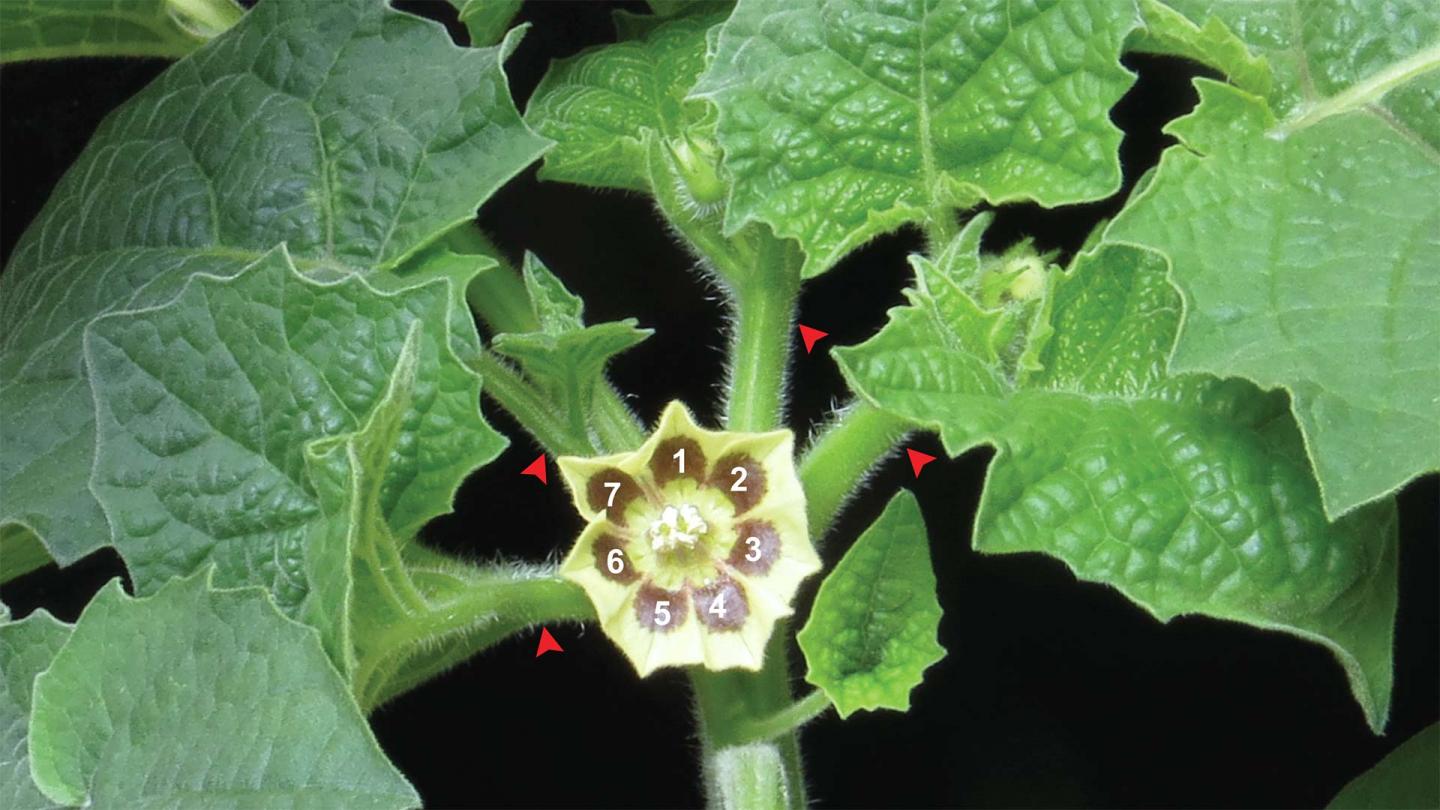
Over evolutionary time scales, a single gene may acquire different roles in diverging species. However, revealing the multiple hidden roles of a gene was not possible before genome editing came along. Cold Spring Harbor Laboratory (CSHL) Professor and HHMI Investigator Zach Lippman and CSHL postdoctoral fellow Anat Hendelman collaborated with Idan Efroni, HHMI International Investigator at Hebrew University Faculty of Agriculture in Israel, to uncover this mystery. They dissected the activity of a developmental gene, WOX9, in different plants and at different moments in development. Using genome editing, they found that without changing the protein produced by the gene, they could change a plant’s traits by changing the gene’s regulation.

“Genes” are the DNA that code for proteins, but other nearby stretches of DNA regulate the activity of genes, instructing them where, when, and to what degree they should be active. With the genome-editing tool CRISPR, scientists can introduce precise mutations into DNA, including these regulatory regions. Though scientists would like to use CRISPR to fine-tune plant traits, the technique sometimes yields surprising results; some genes turn out to have functions that were previously unknown.

WOX9 is one of several “homeobox” genes that help plants and animals set borders in developing structures. While the gene plays a role in early development in arabidopsis, a weedy relative of broccoli, it influences later development–reproduction and flowering–in tomatoes. Lippman and Hendelman used CRISPR to create a series of mutations in the regulatory DNA surrounding WOX9 to reveal additional functions in tomato, groundcherry, and arabidopsis plants. Given the right regulatory sequence, the gene could induce more flowers to form in all three species. WOX9 is thus a candidate to increase yields in these and other crop plants just by changing its regulation. This discovery suggests that other genes may also have hidden multiple roles. Lippman says:

“We know about a whole bunch of genes that you might want to target with genome editing to improve crops, but there’s a whole other set of genes for which they might have really useful functions that could also help improve crops. And so by using this approach, you can expose those roles and then you can predictably fine-tune the activity of that gene for that specific role to get the desired trait modification.”

###

Lippman’s team published their findings in the journal Cell. Their work will make it easier to improve crop traits more predictably.

Media Contact
Sara Roncero-Menendez
[email protected]

Related Journal Article

http://dx.doi.org/10.1016/j.cell.2021.02.001

Tags: AgricultureBiologyFood/Food ScienceGenesGeneticsPlant Sciences
Share12Tweet8Share2ShareShareShare2

Related Posts

Optimizing Polyhydroxybutyrate from Waste Oil: Economic Insights

Optimizing Polyhydroxybutyrate from Waste Oil: Economic Insights

December 19, 2025

Connecting Individual and Community Health Insights: A Study

December 19, 2025

RECQL4 Mutations Impact Helicase Function and Chemotherapy Response

December 19, 2025

Assessing ICU Nurses’ Nutritional Care Skills in China

December 19, 2025
Please login to join discussion

POPULAR NEWS

  • Nurses’ Views on Online Learning: Effects on Performance

    Nurses’ Views on Online Learning: Effects on Performance

    70 shares
    Share 28 Tweet 18
  • NSF funds machine-learning research at UNO and UNL to study energy requirements of walking in older adults

    70 shares
    Share 28 Tweet 18
  • Unraveling Levofloxacin’s Impact on Brain Function

    53 shares
    Share 21 Tweet 13
  • MoCK2 Kinase Shapes Mitochondrial Dynamics in Rice Fungal Pathogen

    72 shares
    Share 29 Tweet 18

About

We bring you the latest biotechnology news from best research centers and universities around the world. Check our website.

Follow us

Recent News

Optimizing Polyhydroxybutyrate from Waste Oil: Economic Insights

Connecting Individual and Community Health Insights: A Study

RECQL4 Mutations Impact Helicase Function and Chemotherapy Response

Subscribe to Blog via Email

Success! An email was just sent to confirm your subscription. Please find the email now and click 'Confirm' to start subscribing.

Join 70 other subscribers
  • Contact Us

Bioengineer.org © Copyright 2023 All Rights Reserved.

Welcome Back!

Login to your account below

Forgotten Password?

Retrieve your password

Please enter your username or email address to reset your password.

Log In
No Result
View All Result
  • Homepages
    • Home Page 1
    • Home Page 2
  • News
  • National
  • Business
  • Health
  • Lifestyle
  • Science

Bioengineer.org © Copyright 2023 All Rights Reserved.