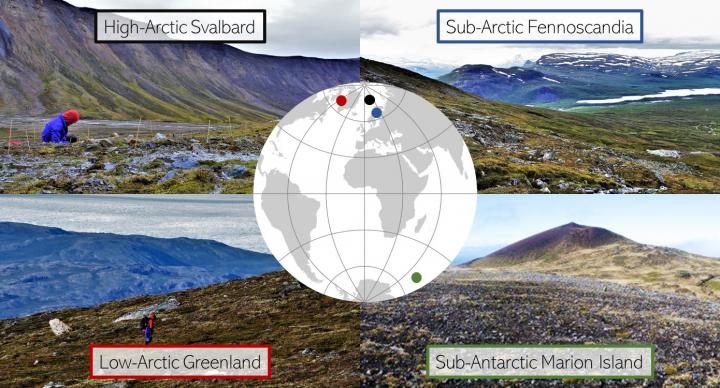
Credit: Photos: Julia Kemppinen and Peter C. le Roux.
Researchers are in the search for generalisable rules and patterns in nature. Biogeographer Julia Kemppinen together with her colleagues tested if plant functional traits show similar patterns along microclimatic gradients across far-apart regions from the high-Arctic Svalbard to the sub-Antarctic Marion Island. Kemppinen and her colleagues found surprisingly identical patterns.
It is widely known that global vegetation patterns and plant properties follow major differences in climate. Yet, it has remained a mystery how well the same rules can be applied at very local scales. Are responses to the environment similar in plant communities along local temperature gradients in Svalbard, Greenland, Fennoscandia, and Marion island? The results published in Nature Ecology & Evolution indicate that these generalisable patterns do exist.
The researchers collected field data on 217 species from nearly 7000 study plots. The results revealed strong, consistent plant functional trait-environment relationships across the four tundra ecosystems.
“This is important because plant functional traits inform us how plants use resources, such as soil moisture, and how plants shape their environments such as carbon cycling. In addition, traits investigations can also give a hint on how plants may react to the ongoing climate change”, says Post doctoral researcher Julia Kemppinen from the University of Oulu.
The researchers found patterns that hold despite unique species pools and other site-specific characteristics. This information improves the biological basis for climate change impact predictions for vulnerable tundra ecosystems.
At coarse spatial scales, there are clear global climatic patterns in temperature and precipitation. For instance, the high-Arctic Svalbard is generally much colder than sub-Arctic Fennoscandia. However, ground-dwelling plants experience local climate conditions, the microclimate, which plays an important role in how ecosystems are responding to climate change.
“It is fascinating to find very distinct differences in soil moisture and soil temperatures at a local scale. If you look close enough, the warmest micro spots in Svalbard have higher temperatures than the coldest spots in Fennoscandia. These local hydrological and thermal conditions clearly affect plants and their functional traits”, says Post doctoral researcher Pekka Niittynen from the University of Helsinki.
The results indicate that the tundra plant communities respond similarly to microclimate. This helps generalising scientific results from one tundra region to another without making too bold conclusions.
Investigating the connections between plant functional traits and the environment requires a lot of data. The researchers combined their field data with over 76000 database trait records provided by the Botanical Information and Ecological Network, TRY Plant Trait Database and the Tundra Trait Team.
“Our research groups at the BioGeoClimate Modelling Lab at the University of Helsinki and the le Roux lab at the University of Pretoria collected a lot of data in the field, but we couldn’t have done this study without high-quality, open data from global databases”, says professor Miska Luoto from the University of Helsinki.
The study is a part of Kemppinen’s PhD thesis Soil moisture and its importance for tundra plants at the University of Helsinki, Helsinki, Finland.
###
The study and data are openly available
Julia Kemppinen, Pekka Niittynen, Peter C. le Roux, Mia Momberg, Konsta Happonen, Juha Aalto, Helena Rautakoski, Brian J. Enquist, Vigdis Vandvik, Aud H. Halbritter, Brian Maitner & Miska Luoto (2021). Consistent trait-environment relationships within and across tundra plant communities. Nature Ecology & Evolution. https:/
Julia Kemppinen, Pekka Niittynen, Peter C. le Roux, Mia Momberg, Konsta Happonen, Juha Aalto, Helena Rautakoski, Brian J. Enquist, Vigdis Vandvik, Aud H. Halbritter, Brian Maitner & Miska Luoto (2021). Data from: Consistent trait-environment relationships within and across tundra plant communities. Zenodo. https:/
Contact information
Post doctoral researcher Julia Kemppinen
Email: [email protected]
Twitter: @juliakemppinen
Post doctoral researcher Pekka Niittynen
Email: [email protected]
Twitter: @PONiittynen
Professor Miska Luoto
Email: [email protected]
Media Contact
Riitta-Leena Inki
[email protected]
Original Source
https:/
Related Journal Article
http://dx.