By collating trends on incidence, mortality, and risk factors for cancer, researchers hope to inform policies, create awareness, and stop the morbid stats from becoming stronger
Credit: Cancer Biology & Medicine
The past century or so has seen unprecedented technological, scientific, and sociological evolution worldwide. These have accompanied global shifts in people’s lifestyles and rapid changes in the environment, both natural and man-made. An unfavorable consequence of these alterations has been the increasing burden of cancer on human society.
As the country with the largest population, China has borne this burden heavily. Despite the massive progress China has made in healthcare since the 1950s, cancer has become the leading killer in the country. In 2015, nearly 2.4 million lives were taken by this disease. Cancer lies latent for years before it manifests; so perhaps, its burden will only continue to grow in the coming decades.
But when you break down these statistics by type of cancer and risk factor, what do the salient trends look like? A group of researchers reviewed data from various national mortality surveys, cancer registries, and online databases to find out.
Speaking of their motivations to conduct the review, lead researcher Dr. Wanqing Chen, Director of the Office of Cancer Screening, National Cancer Center/National Clinical Research Center for Cancer/Cancer Hospital, China, says: “This review could provide scientists and policy-makers with a tool to find what works, what matters, and what is expected.” The paper is published Open Access in Cancer Biology & Medicine.
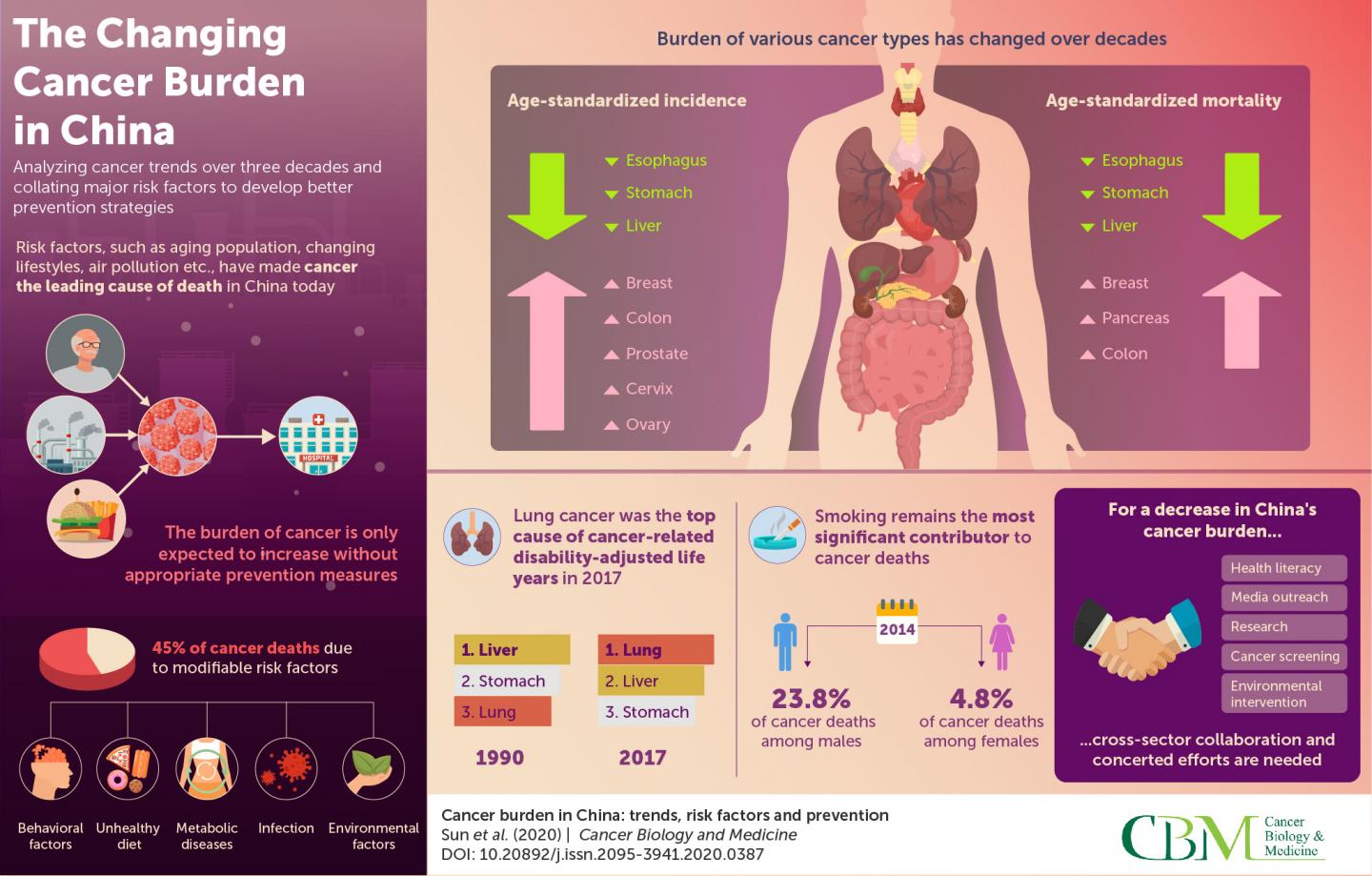
The team’s perusal of 22 Chinese registries revealed an increase in the cancer incidence from 2000 to 2011, with the increase being largely attributable to increased incidences of colorectal, prostate, breast, cervical, and ovarian cancers. Interestingly, the incidences of liver, esophageal, and stomach cancers reduced significantly. This could be because of the widespread hepatitis B vaccination across the country during this period in addition to an overall improvement in food preservation practices and living conditions.
Cancer mortality data from 1990 to 2015 mirrored the incidence data with rising mortality rates seen in the cases of colorectal, pancreatic, and breast cancers and falling rates seen in stomach, esophageal, and liver cancers. Yet, though the burden of these upper gastrointestinal cancers has fallen significantly, it still hangs heavy.
Between 1990 and 2017, lung cancer climbed to the top of the list of different types of cancers responsible for years of healthy life lost to illness, disability, or death (disability-adjusted life years, DALYs). Liver and stomach cancers were second and third in line.
Sadly, further research suggests that quite a large chunk of these cases and deaths could, perhaps, have been prevented. Data from the National Cancer Center, China, attributes 45% of cancer deaths in the country to modifiable risk factors–behavioral, clinical, or environmental. For instance, 23.8% of cancer deaths among men and 4.8% among women in 2014 are attributed to smoking. From 1990 to 2017, cancer deaths caused by smoking increased by over 150%. Given that China currently consumes about 40% of the world’s tobacco, if habits don’t change, the future looks grave.
Apart from smoking, physical inactivity, an unhealthy diet, and heavy alcohol consumption are major contributing behavioral risk factors for cancer; diabetes, obesity, and infectious diseases are prominent clinical risk factors; and air pollution, as well as occupational exposure to carcinogenic compounds such as soot, asbestos, and silica, are important environmental risk factors.
However, even in these seemingly dark times there is a spot of light. Technological advancement coupled with good healthcare and insurance policies and a growing general awareness among the people have, perhaps, contributed to the improvement in cancer survival rates seen between 2003 and 2015.
Still, prevention remains better than cure. As Dr. Chen explains: ”Taking all this critical information together, one can see that implementing cost-effective approaches for primary prevention is of utmost importance. Our paper highlights the requirement for collaborative efforts by the government, public health organizations, and the people to reduce the cancer burden in the country. We hope that our work can inform policies such as Healthy China 2030.”
Perhaps the successful implementation of policies based on such research in China and worldwide can lift the burden of cancer from the world’s shoulders.
###
Reference
Authors: Dianqin Sun (1), He Li (1), Maomao Cao (1), Siyi He (1), Lin Lei (2), Ji Peng (2), Wanqing Chen (1)
Title of original paper: Cancer burden in China: trends, risk factors and prevention
Journal : Cancer Biology & Medicine
DOI: 10.20892/j.issn.2095-3941.2020.0387
Affiliations:
(1) Department of Cancer Screening, National Cancer Center/National Clinical Research Center for Cancer/Cancer Hospital, Chinese Academy of Medical Sciences and Peking Union Medical College, China
(2) Department of Cancer Prevention and Control, Shenzhen Center for Chronic Disease Control, China
About Dr. Wanqing Chen
Dr. Wanqing Chen is Director of the Office of Cancer Screening, National Cancer Center/National Clinical Research Center for Cancer/Cancer Hospital, China. He is also affiliated to the Chinese Academy of Medical Sciences and Peking Union Medical College, China. Over the course of his career, he has led multiple research programs of national and international interest and undertaken several national key public health projects, including the third national retrospective death survey and program of early diagnosis and treatment of cancer. As an authoritative figure in the field of cancer research, he has published over 300 academic papers as first author or corresponding author; and as chief editor or deputy editor, he has compiled 13 monographs.
Media Contact
Indrani Das
[email protected]