• HOME
  • NEWS
  • EXPLORE
    • CAREER
      • Companies
      • Jobs
    • EVENTS
    • iGEM
      • News
      • Team
    • PHOTOS
    • VIDEO
    • WIKI
  • BLOG
  • COMMUNITY
    • FACEBOOK
    • INSTAGRAM
    • TWITTER
Sunday, May 10, 2026
BIOENGINEER.ORG
No Result
View All Result
  • Login
  • HOME
  • NEWS
  • EXPLORE
    • CAREER
      • Companies
      • Jobs
        • Lecturer
        • PhD Studentship
        • Postdoc
        • Research Assistant
    • EVENTS
    • iGEM
      • News
      • Team
    • PHOTOS
    • VIDEO
    • WIKI
  • BLOG
  • COMMUNITY
    • FACEBOOK
    • INSTAGRAM
    • TWITTER
  • HOME
  • NEWS
  • EXPLORE
    • CAREER
      • Companies
      • Jobs
        • Lecturer
        • PhD Studentship
        • Postdoc
        • Research Assistant
    • EVENTS
    • iGEM
      • News
      • Team
    • PHOTOS
    • VIDEO
    • WIKI
  • BLOG
  • COMMUNITY
    • FACEBOOK
    • INSTAGRAM
    • TWITTER
No Result
View All Result
Bioengineer.org
No Result
View All Result
Home NEWS Science News Chemistry

How SARS-CoV-2’s sugar-coated shield helps activate the virus

Bioengineer by Bioengineer
February 25, 2021
in Chemistry
Reading Time: 2 mins read
0
IMAGE
Share on FacebookShare on TwitterShare on LinkedinShare on RedditShare on Telegram

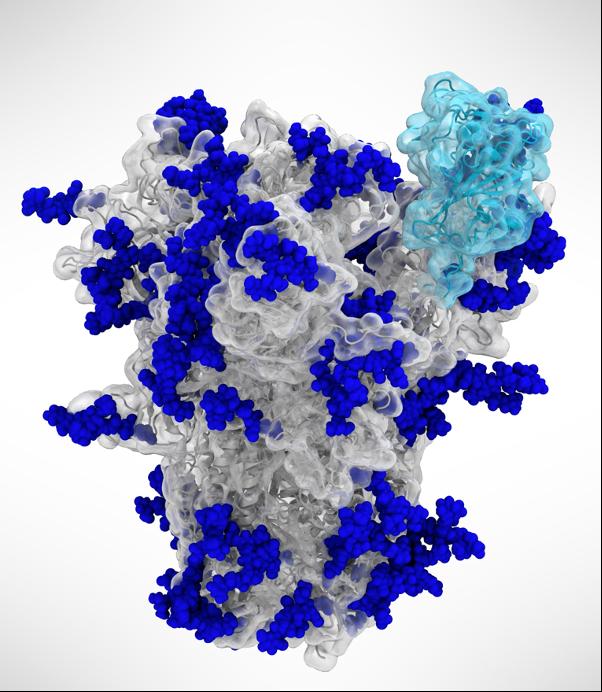
SARS-CoV-2, the virus that causes COVID-19, is coated with sugars called glycans, which help it evade the immune system; new research shows precisely how those sugars help the virus become activated and infectious and could help with vaccine and drug disc
IMAGE

Credit: Image credit: Lorenzo Casalino, Amaro Lab, UCSD.

ROCKVILLE, MD – One thing that makes SARS-CoV-2, the virus that causes COVID-19, elusive to the immune system is that it is covered in sugars called glycans. Once SARS-CoV-2 infects someone’s body, it becomes covered in that person’s unique glycans, making it difficult for the immune system to recognize the virus as something it needs to fight. Those glycans also play an important role in activating the virus. Terra Sztain-Pedone, a graduate student, and colleagues in the labs of Rommie Amaro at the University of California, San Diego and Lillian Chong at the University of Pittsburgh, studied exactly how the glycans activate SARS-CoV-2. Sztain-Pedone will present the research on Thursday, February 25 at the 65th Annual Meeting of the Biophysical Society.

For SARS-CoV-2 to become activated and infectious, the spike proteins on the outside of the virus need to change shape so it can stick to our cells. Scientists knew that the glycans that coat these spikes help SARS-CoV-2 evade the immune system, but it was not known what role they played in the activation process. Studying these molecules is tricky because they are so small and have many parts that move in subtle ways. “There are half a million atoms in just one of these spike protein simulations,” Sztain-Pedone explained.

Using advanced High Performance Computing algorithms that run many simulations in parallel, the research team examined how the positions of each of those atoms changes as the SARS-CoV-2 spike becomes activated. “Most computers wouldn’t be able to do this with half a million atoms,” Sztain-Pedone says.

The team was able to identify the glycans and molecules that are responsible for activating the spike protein. “Surprisingly, one glycan seems to be responsible for initiating the entire opening,” Sztain-Pedone says. Other glycans are involved in subsequent steps. To validate their findings, the team is currently working with Jason McLellan, a professor at the University of Texas, Austin, and colleagues who are performing experiments with spike proteins in the lab.

There is potential to use the simulations developed by Sztain-Pedone and colleagues to identify treatments that will block or prevent SARS-CoV-2 activation. “Because we have all these structures, we can do small molecule screening with computational algorithms,” Sztain-Pedone explained. They can also study new virus mutations, such as the B.1.1.7 variant that is currently spreading, to “look at how that might affect the spike protein activation,” Sztain-Pedone says.

###

Media Contact
Leann Fox
[email protected]

Original Source

https://www.biophysics.org/news-room?ArtMID=802&ArticleID=10416&preview=true

Tags: Biomechanics/BiophysicsBiotechnologyChemistry/Physics/Materials SciencesCritical Care/Emergency MedicineDeath/DyingGeneticsHealth CareVaccines
Share12Tweet8Share2ShareShareShare2

Related Posts

Miniature Sensor Uses Light to Detect Touch — Chemistry

Miniature Sensor Uses Light to Detect Touch

May 8, 2026
Iron Minerals Determine Whether Dissolved Organic Matter Fuels Microbes or Becomes Long-Term Carbon Storage — Chemistry

Iron Minerals Determine Whether Dissolved Organic Matter Fuels Microbes or Becomes Long-Term Carbon Storage

May 8, 2026

Kate Evans Appointed Associate Lab Director for Biological and Environmental Systems Science at ORNL

May 8, 2026

Advancing Multiscale Modeling and Overcoming Operational Challenges in Autothermal COâ‚‚-to-Methanol Reactors

May 8, 2026
Please login to join discussion

POPULAR NEWS

  • Research Indicates Potential Connection Between Prenatal Medication Exposure and Elevated Autism Risk

    840 shares
    Share 336 Tweet 210
  • New Study Reveals Plants Can Detect the Sound of Rain

    727 shares
    Share 290 Tweet 181
  • Scientists Investigate Possible Connection Between COVID-19 and Increased Lung Cancer Risk

    68 shares
    Share 27 Tweet 17
  • Salmonella Haem Blocks Macrophages, Boosts Infection

    61 shares
    Share 24 Tweet 15

About

We bring you the latest biotechnology news from best research centers and universities around the world. Check our website.

Follow us

Recent News

Evaluating Digoxin Use in Patients with Symptomatic Rheumatic Heart Disease

Evaluating the Effectiveness and Safety of Digitalis Glycosides in Treating Heart Failure

Urdu Fall Risk Questionnaire Adapted for Elderly

Subscribe to Blog via Email

Enter your email address to subscribe to this blog and receive notifications of new posts by email.

Join 82 other subscribers
  • Contact Us

Bioengineer.org © Copyright 2023 All Rights Reserved.

Welcome Back!

Login to your account below

Forgotten Password?

Retrieve your password

Please enter your username or email address to reset your password.

Log In
No Result
View All Result
  • Homepages
    • Home Page 1
    • Home Page 2
  • News
  • National
  • Business
  • Health
  • Lifestyle
  • Science

Bioengineer.org © Copyright 2023 All Rights Reserved.