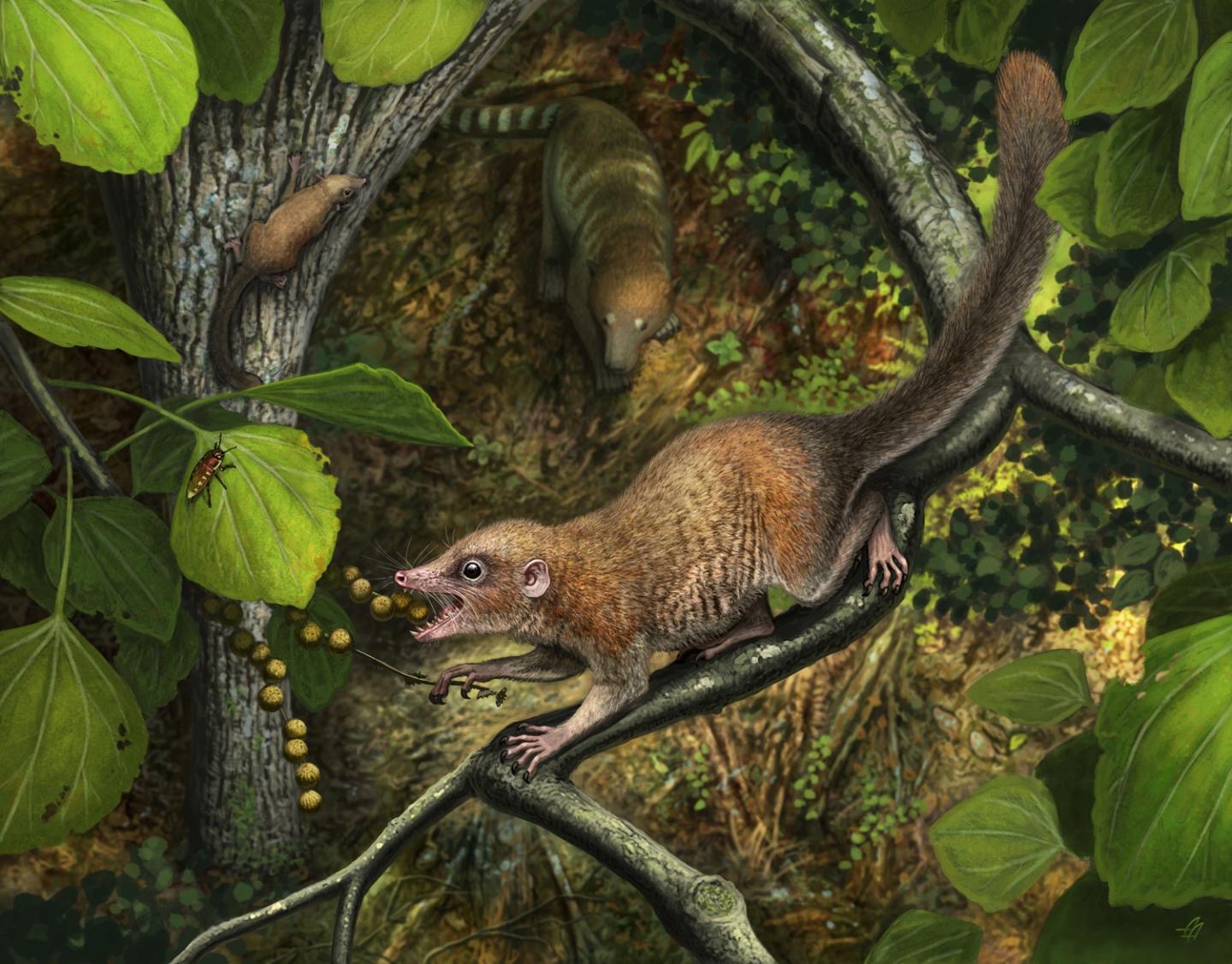
Credit: Andrey Atuchin
A new study published Feb. 24 in the journal Royal Society Open Science documents the earliest-known fossil evidence of primates.
A team of 10 researchers from across the U.S. analyzed several fossils of Purgatorius, the oldest genus in a group of the earliest-known primates called plesiadapiforms. These ancient mammals were small-bodied and ate specialized diets of insects and fruits that varied by species. These newly described specimens are central to understanding primate ancestry and paint a picture of how life on land recovered after the Cretaceous-Paleogene extinction event 66 million years ago that wiped out all dinosaurs — except for birds — and led to the rise of mammals.
Gregory Wilson Mantilla, a University of Washington professor of biology and curator of vertebrate paleontology at the UW’s Burke Museum of Natural History & Culture, co-led the study with Stephen Chester of Brooklyn College and the City University of New York. The team analyzed fossilized teeth found in the Hell Creek area of northeastern Montana. The fossils, which are now part of the collections at the University of California Museum of Paleontology, are estimated to be 65.9 million years old, about 105,000 to 139,000 years after the mass extinction event. Based on the age of the fossils, the team estimates that the ancestor of all primates –including plesiadapiforms and today’s primates such as lemurs, monkeys and apes — likely emerged by the Late Cretaceous and lived alongside large dinosaurs.
“It’s mind blowing to think of our earliest archaic primate ancestors,” said Wilson Mantilla. “They were some of the first mammals to diversify in this new post-mass extinction world, taking advantage of the fruits and insects up in the forest canopy.”
The fossils include two species of Purgatorius: Purgatorius janisae and a new species described by the team named Purgatorius mckeeveri. Three of the teeth found have distinct features compared to any previously known Purgatorius species and led to the description of the new species.
Purgatorius mckeeveri is named after Frank McKeever, who was among the first residents of the area where the fossils were discovered, and also the family of John and Cathy McKeever, who have since supported the field work where the oldest specimen of this new species was discovered.
“This was a really cool study to be a part of, particularly because it provides further evidence that the earliest primates originated before the extinction of non-avian dinosaurs,” said co-author Brody Hovatter, a UW graduate student in Earth and space sciences. “They became highly abundant within a million years after that extinction.”
“This discovery is exciting because it represents the oldest dated occurrence of archaic primates in the fossil record,” said Chester. “It adds to our understanding of how the earliest primates separated themselves from their competitors following the demise of the dinosaurs.”
###
Co-author on the study was the late William Clemens who was a professor emeritus at the University of California, Berkeley and former director of the UC Museum of Paleontology. Additional co-authors are Jason Moore and Wade Mans of the University of New Mexico; Courtney Sprain of the University of Florida; William Mitchell of Minnesota IT Services; Roland Mundil of the Berkeley Geochronology Center; and Paul Renne of UC Berkeley and the Berkeley Geochronology Center. The research was funded by the National Science Foundation, the UC Museum of Paleontology, the Myhrvold and Havranek Charitable Family Fund, the UW, the CUNY and the Leakey Foundation.
For high resolution images and interviews, contact [email protected].
Link to full release with images:
https:/
Contact: Andrea Godinez
University of Washington, Burke Museum of Natural History & Culture
206-616-7538
[email protected]
Media Contact
Andrea Godinez
[email protected]
Original Source
https:/
Related Journal Article
http://dx.