Credit: Kamol Das
Carbon nanotubes are tiny. They can be a hundred thousand times smaller than the width of a human hair. But they have huge potential.
Products manufactured using carbon nanotubes include rebar for concrete, sporting goods, wind turbines, and lithium batteries, among others.
Potential uses of carbon nanotubes could extend to diverse fields, such as agriculture, biomedicine and space science.
But as we use more carbon nanotubes to make things, we also increase the chances that these nanotubes enter different environments and ecosystems.
“That makes it important to understand how carbon nanotubes behave in these environments,” says Yu Yang, a member of the Soil Science Society of America.
In a new study, Yang and his colleagues describe a way to measure levels of a specific kind of carbon nanotube in plant tissues. Their research was recently published in Journal of Environmental Quality.
Carbon nanotubes may make their way into agricultural fields and food products. There, they can pose a threat to human and environmental health.
“Knowing how to measure carbon nanotubes in the environment is crucial to understanding their environmental fate and effects,” says Yang.
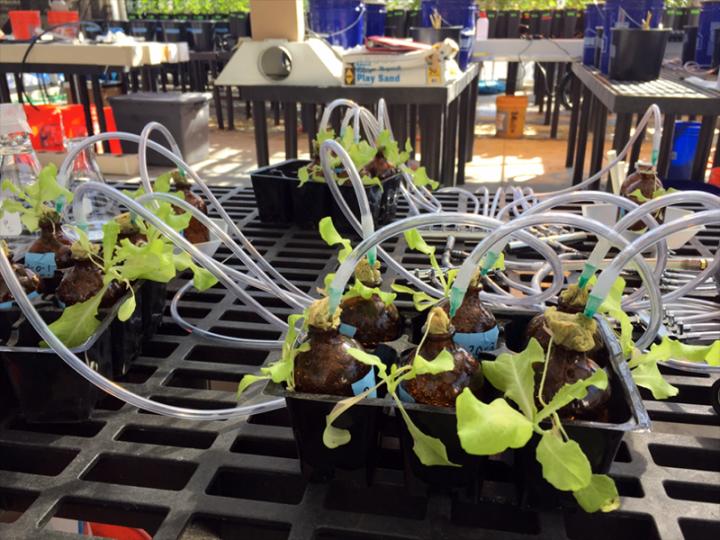
To mimic the nanotubes in the environment, Yang and colleagues grew hydroponic lettuce in the presence of carbon nanotubes. Then they analyzed the lettuce leaves for traces of carbon nanotubes.
Yang found this method could detect small amounts of carbon nanotubes in the leaves, stems and roots of the lettuce plants.
“We have developed a method to address the challenging issue of quantifying carbon nanomaterials in the environment,” says Yang. “These findings can help guide the sustainable application of carbon nanotubes in natural environments.”
The challenge in measuring carbon nanotubes in the environment is that they are made of carbon. All living things on Earth – including humans and plants – have carbon as a key building block.
The task Yang and colleagues faced was to distinguish between carbon in living material from carbon in carbon nanotubes.
A single layer of carbon atoms arranged in a honeycomb pattern is called graphene. A carbon nanotube is a sheet of graphene rolled into a tiny cylinder.
Carbon nanotubes made of a single sheet of graphene are called single-walled nanotubes. Layering multiple tubes within others yields multi-walled carbon nanotubes.
Scientists can add different molecules to carbon nanotubes. Adding these molecules can change their characteristics. They might dissolve more easily in solvents, for example.
“Carbon nanotubes with molecules added on could be used in the fabrication of nanocomposites, biomedicine, and chemical or biological probes,” says Yang.
In previous research, Yang’s group quantified multi-walled carbon nanotubes in plants. But no one had measured if this kind of carbon nanotube with a specific molecule added on gets into plants.
The researchers used a technique called programmed thermal analysis. In this approach, materials are heated in a controlled manner in different environments – say plus or minus oxygen, for example.
How different materials react to being heated in different environments can provide big clues about these materials.
Yang and colleagues found they could use programmed thermal analysis to detect the carbon in the nanotubes. Using these data, they could also tell apart the carbon in carbon nanotubes from the carbon in plants.
This is the first study to measure levels of this kind of carbon nanotube in plants using the thermal analysis. “That’s crucial for understanding carbon nanotube fate in the environment and estimating potential human exposure,” says Yang.
Yang is now working on detecting even smaller amounts of carbon nanotubes in the environment.
“We also want to try to measure carbon nanotubes with different molecules added on,” says Yang. He also plans to expand test materials beyond lettuce plants. “We want to test this approach in different environments.”
Ultimately, the goal is to advance the application of carbon nanotubes. “Being able to accurately measure carbon nanotubes in the environment can promote their sustainable use,” says Yang.
###
Yu Yang is a researcher at the University of Nevada-Reno. This work was supported by National Science Foundation.
Media Contact
Rachel Schutte
[email protected]
Related Journal Article
http://dx.