• HOME
  • NEWS
  • EXPLORE
    • CAREER
      • Companies
      • Jobs
    • EVENTS
    • iGEM
      • News
      • Team
    • PHOTOS
    • VIDEO
    • WIKI
  • BLOG
  • COMMUNITY
    • FACEBOOK
    • INSTAGRAM
    • TWITTER
Thursday, March 26, 2026
BIOENGINEER.ORG
No Result
View All Result
  • Login
  • HOME
  • NEWS
  • EXPLORE
    • CAREER
      • Companies
      • Jobs
        • Lecturer
        • PhD Studentship
        • Postdoc
        • Research Assistant
    • EVENTS
    • iGEM
      • News
      • Team
    • PHOTOS
    • VIDEO
    • WIKI
  • BLOG
  • COMMUNITY
    • FACEBOOK
    • INSTAGRAM
    • TWITTER
  • HOME
  • NEWS
  • EXPLORE
    • CAREER
      • Companies
      • Jobs
        • Lecturer
        • PhD Studentship
        • Postdoc
        • Research Assistant
    • EVENTS
    • iGEM
      • News
      • Team
    • PHOTOS
    • VIDEO
    • WIKI
  • BLOG
  • COMMUNITY
    • FACEBOOK
    • INSTAGRAM
    • TWITTER
No Result
View All Result
Bioengineer.org
No Result
View All Result
Home NEWS Science News Chemistry

ET phones home!

Bioengineer by Bioengineer
February 23, 2021
in Chemistry
Reading Time: 2 mins read
0
IMAGE
Share on FacebookShare on TwitterShare on LinkedinShare on RedditShare on Telegram

Hebrew University finds first evidence of delayed radio flares after star is destroyed by black hole
IMAGE

Credit: Hebrew University

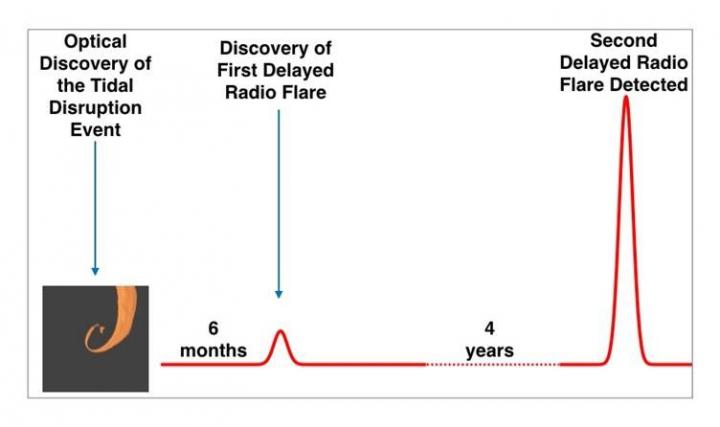
A team of researchers from the Hebrew University of Jerusalem (HUJI) led by Dr. Assaf Horesh have discovered the first evidence of radio flares emitted only long after a star is destroyed by a black hole. Published in the periodical Nature Astronomy, the discovery relied upon ultra-powerful radio telescopes to study these catastrophic cosmic events in distant galaxies called Tidal Disruption Events (TDE). While researchers had known that these events cause the release of radio flares, this latest discovery saw those flares being emitted months or even years after the stellar disruption. The team was led by Dr. Horesh from the Racah Institute of Physics at the Hebrew together with the NASA Swift space telescope director Professor Brad Cenko and Dr. Iair Arcavi from Tel-Aviv University.

“According to existing theories of how these events occur, if no radio emission has been discovered in the immediate wake of the disruption, there is no expectation that one should occur later on” says Dr. Horesh. “However, we decided to conduct one last radio observation six months after the star was destroyed, and surprisingly we discovered bright radio emission. Once we discovered this delayed radio flare, we continued collecting data over a year, during which the radio emission faded away. Moreover, we found a second delayed flare, four years after the initial stellar disruption discovery. This is the first discovery of such delayed radio flares from such events, when a star is disrupted by a black hole.”

Flares are believed to be caused by a huge velocity jet launched when the star is destroyed and sucked into the black hole or as a result of the outward explosion of debris from the explosion.

The analysis of the delayed radio flares lead the research team to several conclusions.

First, they now believe that new models have to be developed to explain such a long delay of radio flare emission. Second, it is possible that such delayed radio flares are a common phenomenon, but in order to find more of them teams will need to remain focused on observations surrounding the affected areas long after the initial disruption. Third, it is possible that a substantial amount of the stellar debris is eventually accreted (pulled in) to the black hole, but only long after the star was destroyed.

“What led to the delay and what is the exact physical process responsible for such late-time emission are still open questions”, says Dr. Horesh. “In light of this discovery, we are actively searching for more such delayed radio flares in other tidal disruption events.”

###

Media Contact
Dena Wimpfheimer
[email protected]

Related Journal Article

http://dx.doi.org/10.1038/s41550-021-01300-8

Tags: AstronomyAstrophysicsPlanets/MoonsSpace/Planetary ScienceStars/The Sun
Share13Tweet8Share2ShareShareShare2

Related Posts

Isolated H2-Reduced Clusters Boost CO2-to-Methanol Catalysis

Isolated H2-Reduced Clusters Boost CO2-to-Methanol Catalysis

March 25, 2026
blank

Physicists Identify Electronic Drivers Behind Flat Band Quantum Materials

March 21, 2026

Würzburg Chemistry Professor Claudia Höbartner Receives Prestigious Honor

March 20, 2026

Scientists Reveal How Magnets Control Metamaterial Behavior

March 20, 2026
Please login to join discussion

POPULAR NEWS

  • blank

    Revolutionary AI Model Enhances Precision in Detecting Food Contamination

    96 shares
    Share 38 Tweet 24
  • Imagine a Social Media Feed That Challenges Your Views Instead of Reinforcing Them

    1003 shares
    Share 397 Tweet 248
  • Uncovering Functions of Cavernous Malformation Proteins in Organoids

    54 shares
    Share 22 Tweet 14
  • Promising Outcomes from First Clinical Trials of Gene Regulation in Epilepsy

    51 shares
    Share 20 Tweet 13

About

We bring you the latest biotechnology news from best research centers and universities around the world. Check our website.

Follow us

Recent News

In-Sensor Cryptography Links Physical Process to Digital Identity

Can Psychosocial Factors Influence Cancer Risk?

Depression Factors in Elderly: Pre vs. Post-COVID Analysis

Subscribe to Blog via Email

Enter your email address to subscribe to this blog and receive notifications of new posts by email.

Join 78 other subscribers
  • Contact Us

Bioengineer.org © Copyright 2023 All Rights Reserved.

Welcome Back!

Login to your account below

Forgotten Password?

Retrieve your password

Please enter your username or email address to reset your password.

Log In
No Result
View All Result
  • Homepages
    • Home Page 1
    • Home Page 2
  • News
  • National
  • Business
  • Health
  • Lifestyle
  • Science

Bioengineer.org © Copyright 2023 All Rights Reserved.