• HOME
  • NEWS
  • EXPLORE
    • CAREER
      • Companies
      • Jobs
    • EVENTS
    • iGEM
      • News
      • Team
    • PHOTOS
    • VIDEO
    • WIKI
  • BLOG
  • COMMUNITY
    • FACEBOOK
    • INSTAGRAM
    • TWITTER
Friday, May 15, 2026
BIOENGINEER.ORG
No Result
View All Result
  • Login
  • HOME
  • NEWS
  • EXPLORE
    • CAREER
      • Companies
      • Jobs
        • Lecturer
        • PhD Studentship
        • Postdoc
        • Research Assistant
    • EVENTS
    • iGEM
      • News
      • Team
    • PHOTOS
    • VIDEO
    • WIKI
  • BLOG
  • COMMUNITY
    • FACEBOOK
    • INSTAGRAM
    • TWITTER
  • HOME
  • NEWS
  • EXPLORE
    • CAREER
      • Companies
      • Jobs
        • Lecturer
        • PhD Studentship
        • Postdoc
        • Research Assistant
    • EVENTS
    • iGEM
      • News
      • Team
    • PHOTOS
    • VIDEO
    • WIKI
  • BLOG
  • COMMUNITY
    • FACEBOOK
    • INSTAGRAM
    • TWITTER
No Result
View All Result
Bioengineer.org
No Result
View All Result
Home NEWS Science News Chemistry

Low-level jets create winds of change for turbines

Bioengineer by Bioengineer
February 23, 2021
in Chemistry
Reading Time: 3 mins read
0
IMAGE
Share on FacebookShare on TwitterShare on LinkedinShare on RedditShare on Telegram

Strong, energetic flows in the lower atmosphere can greatly enhance wind farm performance, if the height is right.
IMAGE

Credit: Srinidhi N. Gadde and Richard J.A.M. Stevens

WASHINGTON, February 23, 2021 — As one of the leading sources of clean and renewable energy, global wind power capacity has increased more than fivefold over the past decade, leading to larger turbines and pushing wind technology to its limits.

“These much larger turbines are operating in very different atmospheric layers than smaller turbines used 5-10 years ago,” said Srinidhi Gadde, one of the authors of a paper in the Journal of Renewable and Sustainable Energy, from AIP Publishing, that examines the impacts of turbine height. “At these scales, local meteorology and extreme shear events, which frequently occur, can impact power production.”

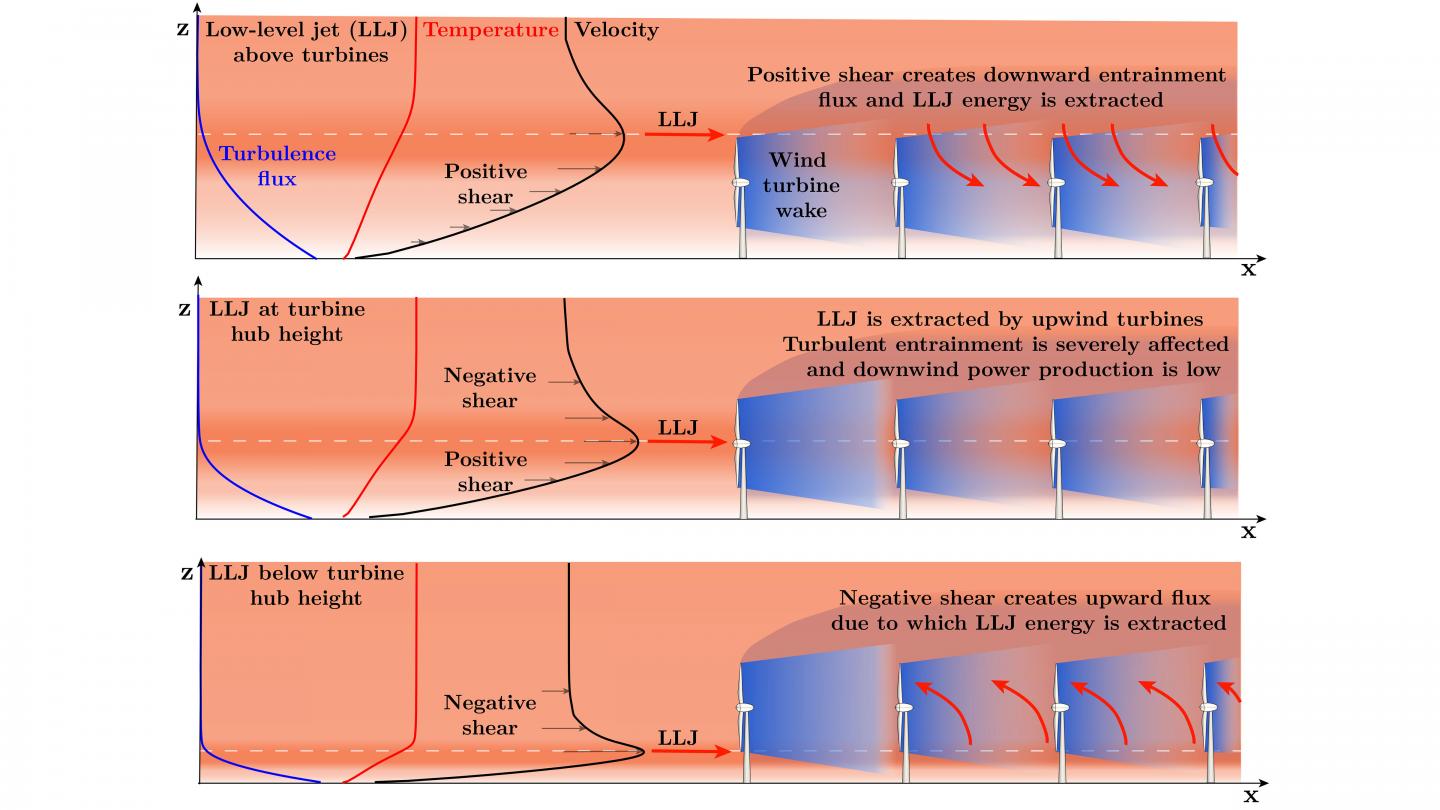
Low-level jets, which are maxima in wind velocity in the lower atmosphere, are one cause for concern with growing turbines. These strong, energetic wind flows can either have desirable or detrimental effects on the turbines, depending on how high the wind flows are in relation to the turbines.

“A simple way to think about LLJs is to visualize them as high-velocity ‘rivers’ or ‘streams’ of wind within the atmosphere,” Gadde said.

In their simulation of a wind farm with a 4-by-10 grid of turbines, Gadde and co-author Richard Stevens considered three different scenarios in which the LLJs were above, below, and in the middle of the turbine rotors.

When the jets and the turbines were at the same height, the researchers found the front rows blocked wind access downstream, causing a reduction in power production in each successive row. Relative to this equal height scenario, a larger downstream energy capture was observed in both other cases, though by different mechanisms.

For high jets, the turbulence generated in the wakes of the turbines pulls the wind from the upper atmosphere down toward the turbines in a process called downward vertical kinetic energy entrainment, leading to large amounts of power production. More surprisingly, when the jets are low, the reverse process occurs. High-velocity wind from the LLJ is pushed upward into the turbine, a previously unknown phenomenon, which the authors termed upward vertical kinetic energy entrainment.

Gadde said he looks forward to applying this work to drive innovation and functionality to meet future power demands, which will require an even deeper understanding of events like LLJs and additional observations of these phenomena.

“As one of the leading renewable energy technologies, wind energy is expected to deliver major contributions to the expected growth in renewable energy production in the coming decades,” he said.

###

The article “Effect of low-level jet height on wind farm performance” is authored by Srinidhi N. Gadde and Richard J.A.M. Stevens. The article will appear in Journal of Renewable and Sustainable Energy on Feb. 23, 2021 (DOI: 10.1063/5.0026232). After that date, it can be accessed at https://aip.scitation.org/doi/full/10.1063/5.0026232.

ABOUT THE JOURNAL

Journal of Renewable and Sustainable Energy is an interdisciplinary journal that publishes across all areas of renewable and sustainable energy relevant to the physical science and engineering communities. Topics covered include solar, wind, biofuels and more, as well as renewable energy integration, energy meteorology and climatology, and renewable resourcing and forecasting. See https://aip.scitation.org/journal/rse.

Media Contact
Larry Frum
[email protected]

Related Journal Article

http://dx.doi.org/10.1063/5.0026232

Tags: Atmospheric ScienceChemistry/Physics/Materials SciencesEarth ScienceEnergy SourcesEnergy/Fuel (non-petroleum)Technology/Engineering/Computer Science
Share12Tweet8Share2ShareShareShare2

Related Posts

Smart Hydrogels Revolutionize Information Security with Photo-Patterning and Multi-Stimuli Responsive Structural Colors — Chemistry

Smart Hydrogels Revolutionize Information Security with Photo-Patterning and Multi-Stimuli Responsive Structural Colors

May 15, 2026
Scientists Overcome Longstanding Challenge in Measuring Semiconductor Defects — Chemistry

Scientists Overcome Longstanding Challenge in Measuring Semiconductor Defects

May 14, 2026

Wall Design Highlights Deaf and Hard-of-Hearing Experience at #ASA190

May 14, 2026

New Method Finds More Efficient Route Between Earth and Moon Than Ever Before

May 14, 2026
Please login to join discussion

POPULAR NEWS

  • Research Indicates Potential Connection Between Prenatal Medication Exposure and Elevated Autism Risk

    843 shares
    Share 337 Tweet 211
  • New Study Reveals Plants Can Detect the Sound of Rain

    729 shares
    Share 291 Tweet 182
  • Salmonella Haem Blocks Macrophages, Boosts Infection

    62 shares
    Share 25 Tweet 16
  • Breastmilk Balances E. coli and Beneficial Bacteria in Infant Gut Microbiomes

    58 shares
    Share 23 Tweet 15

About

We bring you the latest biotechnology news from best research centers and universities around the world. Check our website.

Follow us

Recent News

Digital Health Fear Patterns in Older Cancer Patients

A*STAR Scientists Unveil Novel Technique to Decipher RNA Structure’s Impact on Health and Disease

Smart Hydrogels Revolutionize Information Security with Photo-Patterning and Multi-Stimuli Responsive Structural Colors

Subscribe to Blog via Email

Enter your email address to subscribe to this blog and receive notifications of new posts by email.

Join 82 other subscribers
  • Contact Us

Bioengineer.org © Copyright 2023 All Rights Reserved.

Welcome Back!

Login to your account below

Forgotten Password?

Retrieve your password

Please enter your username or email address to reset your password.

Log In
No Result
View All Result
  • Homepages
    • Home Page 1
    • Home Page 2
  • News
  • National
  • Business
  • Health
  • Lifestyle
  • Science

Bioengineer.org © Copyright 2023 All Rights Reserved.