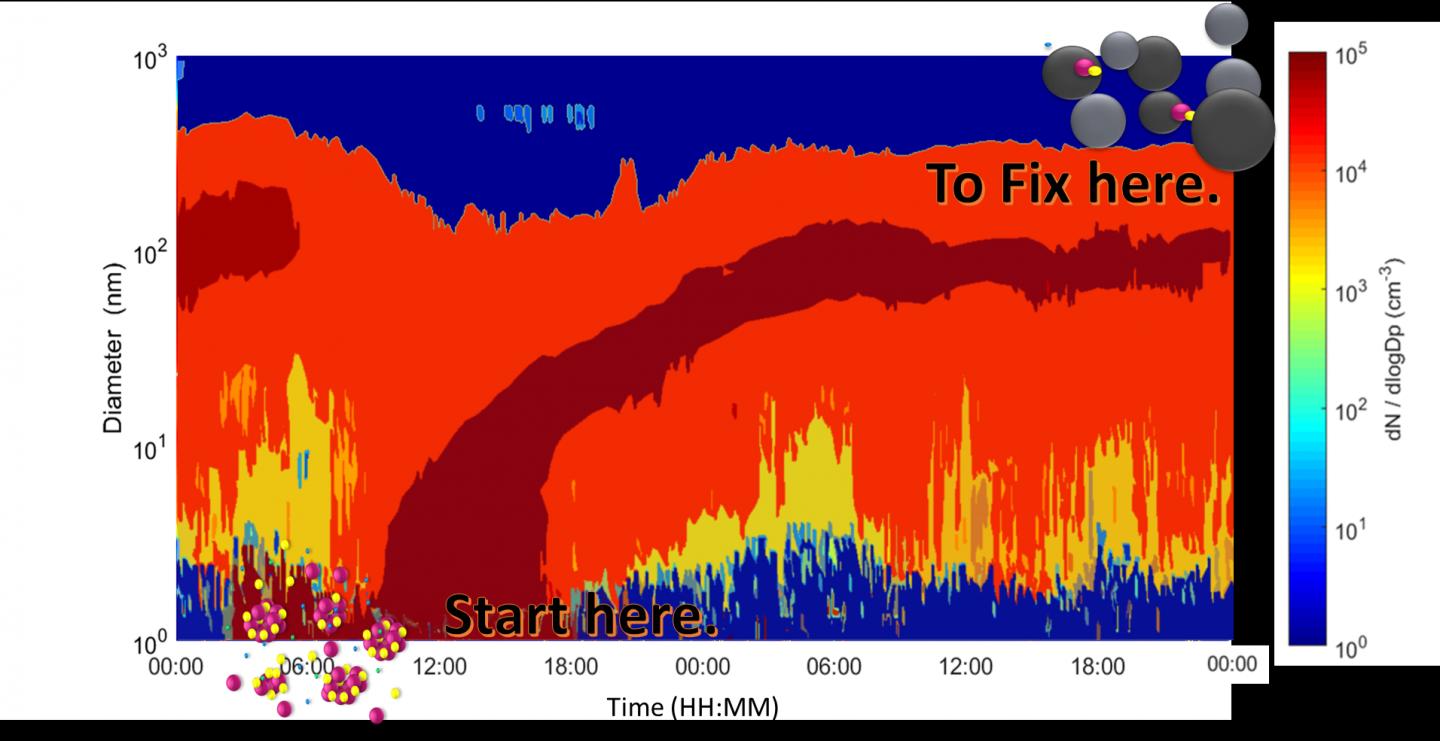
Credit: Lubna Dada
Researchers of the University of Helsinki have resolved for the first time, how the ultrafine particles of atmosphere effect on the climate and health.
Atmospheric air pollution kills more than 10,000 people every day. The biggest threat to human health has been assumed to be the mass accumulation of atmospheric particles with diameter smaller 2.5 μm: the higher the mass and loss of visibility, the bigger the threat.
The researchers of the Institute for Atmospheric and Earth System Research (INAR) at the University of Helsinki together with collaborators in China discovered that if we want to solve the accumulation of the biggest particles, we need to start with the smallest.
Until recent studies, very little attention had been given to the ultrafine particles, smaller than 100 nm in diameter, since their weight and surface area are comparably negligible. It has been controversial whether these particles can grow to relevant sizes where they can affect visibility and human health.
“We found that the smallest particles matter the most”, says Academician Markku Kulmala from the Institute for Atmospheric and Earth System Research (INAR).
The results of two studies were recently published in Faraday Discussion and Nature NPJ climate and atmospheric science.
Survival to mass relevant sizes
When there are enough precursor vapors available and when the conditions are favorable, particles forming in the atmosphere through gas-to-particle conversion at ~1 nm in diameter appear abruptly in the air. This atmospheric phenomenon known as New Particle Formation is observed in many different environments around the world.
“We are speaking of hundred thousands of particles per cubic centimeter especially in Megacities where increased population meets increased pollution”, says Lubna Dada from the Institute for Atmospheric and Earth System Research (INAR).
The researchers tackled the for-long controversial topic whether these smallest particles have an effect on haze formation, visibility and air pollution. In two parallel studies, they deployed the most up-to-date state-of-the-art instrumentation in the center of Beijing to tackle ‘haze’.
In the first study, they followed the growth and chemical composition of the freshly formed particles from sizes ~ 1 nm until those reached sizes where they contribute to mass accumulation, in an attempt to understand the reasons behind their formation and survival to mass relevant sizes.
In the second study, the researchers deployed sophisticated instrumentation at ground level and at a 260 m and estimated the contribution of ground base sources to haze formation and accumulation.
Also the smallest matter
The results showed that In Megacities, Beijing in this case, the smallest particles are formed from gaseous sulfuric acid and ammonia or amines, which are ubiquitous. The particles grow via condensation of organics and nitrate which are equally available throughout the city.
While traffic and other anthropogenic activities do contribute to haze formation, new particle formation and growth are equally important.
In order to alleviate the air pollution problem and to reduce haze, the researchers suggest an increased attention towards the very small particles and vapors.
“It´s crucial to control the precursor vapors needed to form the particles and the vapors needed to grow them”, Dada says.
A bubble preventing dilution
It was also found in the studies that new particle formation is a regional phenomenon happening over 100 of kilometers, while its amplification and growth to haze relevant sizes is rather local. The increased pollution on ground level together with amplified urbanization like high buildings create something like a bubble which separates the city from the upper atmosphere.
The more pollution is trapped in this bubble, the more stable it makes it, preventing the pollutants from being diluted into the upper atmosphere and concentrating pollution inside the city where people live. It is a runaway effect, the more pollutants are emitted the more trapping happens, making haze even worse at ground level.
“In brief, it is not only the particles that are directly emitted by anthropogenic activities such as traffic and industry need to be controlled, but also the associated vapors which are capable of forming seed particles on their own or grow those that are already present. To solve the big, we need to start small,” Dada summarizes.
###
Publications:
Kulmala et al. (2021). Is reducing new particle formation a plausible solution to mitigate particulate air pollution in Beijing and other Chinese megacities? Faraday Discussions.
https:/
Du and Dada et al. (2021). A 3D study on the amplification of regional haze and particle growth by local emissions. Nature NPJ climate and atmospheric science.
https:/
More information:
Markku Kulmala
Academician, Professor, University of Helsinki
Institute for Atmospheric and Earth System Research (INAR)
[email protected]
+358 40 596 2311
Twitter: @MarkkuKulmala1
Lubna Dada
Doctor, Postdoctoral Researcher, University of Helsinki
Institute for Atmospheric and Earth System Research (INAR)
[email protected]
+358 50 448 8568
Twitter: @Dadalubna
Wei Du
Doctor, Postdoctoral Researcher, University of Helsinki
Institute for Atmospheric and Earth System Research (INAR)
[email protected]
Media Contact
Johanna Pellinen
[email protected]
Original Source
https:/
Related Journal Article
http://dx.