• HOME
  • NEWS
  • EXPLORE
    • CAREER
      • Companies
      • Jobs
    • EVENTS
    • iGEM
      • News
      • Team
    • PHOTOS
    • VIDEO
    • WIKI
  • BLOG
  • COMMUNITY
    • FACEBOOK
    • INSTAGRAM
    • TWITTER
Saturday, February 7, 2026
BIOENGINEER.ORG
No Result
View All Result
  • Login
  • HOME
  • NEWS
  • EXPLORE
    • CAREER
      • Companies
      • Jobs
        • Lecturer
        • PhD Studentship
        • Postdoc
        • Research Assistant
    • EVENTS
    • iGEM
      • News
      • Team
    • PHOTOS
    • VIDEO
    • WIKI
  • BLOG
  • COMMUNITY
    • FACEBOOK
    • INSTAGRAM
    • TWITTER
  • HOME
  • NEWS
  • EXPLORE
    • CAREER
      • Companies
      • Jobs
        • Lecturer
        • PhD Studentship
        • Postdoc
        • Research Assistant
    • EVENTS
    • iGEM
      • News
      • Team
    • PHOTOS
    • VIDEO
    • WIKI
  • BLOG
  • COMMUNITY
    • FACEBOOK
    • INSTAGRAM
    • TWITTER
No Result
View All Result
Bioengineer.org
No Result
View All Result
Home NEWS Science News Health

Artificial pancreas system upgraded with AI algorithm

Bioengineer by Bioengineer
February 23, 2021
in Health
Reading Time: 2 mins read
0
IMAGE
Share on FacebookShare on TwitterShare on LinkedinShare on RedditShare on Telegram

IMAGE

Credit: POSTECH

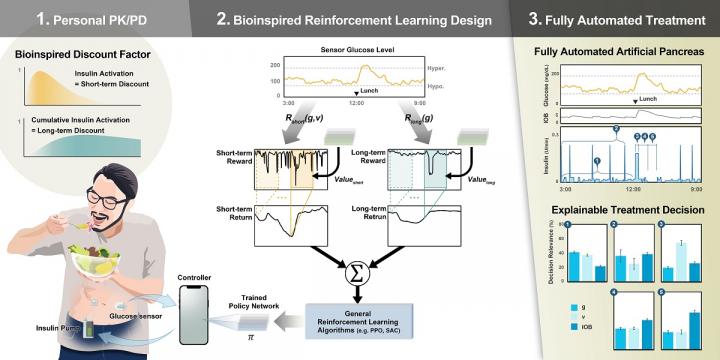
Diabetes is on the rise worldwide. It is a permanent condition that requires care over a life time. To help manage it, an artificial pancreas system, which automatically measures blood sugar levels to infuse the appropriate amount of insulin into the blood, has now become smarter thanks to AI learning.

A research team, led by Professor Sung-Min Park and Ph.D. candidate Seunghyun Lee and M.S. candidate Jiwon Kim of POSTECH’s Department of Convergence IT Engineering and Electrical Engineering, has newly developed a reinforcement learning (RL) based AI algorithm that calculates the amount of insulin needed for a diabetic patient and injects it automatically. These findings were published as a feature article in the latest issue of IEEE Journal of Biomedical and Health Informatics, an international journal on medical information science.

Patients with type 1 diabetes must inject insulin daily. One must check the amount of carbohydrates in the food ingested each time, calculate the proper amount of insulin, then inject the correct dosage before each meal. Though artificial pancreas systems on the market help with this process, there is still the hassle of having to input the meal intake in advance each time.

To eliminate this inconvenience, the research team added a pharmacological concept to reinforcement learning, widely known as the algorithm of AlphaGo. This method of AI algorithm achieved a mean glucose of 124.72 mg/dL and percentage time in the normal range of 89.56%. Even without inputting the meal intake, the policy showed performance comparable to that of conventional artificial pancreas.

“The fully automated artificial pancreas is like autonomous driving for the medical industry,” explained Professor Sung-Min Park. “The newly developed AI algorithm enables fully automated blood sugar control without the hassle of inputting meal or exercise information.” He added, “We expect this algorithm to be extended to other drug-based treatments.”

###

This study was conducted with the support from the Mid-career Researcher Program in Basic Research in Science and Engineering of the National Research Foundation of Korea.

Media Contact
Jinyoung Huh
[email protected]

Original Source

http://postech.ac.kr/eng/artificial-pancreas-system-upgraded-with-ai-algorithm/?pageds=1&k=&c=

Related Journal Article

http://dx.doi.org/10.1109/JBHI.2020.3002022

Tags: BiologyBiomedical/Environmental/Chemical EngineeringBiotechnologyDiabetesMedicine/HealthMetabolism/Metabolic DiseasesPharmaceutical ScienceRobotry/Artificial IntelligenceSurgeryTransplantation
Share13Tweet8Share2ShareShareShare2

Related Posts

Phage-Antibiotic Combo Beats Resistant Peritoneal Infection

February 7, 2026

Boosting Remote Healthcare: Stepped-Wedge Trial Insights

February 7, 2026

Barriers and Boosters of Seniors’ Physical Activity in Karachi

February 7, 2026

Evaluating Pediatric Emergency Care Quality in Ethiopia

February 7, 2026
Please login to join discussion

POPULAR NEWS

  • Robotic Ureteral Reconstruction: A Novel Approach

    Robotic Ureteral Reconstruction: A Novel Approach

    82 shares
    Share 33 Tweet 21
  • Digital Privacy: Health Data Control in Incarceration

    63 shares
    Share 25 Tweet 16
  • Study Reveals Lipid Accumulation in ME/CFS Cells

    57 shares
    Share 23 Tweet 14
  • Breakthrough in RNA Research Accelerates Medical Innovations Timeline

    53 shares
    Share 21 Tweet 13

About

We bring you the latest biotechnology news from best research centers and universities around the world. Check our website.

Follow us

Recent News

Phage-Antibiotic Combo Beats Resistant Peritoneal Infection

Boosting Remote Healthcare: Stepped-Wedge Trial Insights

Barriers and Boosters of Seniors’ Physical Activity in Karachi

Subscribe to Blog via Email

Enter your email address to subscribe to this blog and receive notifications of new posts by email.

Join 73 other subscribers
  • Contact Us

Bioengineer.org © Copyright 2023 All Rights Reserved.

Welcome Back!

Login to your account below

Forgotten Password?

Retrieve your password

Please enter your username or email address to reset your password.

Log In
No Result
View All Result
  • Homepages
    • Home Page 1
    • Home Page 2
  • News
  • National
  • Business
  • Health
  • Lifestyle
  • Science

Bioengineer.org © Copyright 2023 All Rights Reserved.