• HOME
  • NEWS
  • EXPLORE
    • CAREER
      • Companies
      • Jobs
    • EVENTS
    • iGEM
      • News
      • Team
    • PHOTOS
    • VIDEO
    • WIKI
  • BLOG
  • COMMUNITY
    • FACEBOOK
    • INSTAGRAM
    • TWITTER
Friday, October 9, 2026
BIOENGINEER.ORG
No Result
View All Result
  • Login
  • HOME
  • NEWS
  • EXPLORE
    • CAREER
      • Companies
      • Jobs
        • Lecturer
        • PhD Studentship
        • Postdoc
        • Research Assistant
    • EVENTS
    • iGEM
      • News
      • Team
    • PHOTOS
    • VIDEO
    • WIKI
  • BLOG
  • COMMUNITY
    • FACEBOOK
    • INSTAGRAM
    • TWITTER
  • HOME
  • NEWS
  • EXPLORE
    • CAREER
      • Companies
      • Jobs
        • Lecturer
        • PhD Studentship
        • Postdoc
        • Research Assistant
    • EVENTS
    • iGEM
      • News
      • Team
    • PHOTOS
    • VIDEO
    • WIKI
  • BLOG
  • COMMUNITY
    • FACEBOOK
    • INSTAGRAM
    • TWITTER
No Result
View All Result
Bioengineer.org
No Result
View All Result
Home NEWS Science News Chemistry

RUDN University chemist used iodine to synthesize new chalcogenides

Bioengineer by Bioengineer
February 19, 2021
in Chemistry
Reading Time: 2 mins read
0
IMAGE
Share on FacebookShare on TwitterShare on LinkedinShare on RedditShare on Telegram

IMAGE

Credit: RUDN University

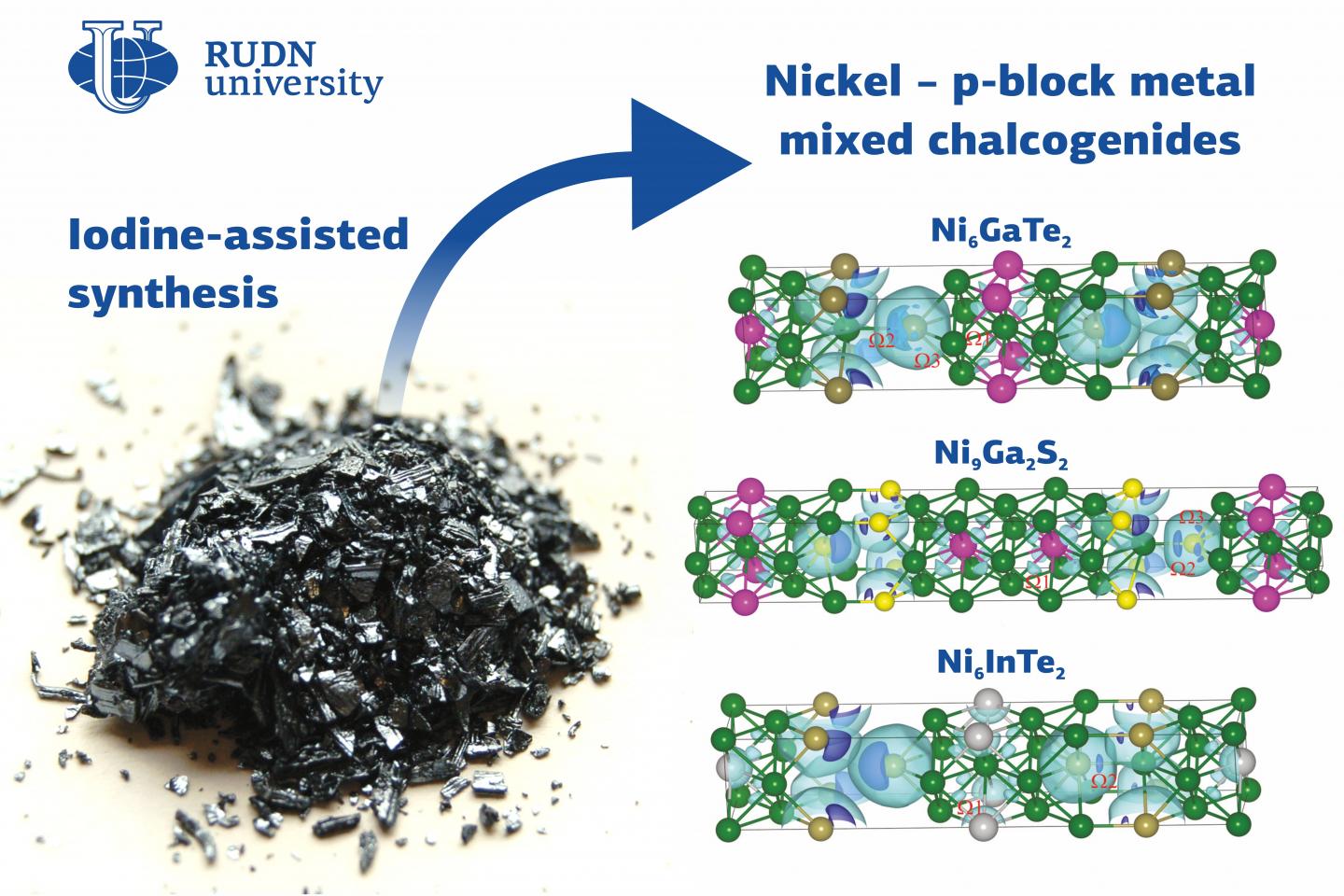
A chemist from RUDN University, working with a group of colleagues, synthesized three new chalcogenides (compounds that contain metals and elements from group 16 of the periodic table). The team suggested an unusual approach to synthesis that was based on iodine. An article about the work was published in the Dalton Transactions journal.

Chalcogens are elements of group 16 of the periodic table that include oxygen, sulfur, selenium, tellurium, polonium, and livermorium–an artificial radioactive element. Chalcogenides are compounds of chalcogens with metals that are used as photosensitive materials. Today, scientists are looking for ways to obtain new stable chalcogenide structures. A group of chemists including a scientist from RUDN University was the first to use iodine in the synthesis of new stable crystalline chalcogenides and to confirm its efficiency.

“Ordered metal compounds and their derivatives are a broad and exciting field of research. They are being studied both theoretically (because of complex crystalline structures and unusual binding schemes) and practically, due to their useful physical properties. We have obtained three new chalcogenides using iodine-based high-temperature synthesis”, said Viktor Khrustalev, a Doctor of Chemistry and the Head of the Inorganic Chemistry Department, RUDN University.

Of the three new chalcogenides obtained by the team, two were based on tellurium (Ni5.80GaTe2 and Ni5.78InTe2) and one on sulfur (Ni9.39Ga2S2). These are rare structures in which nickel fragments alternate with nickel-sulfur or nickel-tellurium ones. Besides iodine, the scientists used nickel, gallium, indium, elemental sulfur, and tellurium for synthesis. Crystalline iodine and nickel powder were purified and then mixed. After that, the mix was put in a silicon dioxide capsule and subject to 600? heat for several days until it was completely dried.

As a result, monocrystals of the first two compounds and small crystal flakes of the third one were obtained. To study the new compounds, the scientists used X-ray structural analysis. It turned out that the new chalcogenides formed rhombic system crystals, unlike other similar compounds that usually form their chrystals in the tetragonal system. In the former case, an elementary cell of a crystal system is a parallelepiped with different side lengths, while in the latter it is a cube stretched along the tetrad axis. The rhombic crystal system in the new compounds is stable, and in Ni5.80GaTe2 it is preserved even under pressure or at high temperature.

“It is essential to mention the key role of iodine in the synthesis of the new chalcogenides. Because of iodine, we managed to obtain new synthesis products, only one of which would be available with traditional methods. Apparently, the reactions that cause the formation of new triple bonds require the presence of iodine,” added Viktor Khrustalev from RUDN University.

###

Media Contact
Valeriya Antonova
[email protected]

Related Journal Article

http://dx.doi.org/10.1039/d0dt03082a

Tags: Chemistry/Physics/Materials Sciences
Share12Tweet8Share2ShareShareShare2

Related Posts

New Look-Up Tables Sharpen the Sizing of Airborne Particles Measured by Optical Counters

New Look-Up Tables Sharpen the Sizing of Airborne Particles Measured by Optical Counters

October 9, 2026
New tellurium-rich silver mineral fengruiite reveals how hot fluids trap silver in China's Qinling ore belt

New tellurium-rich silver mineral fengruiite reveals how hot fluids trap silver in China’s Qinling ore belt

October 9, 2026

Sinking Air Shapes Arctic Clouds: New Study Tracks Cold Air Outbreaks Over the Fram Strait

October 9, 2026

Hidden Atomic Spiral in Uranium Crystal Reveals Rare Dual Magnetism

October 8, 2026
Please login to join discussion

POPULAR NEWS

  • Alloys That Shrink Their Own Grains: New PIX Mechanism Refines Metals With Heat Alone

    Alloys That Shrink Their Own Grains: New PIX Mechanism Refines Metals With Heat Alone

    29 shares
    Share 12 Tweet 7
  • Endurance Exercise Reshapes the Liver in Males and Females Through Distinct Molecular Routes

    29 shares
    Share 12 Tweet 7
  • Single Transcription Factor PU.1 Rapidly Converts Fibroblasts into Macrophage-Lineage Cells

    29 shares
    Share 12 Tweet 7
  • New Scale Measures How Ready Nurse Educators Really Are for the AI Era

    29 shares
    Share 12 Tweet 7

About

We bring you the latest biotechnology news from best research centers and universities around the world. Check our website.

Follow us

Recent News

Alloys That Shrink Their Own Grains: New PIX Mechanism Refines Metals With Heat Alone

Endurance Exercise Reshapes the Liver in Males and Females Through Distinct Molecular Routes

Single Transcription Factor PU.1 Rapidly Converts Fibroblasts into Macrophage-Lineage Cells

Subscribe to Blog via Email

Success! An email was just sent to confirm your subscription. Please find the email now and click 'Confirm' to start subscribing.

Join 85 other subscribers
  • Contact Us

Bioengineer.org © Copyright 2023 All Rights Reserved.

Welcome Back!

Login to your account below

Forgotten Password?

Retrieve your password

Please enter your username or email address to reset your password.

Log In
No Result
View All Result
  • Homepages
    • Home Page 1
    • Home Page 2
  • News
  • National
  • Business
  • Health
  • Lifestyle
  • Science

Bioengineer.org © Copyright 2023 All Rights Reserved.