Brain enzyme activates dormant neural stem cells
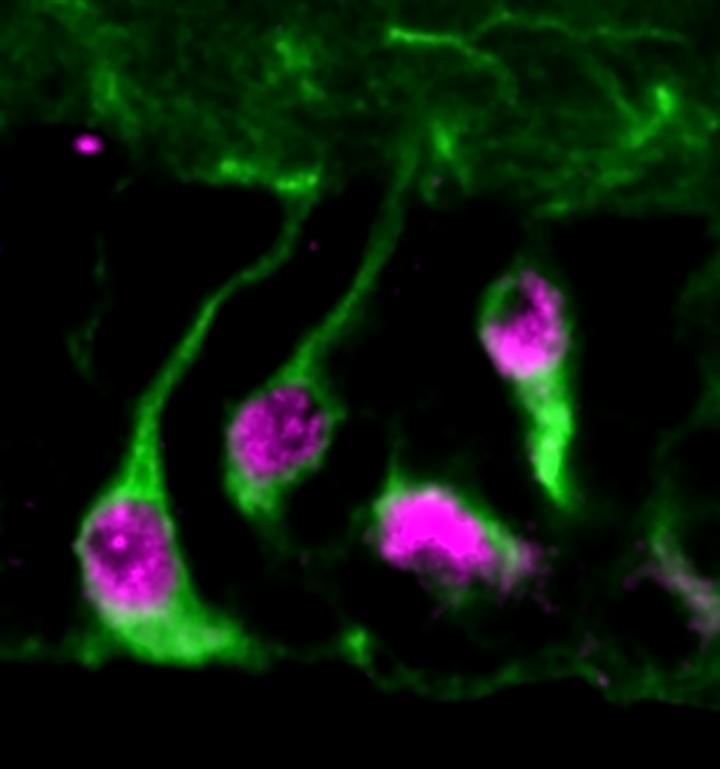
Credit: Wang Hongyan
SINGAPORE, 10 February 2021 – Researchers studying an enzyme in fruit fly larvae have found that it plays an important role in waking up brain stem cells from their dormant ‘quiescent’ state, enabling them to proliferate and generate new neurons. Published in the journal EMBO Reports, the study by Duke-NUS Medical School, Singapore, could help clarify how some neurodevelopmental disorders such as autism and microcephaly occur.
Quiescent neural stem cells in the fruit fly larval brainPr-set7 is an enzyme involved in maintaining genome stability, DNA repair and cell cycle regulation, as well as turning various genes on or off. This protein, which goes by a few different names, has remained largely unchanged as species have evolved. Professor Wang Hongyan, a professor and deputy director at Duke-NUS’ Neuroscience and Behavioural Disorders Programme, and her colleagues set out to understand the protein’s function during brain development.
“Genetic variants of the human version of Pr-set7 are associated with neurodevelopmental disorders, with typical symptoms including intellectual disability, seizures and developmental delay,” explained Professor Wang. “Our study is the first to show that Pr-set7 promotes neural stem cell reactivation and, therefore, plays an important role in brain development.”
Neural stem cells normally oscillate between states of quiescence and proliferation. Maintaining an equilibrium between the two is very important. Most neural stem cells are quiescent in adult mammalian brains. They are reactivated to generate new neurons in response to stimuli, such as injury, the presence of nutrients or exercise. However, neural stem cells gradually lose their capacity to proliferate with age and in response to stress, and anxiety.
Professor Wang and her colleagues studied what happened when the gene coding for Pr-set7 is turned off in larval fruit fly brains. They found it caused a delay in the reactivation of neural stem cells from their quiescent state. To reactivate neural stem cells, Pr-set7 needs to turn on at least two genes: cyclin-dependent kinase 1 (cdk1) and earthbound 1 (Ebd1). The scientists found that overexpressing the proteins coded by these genes led to the reactivation of neural stem cells even when the Pr-set7 gene was turned off. These findings show that Pr-set7 binds to the cdk1 and Ebd1 genes to activate a signalling pathway that reactivates neural stem cells from their quiescent state.
“Since Pr-set7 is conserved across species, our findings could contribute to the understanding of the roles of its mammalian counterpart in neural stem cell proliferation and its associated neurodevelopmental disorders,” said Prof Wang.
Professor Patrick Casey, Senior Vice-Dean for Research at Duke-NUS, commented: “With this latest study, Professor Wang’s fundamental research in neuroscience has yielded valuable insights into several neurodevelopmental disorders; insights that have the potential to improve the way we care for people with such disorders.”
The scientists are now extrapolating this study to understand the roles of the mammalian and human forms of Pr-set7, called SETD8 and KMT5A respectively, in brain development.
###
EMBO Reports is published by the European Molecular Biology Organization (EMBO), which elected Prof Wang as an Associate Member in July 2020, a lifetime honour reserved for leading scientists in recognition of their research excellence and outstanding accomplishments. Prof Wang became the third Singapore-based scientist to become an EMBO Associate Member, based on her extensive academic and research contributions in the field of neuroscience.
Media Contact
Federico Graciano
[email protected]
Original Source
https:/
Related Journal Article
http://dx.