• HOME
  • NEWS
  • EXPLORE
    • CAREER
      • Companies
      • Jobs
    • EVENTS
    • iGEM
      • News
      • Team
    • PHOTOS
    • VIDEO
    • WIKI
  • BLOG
  • COMMUNITY
    • FACEBOOK
    • INSTAGRAM
    • TWITTER
Saturday, February 7, 2026
BIOENGINEER.ORG
No Result
View All Result
  • Login
  • HOME
  • NEWS
  • EXPLORE
    • CAREER
      • Companies
      • Jobs
        • Lecturer
        • PhD Studentship
        • Postdoc
        • Research Assistant
    • EVENTS
    • iGEM
      • News
      • Team
    • PHOTOS
    • VIDEO
    • WIKI
  • BLOG
  • COMMUNITY
    • FACEBOOK
    • INSTAGRAM
    • TWITTER
  • HOME
  • NEWS
  • EXPLORE
    • CAREER
      • Companies
      • Jobs
        • Lecturer
        • PhD Studentship
        • Postdoc
        • Research Assistant
    • EVENTS
    • iGEM
      • News
      • Team
    • PHOTOS
    • VIDEO
    • WIKI
  • BLOG
  • COMMUNITY
    • FACEBOOK
    • INSTAGRAM
    • TWITTER
No Result
View All Result
Bioengineer.org
No Result
View All Result
Home NEWS Science News Biology

Really random networks

Bioengineer by Bioengineer
February 10, 2021
in Biology
Reading Time: 2 mins read
0
IMAGE
Share on FacebookShare on TwitterShare on LinkedinShare on RedditShare on Telegram

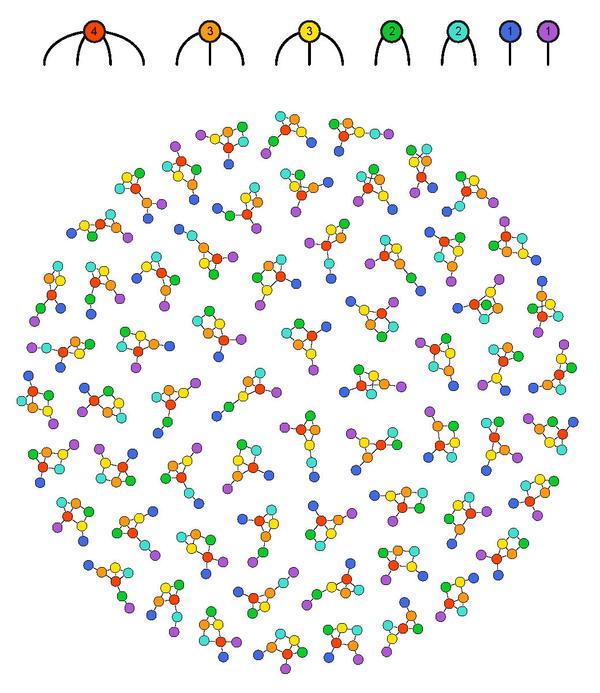
New mathematical method for generating random connected networks
IMAGE

Credit: Szabolcs Horvat et al. 2020 / MPI-CBG / CSBD

Many natural and human-made networks, such as computer, biological or social networks have a connectivity structure that critically shapes their behavior. The academic field of network science is concerned with analyzing such real-world complex networks and understanding how their structure influences their function or behavior. Examples are the vascular network of our bodies, the network of neurons in our brain, or the network of how an epidemic is spreading through a society.

The need for reliable null models

The analysis of such networks often focuses on finding interesting properties and features. For example, does the structure of a particular contact network help diseases spread especially quickly? In order to find out, we need a baseline–a set of random networks, a so-called “null model”–to compare to. Furthermore, since more connections obviously create more opportunities for infection, the number of connections of each node in the baseline should be matched to the network we analyze. Then if our network appears to facilitate spreading more than the baseline, we know it must be due to its specific network structure. However, creating truly random, unbiased, null models that are matched in some property is difficult–and usually requires a different approach for each property of interest. Existing algorithm that create connected networks with a specific number of connections for each node all suffer from uncontrolled bias, which means that some networks are generated more than others, potentially compromising the conclusions of the study.

A new method that eliminates bias

Szabolcs Horvát and Carl Modes at the Center for Systems Biology Dresden (CSBD) and the Max Planck Institute of Molecular Cell Biology and Genetics (MPI-CBG) developed such a model which makes it possible to eliminate bias, and reach solid conclusions. Szabolcs Horvát describes: “We developed a null model for connected networks where the bias is under control and can be factored out. Specifically, we created an algorithm which can generate random connected networks with a prescribed number of connections for each node. With our method, we demonstrated that more naïve but commonly used approaches may lead to invalid conclusions.” The coordinating author of the study, Carl Modes concludes: “This finding illustrates the need for mathematically well-founded methods. We hope that our work will be useful to the broader network science community. In order to make it as easy as possible for other researchers to use it, we also developed a software and made it publicly available.”

###

Publicly available software:

https://github.com/szhorvat/ConnectedGraphSampler

Original Publication

Szabolcs Horvát and Carl D. Modes, Connectedness matters: Construction and exact random sampling of connected networks, J. Phys. Complex 2, 015008 (2021).

Media Contact
Katrin Boes
[email protected]

Original Source

https://www.mpi-cbg.de/news-events/latest-news/article/news/really-random-networks/

Tags: Algorithms/ModelsBiologyCell BiologyMathematics/Statistics
Share13Tweet8Share2ShareShareShare2

Related Posts

Florida Cane Toad: Complex Spread and Selective Evolution

Florida Cane Toad: Complex Spread and Selective Evolution

February 7, 2026
New Study Uncovers Mechanism Behind Burn Pit Particulate Matter–Induced Lung Inflammation

New Study Uncovers Mechanism Behind Burn Pit Particulate Matter–Induced Lung Inflammation

February 6, 2026

DeepBlastoid: Advancing Automated and Efficient Evaluation of Human Blastoids with Deep Learning

February 6, 2026

Navigating the Gut: The Role of Formic Acid in the Microbiome

February 6, 2026
Please login to join discussion

POPULAR NEWS

  • Robotic Ureteral Reconstruction: A Novel Approach

    Robotic Ureteral Reconstruction: A Novel Approach

    82 shares
    Share 33 Tweet 21
  • Digital Privacy: Health Data Control in Incarceration

    63 shares
    Share 25 Tweet 16
  • Study Reveals Lipid Accumulation in ME/CFS Cells

    57 shares
    Share 23 Tweet 14
  • Breakthrough in RNA Research Accelerates Medical Innovations Timeline

    53 shares
    Share 21 Tweet 13

About

We bring you the latest biotechnology news from best research centers and universities around the world. Check our website.

Follow us

Recent News

Improving Dementia Care with Enhanced Activity Kits

Decoding Prostate Cancer Origins via snFLARE-seq, mxFRIZNGRND

Digital Health Perspectives from Baltic Sea Experts

Subscribe to Blog via Email

Enter your email address to subscribe to this blog and receive notifications of new posts by email.

Join 73 other subscribers
  • Contact Us

Bioengineer.org © Copyright 2023 All Rights Reserved.

Welcome Back!

Login to your account below

Forgotten Password?

Retrieve your password

Please enter your username or email address to reset your password.

Log In
No Result
View All Result
  • Homepages
    • Home Page 1
    • Home Page 2
  • News
  • National
  • Business
  • Health
  • Lifestyle
  • Science

Bioengineer.org © Copyright 2023 All Rights Reserved.