Study shows super-Earths are not leftovers of mini-Neptunes, challenging our understanding of planetary formation
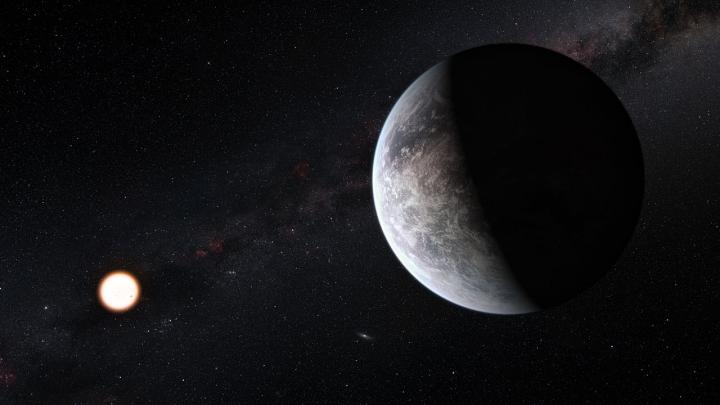
Credit: ESO/M. Kornmesser
Mini-Neptunes and super-Earths up to four times the size of our own are the most common exoplanets orbiting stars beyond our solar system. Until now, super-Earths were thought to be the rocky cores of mini-Neptunes whose gassy atmospheres were blown away. In a new study published in The Astrophysical Journal, astronomers from McGill University show that some of these exoplanets never had gaseous atmospheres to begin with, shedding new light on their mysterious origins.
From observations, we know about 30 to 50 percent of host stars have one or the other, and the two populations appear in about equal proportion. But where did they come from?
One theory is that most exoplanets are born as mini-Neptunes but some are stripped of their gas shells by radiation from host stars, leaving behind only a dense, rocky core. This theory predicts that our Galaxy has very few Earth-sized and smaller exoplanets known as Earths and mini-Earths. However, recent observations show this may not be the case.
To find out more, the astronomers used a simulation to track the evolution of these mysterious exoplanets. The model used thermodynamic calculations based on how massive their rocky cores are, how far they are from their host stars, and how hot the surrounding gas is.
“Contrary to previous theories, our study shows that some exoplanets can never build gaseous atmospheres to begin with,” says co-author Eve Lee, Assistant Professor in the Department of Physics at McGill University and the McGill Space Institute.
The findings suggest that not all super-Earths are remnants of mini-Neptunes. Rather, the exoplanets were formed by a single distribution of rocks, born in a spinning disk of gas and dust around host stars. “Some of the rocks grew gas shells, while others emerged and remained rocky super-Earths,” she says.
How mini-Neptunes and super-Earths are born
Planets are thought to form in a spinning disk of gas and dust around stars. Rocks larger than the moon have enough gravitational pull to attract surrounding gas to form a shell around its core. Over time this shell of gas cools down and shrinks, creating space for more surrounding gas to be pulled in, and causing the exoplanet to grow. Once the entire shell cools down to the same temperature as the surrounding nebular gas, the shell can no longer shrink and growth stops.
For smaller cores, this shell is tiny, so they remain rocky exoplanets. The distinction between super-Earths and mini-Neptunes comes about from the ability of these rocks to grow and retain gas shells.
“Our findings help explain the origin of the two populations of exoplanets, and perhaps their prevalence” says Lee. “Using the theory proposed in the study, we could eventually decipher how common rocky exoplanets like Earths and mini-Earths may be.”
About the study
###
“Primordial Radius Gap and Potentially Broad Core Mass Distributions of Super-Earths and Sub-Neptunes” by Eve Lee and Nicholas Connors was published in The Astrophysical Journal.
DOI: https:/
Link: https:/
About McGill University
Founded in Montreal, Quebec, in 1821, McGill University is Canada’s top ranked medical doctoral university. McGill is consistently ranked as one of the top universities, both nationally and internationally. It?is a world-renowned?institution of higher learning with research activities spanning two campuses, 11 faculties, 13 professional schools, 300 programs of study and over 40,000 students, including more than 10,200 graduate students. McGill attracts students from over 150 countries around the world, its 12,800 international students making up 31% of the student body. Over half of McGill students claim a first language other than English, including approximately 19% of our students who say French is their mother tongue.
https:/
Media Contact
Shirley Cardenas
[email protected]
Original Source
https:/
Related Journal Article
http://dx.