A step in the search for life elsewhere in the galaxy
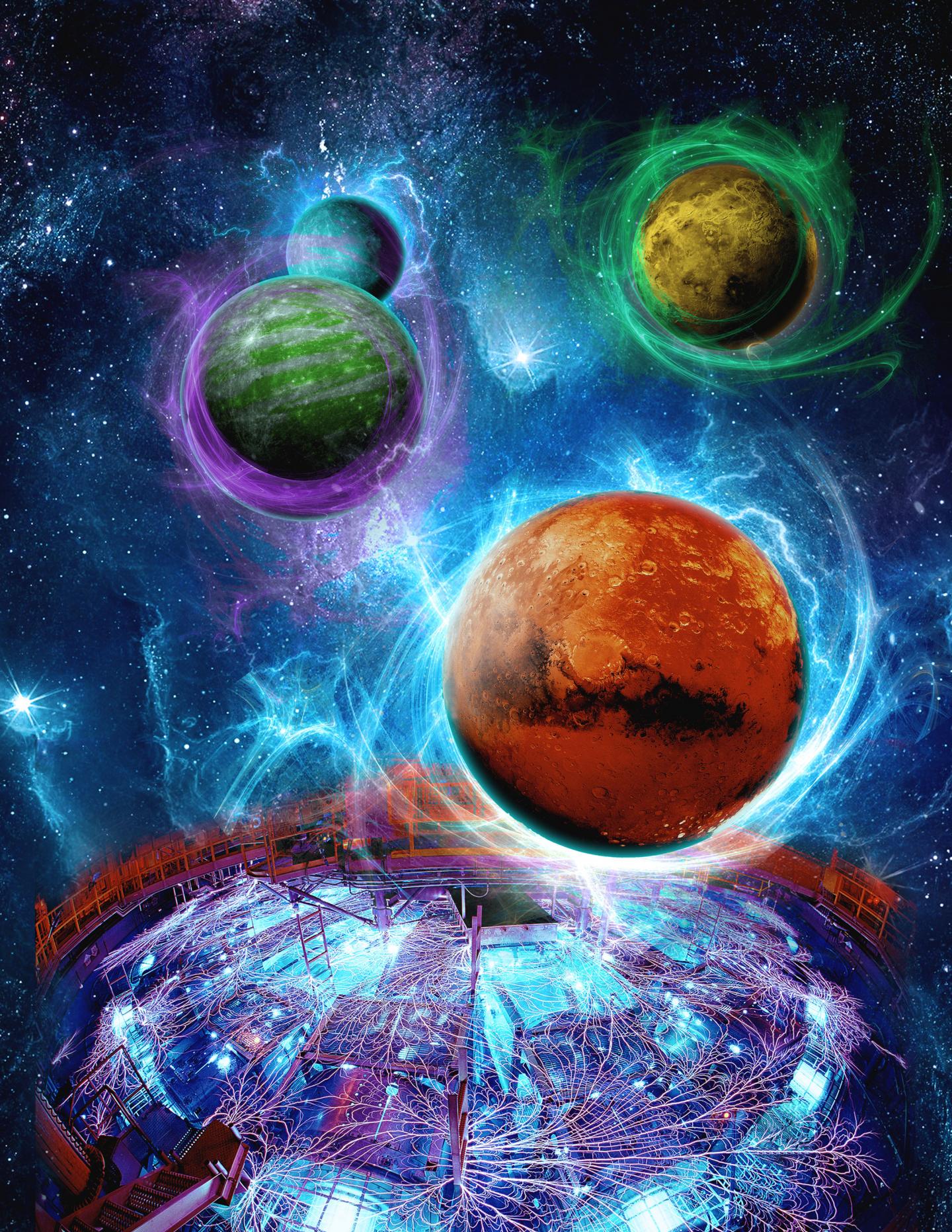
Credit: Artist image by Eric Lundin; Z firing photo by Randy Montoya
ALBUQUERQUE, N.M. — The huge forces generated by the Z machine at Sandia National Laboratories are being used to replicate the gravitational pressures on so-called “super-Earths” to determine which might maintain atmospheres that could support life.
Astronomers believe that super-Earths — collections of rocks up to eight times larger than Earth — exist in the millions in our galaxy. “The question before us is whether any of these super planets are actually Earthlike, with active geological processes, atmospheres and magnetic fields,” said Sandia physicist Joshua Townsend.
The current work at Z is described in today’s Nature Communications. Researchers in Sandia’s Fundamental Science Program, working with colleagues at the Earth and Planets Laboratory of the Carnegie Institution for Science in Washington, D.C., use the forces available at Sandia’s uniquely powerful Z facility to near-instantly apply the equivalent of huge gravitational pressures to bridgmanite, also known as magnesium-silicate, the most abundant material in solid planets.
The experiments, said Townsend, gave birth to a data-supported table that shows when a planet’s interior would be solid, liquid or gaseous under various pressures, temperatures and densities, and in what predicted time spans. Only a liquid core — with its metals shifting over each other in conditions resembling that of an earthly dynamo — produces the magnetic fields that can shunt destructive solar winds and cosmic rays away from a planet’s atmosphere, allowing life to survive. This critical information about magnetic field strengths produced by the core states of different-sized super-Earths was formerly unavailable: cores are well-hidden by the bulk of the planets surrounding them, and thus not visible by remote viewing. For researchers who preferred earthly experiments rather than long-distance imaging, sufficient pressures weren’t available until Z’s capabilities were enlisted.
Yingwei Fei, the corresponding author of the current study and senior staff scientist at Carnegie’s Earth and Planets Laboratory, is known for his skill in synthesizing large-diameter bridgmanite using multiton presses with sintered diamond anvils.
“Z has provided our collaboration a unique tool that no other technique can match, for us to explore the extreme conditions of super-Earths’ interiors,” he said. “The machine’s unprecedented high-quality data have been critical for advancing our knowledge of super-Earths.”
The Magnificent Seven
Further analysis of the state of gaseous and dense materials on specific super-Earths produced a list of seven planets possibly worthy of further study: 55 Cancri e; Kepler 10b, 36b, 80e, and 93b; CoRoT-7b; and HD-219134b.
Sandia manager Christopher Seagle, who with Fei initially proposed these experiments, said, “These planets, which we found most likely to support life, were selected for further study because they have similar ratios to Earth in their iron, silicates and volatile gasses, in addition to interior temperatures conducive to maintaining magnetic fields for protection against solar wind.”
The focus on supersized, rather than small, planets came about because large gravitational pressures mean atmospheres are more likely to survive over the long haul, said Townsend.
For example, he said, “Because Mars was smaller, it had a weaker gravitational field to begin with. Then as its core quickly cooled, it lost its magnetic field and its atmosphere was subsequently stripped away.”
Z in action
For these experiments, the Z machine, with operating conditions of up to 26 million amps and hundreds of thousands of volts, creates magnetic pulses of enormous power that accelerate credit card-sized pieces of copper and aluminum called flyer-plates. These were propelled much faster than a rifle bullet into samples of bridgmanite, the Earth’s most common mineral. The near-instantaneous pressure of the forceful interaction created longitudinal and transverse sound waves in the material that reveal whether the material remains solid or changes to a liquid or gas, said Sandia researcher and paper author Chad McCoy. With these new results, researchers were supplied with solid data on which to anchor otherwise theoretical planetary models.
The technical paper concludes that the high-precision density data and unprecedently high melting temperatures achieved at the Z machine “provide benchmarks for theoretical calculations under extreme conditions.”
Concluded Fei, “Our collaboration with Sandia scientists has led to results that will encourage more academic exploration of exoplanets, whose discovery has captured the public imagination.”
“This work identifies interesting exoplanet candidates to explore further,” said Seagle. “Z shock compression plus Fei’s unusual capability to synthesize large-diameter bridgmanite lead to an opportunity to obtain data relevant to exoplanets that would not be possible anywhere else.”
###
The work was supported by the National Science Foundation, the Z Fundamental Science Program and a Carnegie Venture grant.
Sandia National Laboratories is a multimission laboratory operated by National Technology and Engineering Solutions of Sandia LLC, a wholly owned subsidiary of Honeywell International Inc., for the U.S. Department of Energy’s National Nuclear Security Administration. Sandia Labs has major research and development responsibilities in nuclear deterrence, global security, defense, energy technologies and economic competitiveness, with main facilities in Albuquerque, New Mexico, and Livermore, California.
Sandia news media contact:
Neal Singer,
[email protected],
505-977-7255
Media Contact
Neal Singer
[email protected]