Credit: Eduardo Maeda
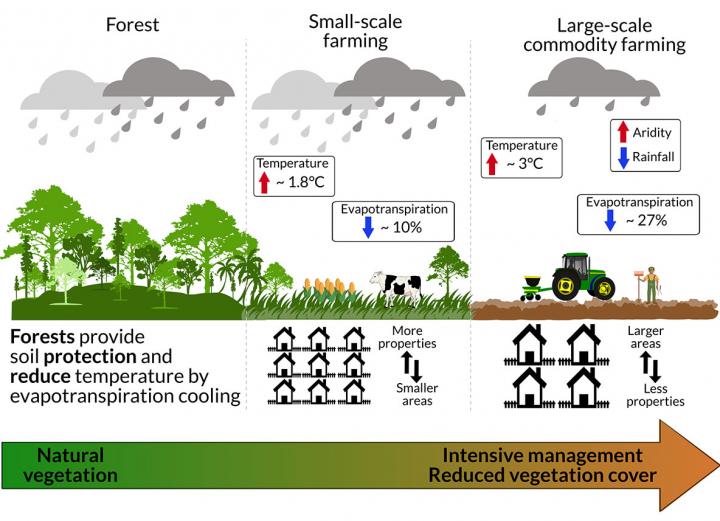
Researchers report that large-scale commercial farms on deforested land in the southern Amazon result in higher temperature increases and less rainfall than small-scale farms.
Deforestation has converted swaths of land in the southern Amazon region from rainforest to farmland. The uses of the deforested land are diverse, and activities can range from small-scale farming in rural settlements to large-scale commodity agriculture. Commercial farms in the Southern Amazon can reach hundreds of thousands of hectares in area, exporting millions of tons in grains and beef every year.
Eduardo Maeda from the University of Helsinki and colleagues used satellite data to compare areas dominated by different land uses and farm sizes to evaluate their impacts on the regional climate. Although small rural settlements experienced no clear changes in rainfall during recent decades, areas dominated by commodity farms have become significantly drier. Areas of commodity farming also experienced a much higher increase in temperature, in comparison with small-scale rural settlements, largely due to intense management of commercial crops leading to reduced vegetation cover throughout the year and decreased plant transpiration. According to the authors, mitigating climate change in the Amazon basin will require alternatives to current commodity farming practices.
“Our results show that deforestation caused by big commodity farms can cause a local temperature increase up to 3x higher than what is observed in deforestation caused by small rural settlements”, says Maeda.
Tropical forests are natural air conditioners
Tropical forests act as a water pump, getting water from the land surface and throwing it back into the atmosphere. Because this process requires energy, it causes a reduction in the surface temperature. The water that returns to the atmosphere, often falls back into the forest in the form of rain. The trees then becomes a critical component of a complex water recycling machine, which guarantee that the forest is kept always moist. When the forest is removed, the water returning to the atmosphere is reduced, and the unused energy contributes to increase local temperatures.
The research by Maeda and colleagues demonstrate that this process is further aggravated by large commodity farms. The production of commodity crops in the Amazon forest is often associated with a very intensive management of the land. Because of the favorable climatic conditions, farmers often have two harvesting/seeding seasons per year. These activities completely remove vegetation from the land surface, leading to a warmer and drier local climate.
Although areas dominated by small rural settlements also experience temperature increase, the magnitude of the changes are substantially smaller than those observed in big commodity farms. The authors of the study argue that the main reason is because these small rural settlements are often less managed, leaving a denser and more continuous vegetation cover than in the large monoculture farms.
Alternative agricultural practices needed to help saving the Amazon rainforest
The results of this research provide compelling evidence that alternative agricultural practices will be critical for a sustainable future in the Amazon rainforest.
“This means that stopping deforestation is no longer enough. To protect the remaining forests, farmers in the Amazon region will have to incorporate more sustainable practices”.
According to the research, this means that agricultural activities need to be better integrated with the natural Amazon ecosystem.
Agroforestry is for example an interesting alternative, as it seeks to manage forest services and agriculture at the same time, improving soil fertility, increasing water availability, while preserving vegetation cover and microclimate. Reforestation of abandoned pastures and areas of illegal deforestation are also important pathways to mitigate environmental changes.
The authors of the study warn that such changes will not come easily. The production of commodity crops in the Southern Amazon can be a very profitable business. Hence, local and international policies, in combination with actions led by the food industry and civil society organizations, will play a critical role in changing the current mentality. Finally, increasing international awareness and consumers’ preference for more sustainable products, will be essential to create real pressure in the supply-chain, hopefully giving some hope for the future of the Amazon rainforest.
###
The research was funded by the Academy of Finland, and carry out at the Terrestrial Ecosystem Dynamics Laboratory at the University of Helsinki.
More details:
Academy Research Fellow Eduardo Maeda,
University of Helsinki,
[email protected],
+358 504 764677
Media Contact
Riitta-Leena Inki
[email protected]
Original Source
https:/
Related Journal Article
http://dx.