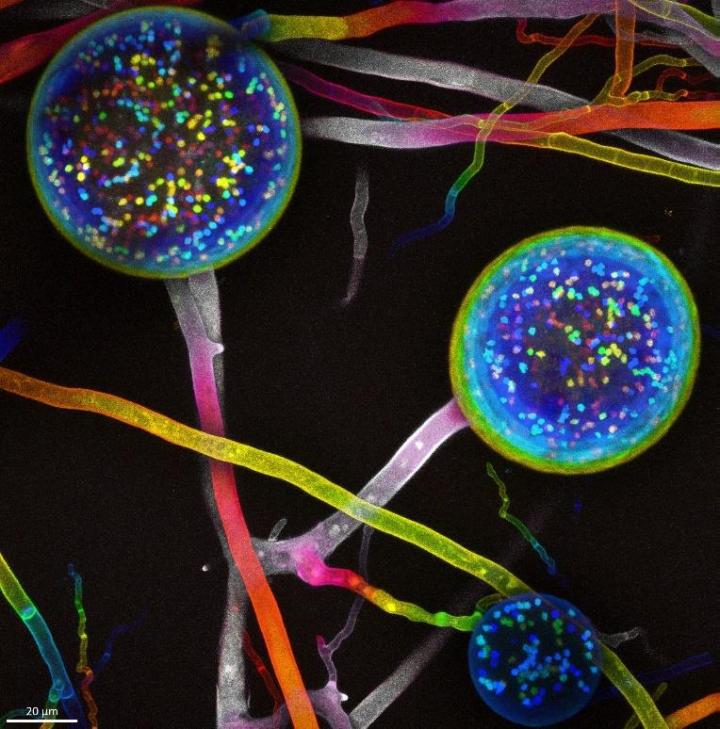
Credit: University of Ottawa/ Microscope Laboratory (Ottawa-RDC, Agriculture and Agri-Food Canada)
Researchers from the University of Ottawa have discovered that plants may be able to control the genetics of their intimate root symbionts – the organism with which they live in symbiosis – thereby providing a better understanding of their growth.
In addition to having a significant impact on all terrestrial ecosystems, their discovery may lead to improved eco-friendly agricultural applications.
We talked to research lead Nicolas Corradi, Associate Professor in the Department of Biology and Research Chair in Microbial Genomics at the University of Ottawa, and lead author Vasilis Kokkoris, Postdoctoral Fellow in the Corradi Lab, to learn more about their recent study published in the journal Current Biology.
Can you tell us more about your findings?
Nicolas Corradi: “We have uncovered a fascinating genetic regulation between plants and their microbial symbionts, known as Arbuscular Mycorrhizal Fungi (AMF).
AMF are plant obligate symbionts that grow within the plant roots and help their hosts to grow better and be more resistant to environmental stressors.
AMF genetics have long been mysterious; while typical cells carry one nucleus, the cells of AMF carry thousands of nuclei that can be genetically diverse. How these nuclei communicate with each other and whether the plants can control their relative abundance, has been a total mystery.
Our work provides insights into this unique genetic condition:
1- We demonstrate that the host plant symbiont influences the relative abundance of thousands of co-existing nuclei carried by their fungal symbionts.
2- We find evidence that co-existing nuclei of different genetic backgrounds cooperate, rather than compete with one another thus potentially maximizing growth benefits for both the fungi and their plant partners.”
How did you come to these conclusions?
Vasilis Kokkoris: “We implemented a novel molecular approach accompanied by advanced microscopy and mathematical modelling. Every single AMF spore carries hundreds of nuclei (see image).
By analyzing single spores, we were able to quantify the genetics of thousands of nuclei and define their relative abundance in different fungal strains and across plant species.
To ensure that we accurately analyze single nuclei, we used advanced microscopy to visualize and count the nuclei in the spores.
Lastly, we used mathematical modelling to prove that the observed abundance of nuclear genotypes we identified cannot be a product of luck but instead is the result of a driven cooperation between them.
To better understand what is regulating the AMF nuclei we grew different AMF strains with different hosts and found that plants have control of the relative abundance of the fungal nuclei.”
What are the impacts of your discovery?
Nicolas Corradi: “For many years, AMF have been considered to be genetic peculiarities and far away from model organisms. Inconsistencies are commonly observed in plant-AMF experiments. For example, growing the same fungal strain with different plants can lead to drastically different plant yields. For a long time, this variance in plant growth was blamed on the AMF mysterious genetics.
Our research provides an answer as we demonstrate that the genetics of these fungi, and their effect on plant growth, can be manipulated by plants thus explaining the reason for the observed variability on plant growth.
From an environmental standpoint, this new knowledge allows for better understanding how plants can influence the genetics of their symbiotic partners, thus influencing entire terrestrial ecosystems.
From an economic standpoint, it opens doors to improved sustainable agricultural applications.”
###
The research was led by the Corradi Lab, at the University of Ottawa and was conducted at the University of Ottawa and the Agriculture and Agri-Food Canada (AAFC). Two members of the Corradi lab, uOttawa PhD student Gökalp Yildirir and recent graduate Kelsey Clarke, also contributed to this study.
The other co-authors include Dr. Pierre-Luc Chagnon, Assistant Professor in the Department of biological sciences at the University of Montreal, Dr. Allyson M MacLean, Assistant Professor in the Department of Biology at the University of Ottawa and her MSc student Dane Goh, and Dr. Jeremy Dettman and Dr. Franck Stefani from the Agriculture and Agri-food Canada (Ottawa Research and Development Centre).
The paper “Host identity influences nuclear dynamics in arbuscular mycorrhizal fungi” is published in the journal Current Biology.
Media Contact
Justine Boutet
[email protected]
Original Source
https:/
Related Journal Article
http://dx.