New genetics-based approach could see remarkable increase in food supply, improved carbon capture and less need for pollutant fertilizers
Credit: Issey Takahashi
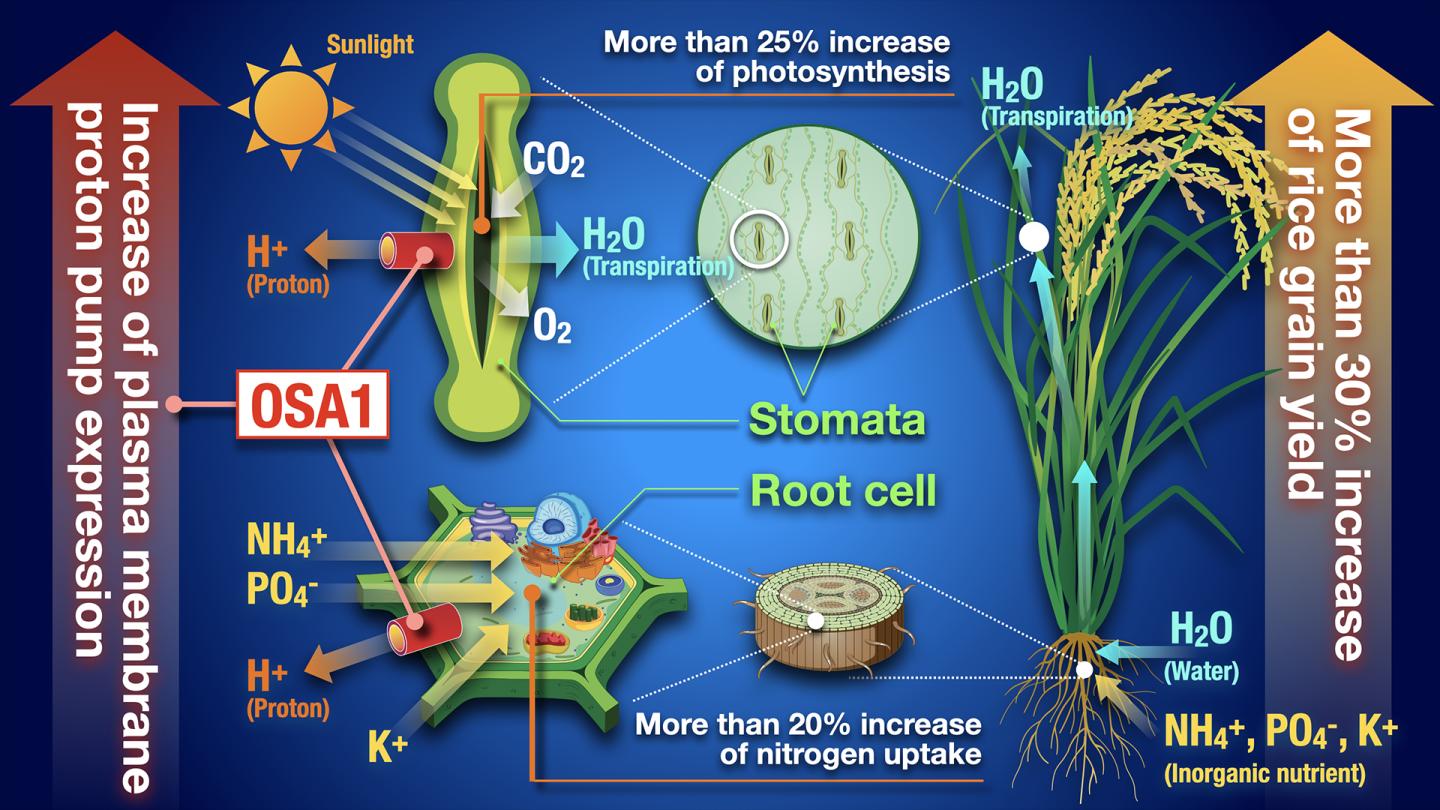
A group of scientists led by Drs Toshinori Kinoshita and Maoxing Zhang (Institute of Transformative Bio-Molecules,Nagoya University, Japan) and Dr Yiyong Zhu (Jiangsu Collaborative Innovation Center for Solid Organic Waste Utilization, Nanjing Agricultural University, China) have developed a method which, by increasing the number of a plasma membrane proton pump gene in rice, simultaneously increases nutrient uptake through the roots and stomatal opening, thus increasing the yield of paddy field grown rice by over 30%.
In their previous research, the group had found that the plasma membrane proton pump played an important role in influencing stomatal opening. When they created a variant of rice with an overexpression of a particular plasma membrane proton pump gene, they found that nutrient uptake through the roots increased by over 20%, and photosynthesis by over 20%. Growth experiments at four separate rice farms with different growth conditions showed an increase in overall rice yield of over 30%. The success of this research is a groundbreaking achievement, with its simultaneous effect upon nutrient uptake and stomatal opening, and is expected to see a variety of practical uses in the future.
As they take in mineral nutrients such as nitrogen, phosphorous and potassium through their roots, plants simultaneously absorb carbon dioxide through the stomata on their leaves, and grow through photosynthesis. Photosynthesis enables not only the farming of plants for food, but the exchange of carbon dioxide and management of the earth’s environment. CO2 intake in plants occurs exclusively through the stomata, which are holes on the surface of the leaves. Thus, if it were possible to open the stomata wider, increase the nutrient uptake through the roots, and thus increase the rate of photosynthesis, not only would it be possible to speed up growth and increase yield of plants, but also to reduce CO2 levels and the use of fertilizers.
With that in mind, in this study, they created a variant of the rice plant with an increased expression of the plasma membrane proton pump gene OSA1 and carried out an analysis of its phenotype. They found that the proton pump overexpressed rice, when compared to a wild strain, took up over 20% more mineral nutrients, and opened its stomata over 25% wider when exposed to light (Figure 2). On further analysis, they found that its carbon dioxide storage capacity (the indicator of photosynthesis activity) was increased by over 25%, and that its dry weight (biomass) increased by 18-33% in hydroponic laboratory growth.
With this determined, the researchers set out to find if the results could be replicated under realistic growing conditions. They conducted yield measurement exercises at four separate rice farms over the course of two years, finding that the rice with the overexpressed OSA1 gene had a yield over 30% higher than that of the wild strain. Even more interestingly, they discovered that even if the level of nitrogen fertilizer was reduced by half, it still produced a greater yield than the wild strain did with normal levels of nitrogen.
The success of this revolutionary piece of research points to a future in which food supply and CO2 overproduction issues can be solved through use of these proton pump gene overexpression plants. While these early stage models have been created through genetic modification, it is anticipated that future generations not reliant on GM but instead using genome editing or chemical engineering will be realized.
###
Media Contact
Toshinori Kinoshita
[email protected]
Related Journal Article
http://dx.