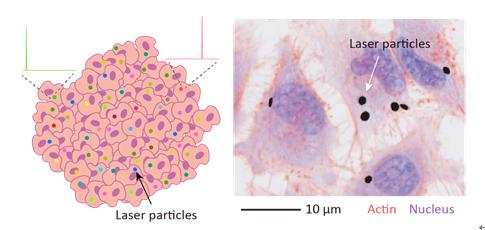
Credit: by Shui-Jing Tang, Paul H. Dannenberg, Andreas C. Liapis, Nicola Martino, Yue Zhuo, Yun-Feng Xiao, and Seok-Hyun Yun
Laser particles are micrometre and nanometre lasers in the form of particles dispersible in aqueous solution, which have attracted considerable interest in the life sciences as a promising new optical probe. Laser particles emit highly bright light with extremely narrow spectral bandwidth. By transferring laser particles into live cells as shown in Figure 1, individual cells in a heterogeneous population can be tracked using each intracellular particle’s specific spectral fingerprint as an optically readable barcode. However, laser particles emit directional light (Figure 2) and freely tumble inside living cells, their orientation varying randomly over time. Therefore optical readout of these labels results in “lighthouse-like” blinking, leading to frequent loss of cell traces.
In a new paper published in Light: Science & Application, scientists from Professor Seok-Hyun Yun’s group at Harvard Medical School, and Professor Yun-Feng Xiao’s group at Peking University demonstrate single-cell tracking with intracellular laser particles engineered to emit nearly homogeneously in all directions. The omnidirectional laser emission is achieved by incorporating light scattering into the microdisk cavity, which reduces orientation dependent intensity fluctuations by two orders of magnitude (Figure 2), enabling blinking-free tracking of single cells under the same conditions where existing technology suffers from frequent tracking failure. The reported technique will open new avenues for large-scale single-cell analysis, and facilitate other applications of laser particles, such as cellular and biochemical sensing and single-cell analysis in microfluidics.
These scientists summarize the single-cell tagging principle of laser particles:
“Typically, researchers use fluorescent probes to label specific cells, but only a few colors can be used at the same time before spectral overlap becomes a problem. Laser particles are tiny lasers that can be inserted inside living cells. These tiny lasers can be designed to produce many more distinguishable colors. The intracellular laser particles with a specific color will move with live cells, and therefore single cells can be tracked as they move throughout complex biological samples,” said Dr. Shui-Jing Tang, a former visiting student at Harvard Medical School and a current Boya postdoctoral researcher at Peking University.
“Unfortunately, laser particles emit light in a specific direction. When particles rotate freely over time as the cell moves, their apparent brightness, as seen by a photodetector, changes dramatically. We developed a new kind of laser particle emitting light in all directions. Therefore, the spatial cell traces could be tracked continuously no matter how each particle was oriented inside a cell,” added Paul Dannenberg, a graduate student at Harvard Medical School.
“The presented technique makes it possible to detect and identify laser particles reliably over time in cell tracking applications, which could enable large-scale single-cell analysis in complex biological specimens. In addition to cell-tracking, our work will facilitate other applications of laser particles, such as cellular and biochemical sensing and single-cell analysis in microfluidics,” said Dr. Andreas Liapis, a research fellow at Harvard University.
###
Media Contact
Seok-Hyun Yun
[email protected]
Related Journal Article
http://dx.