Researchers at Osaka University demonstrate wireless transmission of uncompressed full-resolution 8K video using terahertz waves
Credit: Osaka University
A team of researchers at Osaka University, together with Rohm Co., Ltd., has employed 300-GHz band terahertz waves as an information carrier that allows for wireless communications of 8K ultrahigh definition (UHD) video with a data rate of 48 Gbit/s under the JST CREST project “Development of terahertz integrated technology platform through fusion of resonant tunneling diodes and photonic crystals.”
The next-generation 6G mobile communication standard beyond the present 5G system is expected to transmit 8K and other UHD videos with low latency and low power consumption. Since the data rate of UHD video is very high, however, it is necessary to compress the data when being transmitted wirelessly using microwaves or millimeter waves, which results in delays and increased power consumption. Thus, the development of a technology for uncompressed wireless transmission of UHD video is required.
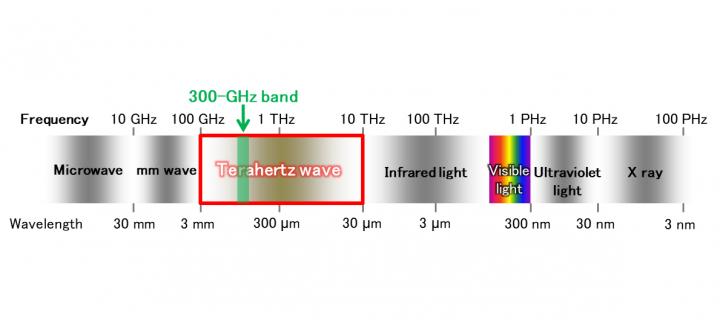
“In general, the higher the frequency, the greater the capacity to transmit information, with terahertz waves having a higher frequency than microwaves and millimeter waves (Fig. 1). We focused on terahertz waves in the 300-GHz band,” explains Assistant Professor Julian Webber.
The researchers configured a two-channel terahertz transmitter (Tx) by modulating the output of a laser pair with wavelengths in the 1.55-micron band, which was set so that the frequency difference was in the 300-GHz band, with an 8K video signal source using an intensity modulator and converting it into terahertz waves using an ultrafast photodiode (PD) (Fig. 2).
As the 8K video signal source, the team prepared commercially available uncompressed full-resolution 8K video content by Astrodesign Inc., which is output as a four-channel 12 Gbit/s signal, and used an on-off keying (OOK) modulation signal that was combined to form a two-channel 24 Gbit/s signal. After the wirelessly transmitted terahertz waves were detected by sensitive terahertz coherent receivers (Rxs) using resonant tunnel diodes (RTDs) (see December 2, 2019 press release, “A trick for taming terahertz transmissions: Researchers at Osaka University invent a new receiver for terahertz-frequency radiation”), they were split from the two channels into four channels and connected to an 8K monitor via HDMI cable. Using this system, uncompressed 8K video (equivalent to 48 Gbit/s) was successfully transmitted wirelessly using terahertz waves (Fig. 3).
“In general, such ultrahigh-speed data transmission experiments are performed using multilevel modulations via a complex system with high power consumption that uses off-line or on-line digital signal processing. The present real-time demonstration, which uses the simplest OOK format, shows the capability of ultra-broad band terahertz waves,” says Associate Professor Masayuki Fujita, who leads the team.
“Our achievement demonstrates the usefulness of terahertz waves and is expected to accelerate research and development activities for the realization of Beyond 5G and eventually 6G. Such uncompressed wireless transmission technology for UHD video will enhance the quality of telemedicine and telework, which are directly related to social issues, and will lead to the advancement of physical-cyber fusion by utilizing the big data of UHD video.”
###
Related link
Development of terahertz integrated technology platform through fusion of resonant tunneling diodes and photonic crystals, JST CREST
https:/
Related movie
https:/
About Osaka University
Osaka University was founded in 1931 as one of the seven imperial universities of Japan and now has expanded to one of Japan’s leading comprehensive universities. The University has now embarked on open research revolution from a position as Japan’s most innovative university and among the most innovative institutions in the world according to Reuters 2015 Top 100 Innovative Universities and the Nature Index Innovation 2017. The university’s ability to innovate from the stage of fundamental research through the creation of useful technology with economic impact stems from its broad disciplinary spectrum.
Website: https:/
Media Contact
Saori Obayashi
[email protected]
Original Source
https:/