• HOME
  • NEWS
  • EXPLORE
    • CAREER
      • Companies
      • Jobs
    • EVENTS
    • iGEM
      • News
      • Team
    • PHOTOS
    • VIDEO
    • WIKI
  • BLOG
  • COMMUNITY
    • FACEBOOK
    • INSTAGRAM
    • TWITTER
Saturday, February 7, 2026
BIOENGINEER.ORG
No Result
View All Result
  • Login
  • HOME
  • NEWS
  • EXPLORE
    • CAREER
      • Companies
      • Jobs
        • Lecturer
        • PhD Studentship
        • Postdoc
        • Research Assistant
    • EVENTS
    • iGEM
      • News
      • Team
    • PHOTOS
    • VIDEO
    • WIKI
  • BLOG
  • COMMUNITY
    • FACEBOOK
    • INSTAGRAM
    • TWITTER
  • HOME
  • NEWS
  • EXPLORE
    • CAREER
      • Companies
      • Jobs
        • Lecturer
        • PhD Studentship
        • Postdoc
        • Research Assistant
    • EVENTS
    • iGEM
      • News
      • Team
    • PHOTOS
    • VIDEO
    • WIKI
  • BLOG
  • COMMUNITY
    • FACEBOOK
    • INSTAGRAM
    • TWITTER
No Result
View All Result
Bioengineer.org
No Result
View All Result
Home NEWS Science News Chemistry

Islands without structure inside metal alloys could lead to tougher materials

Bioengineer by Bioengineer
January 29, 2021
in Chemistry
Reading Time: 2 mins read
0
IMAGE
Share on FacebookShare on TwitterShare on LinkedinShare on RedditShare on Telegram

These high-entropy alloys could lead to better technologies in transportation, energy and denfense
IMAGE

Credit: University of California San Diego

An international team of researchers produced islands of amorphous, non-crystalline material inside a class of new metal alloys known as high-entropy alloys.

This discovery opens the door to applications in everything from landing gears, to pipelines, to automobiles. The new materials could make these lighter, safer, and more energy efficient.

The team, which includes researchers from the University of California San Diego and Berkeley, as well as Carnegie Mellon University and University of Oxford, details their findings in the Jan. 29 issue of Science Advances.

“These present a bright potential for increased strength and toughness since metallic glasses (amorphous metals) have a strength that is vastly superior to that of crystalline metals and alloys,” said Marc Meyers, a professor in the Department of Mechanical and Aerospace Engineering at UC San Diego, and the paper’ s corresponding author.

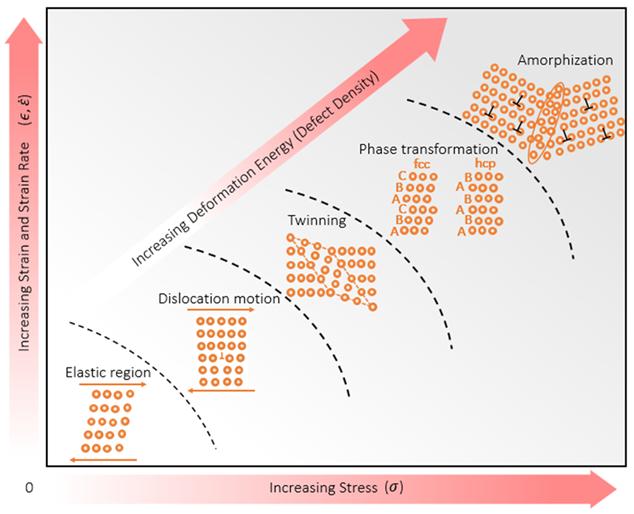
Using transmission electron microscopy, which can identify the arrangement of atoms, the researchers concluded that this amorphization is triggered by extreme deformation at high velocities. It is a new deformation mechanism that can increase the strength and toughness of these high entropy alloys even further.

The research is based on seminal work by Brian Cantor at the University of Oxford, and Jien-Wei Yeh at National Tsing Hua University in Taiwan. In 2004, both researchers led teams that reported the discovery of high-entropy alloys. This triggered a global search for new materials in the same class, driven by numerous potential applications in the transportation, energy, and defense industries.

“Significant new developments and discoveries in metal alloys are quite rare,” Meyers said.

###

Amorphization in extreme deformation of the CrMnFeCoNi high-entropy alloy

Shiteng Zhao and Robert O. Ritchie, University of California Berkeley; Zezhou Li, Wen Yang and Marc A. Meyers, University of California San Diego; Chaoyi Zhu, Carnegie Mellon University; Zhouran Zhang, David E. J. Armstrong and Patrick S. Grant, University of Oxford.

Media Contact
Ioana Patringenaru
[email protected]

Original Source

https://ucsdnews.ucsd.edu/pressrelease/amorphous_islands

Tags: Chemistry/Physics/Materials SciencesMaterialsNanotechnology/Micromachines
Share13Tweet8Share2ShareShareShare2

Related Posts

blank

Breakthrough in Environmental Cleanup: Scientists Develop Solar-Activated Biochar for Faster Remediation

February 7, 2026
blank

Cutting Costs: Making Hydrogen Fuel Cells More Affordable

February 6, 2026

Scientists Develop Hand-Held “Levitating” Time Crystals

February 6, 2026

Observing a Key Green-Energy Catalyst Dissolve Atom by Atom

February 6, 2026
Please login to join discussion

POPULAR NEWS

  • Robotic Ureteral Reconstruction: A Novel Approach

    Robotic Ureteral Reconstruction: A Novel Approach

    82 shares
    Share 33 Tweet 21
  • Digital Privacy: Health Data Control in Incarceration

    63 shares
    Share 25 Tweet 16
  • Study Reveals Lipid Accumulation in ME/CFS Cells

    57 shares
    Share 23 Tweet 14
  • Breakthrough in RNA Research Accelerates Medical Innovations Timeline

    53 shares
    Share 21 Tweet 13

About

We bring you the latest biotechnology news from best research centers and universities around the world. Check our website.

Follow us

Recent News

TPMT Expression Predictions Linked to Azathioprine Side Effects

Improving Dementia Care with Enhanced Activity Kits

Decoding Prostate Cancer Origins via snFLARE-seq, mxFRIZNGRND

Subscribe to Blog via Email

Enter your email address to subscribe to this blog and receive notifications of new posts by email.

Join 73 other subscribers
  • Contact Us

Bioengineer.org © Copyright 2023 All Rights Reserved.

Welcome Back!

Login to your account below

Forgotten Password?

Retrieve your password

Please enter your username or email address to reset your password.

Log In
No Result
View All Result
  • Homepages
    • Home Page 1
    • Home Page 2
  • News
  • National
  • Business
  • Health
  • Lifestyle
  • Science

Bioengineer.org © Copyright 2023 All Rights Reserved.