Credit: UT Southwestern Medical Center
DALLAS – Jan. 28, 2021 – Simulation can be a viable way to quickly evaluate and refine new medical guidelines and educate hospital staff in new procedures, a recent study from UT Southwestern’s Department of Pediatrics shows. The findings, published recently in the journal Pediatric Quality and Safety and originally shaped around new COVID-19-related pediatric resuscitation procedures at UTSW and Children’s Health, could eventually be used to help implement other types of guidelines at medical centers nationwide.
For decades, U.S. hospitals have used the same standard procedures for CPR and intubation. But when the COVID-19 pandemic began early last year, some details of these procedures needed to change, explains Blake E. Nichols, M.D., assistant professor of pediatrics at UTSW and a critical care physician at Children’s Health.
CPR and intubation are among procedures with the highest risk of spreading SARS-CoV-2, the virus that causes COVID-19, to health care workers. To help protect hospital staff, the American Heart Association (AHA) and the Society of Critical Care Medicine (SCCM) published recommendations in April 2020 for performing these procedures in the safest way possible on patients who are either positive for COVID-19 or suspected of having the virus.
Because children who are critically ill with COVID-19 make up just a fraction of the patient population, resuscitation is thankfully a rare event, says Nichols. But this rarity also makes it more difficult to create practical guidelines around these scenarios and educate hundreds of staff members who might be involved in these procedures at hospitals.
To evaluate best practices, Nichols and his colleagues performed a simulation using protocols that differ from the typical simulation events used for CPR or intubation training. The researchers started with new guidelines written by a UTSW/Children’s Health committee based on AHA and SCCM recommendations. These guidelines had distinct differences from the usual resuscitation procedures, including involving a medical team with significantly fewer members, making sure each member is fully secured in personal protective equipment (PPE) before entering a patient’s room, and ensuring the patient is enclosed in as much protective gear as possible to block the spray of infectious droplets.
Nichols pulled together a team of six individuals to participate in a resuscitation event. The team included pediatric intensive care physicians, nurses, respiratory therapists, and a writer from the guidelines committee.
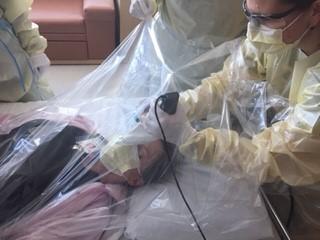
The team tested the guidelines in two different scenarios: In one, a mock patient posed under a plastic equipment drape that had been repurposed as a protective shield, confirming its utility for protecting health care workers during intubation and CPR and determining how to secure the shield around the patient for best results. In another, the team performed simulated intubation and CPR on a mannequin in a negative pressure room, with some team members outside the room passing off equipment and medications and others actively treating the simulated patient.
During the four-hour event, the team used rapid cycle deliberate practice (RCDP), an established medical simulation technique that allows the exercise to be stopped at any time to refine guidelines or correct mistakes. But unlike typical RCDP – in which just one member acts as an expert and is in charge of stopping the simulation for corrections – in this case every member of the team was considered an expert, allowing each to give input, make quick changes, and hone the guidelines. The simulation was recorded to create an educational video for other hospital staff.
Nichols says the team identified several problems with the proposed guidelines written for UTSW/Children’s Health. For example, the team found that two nurses were needed at the patient’s bedside during resuscitation – rather than just one as proposed in the guidelines – to prevent task overload. Additionally, communication needed to be refined since the PPE prevented team members from clearly seeing facial expressions or hearing commands as they normally would.
The video was used to educate nearly 300 staff members at UTSW and Children’s Health on the new guidelines within a few days, enabling a quick rollout, Nichols says. The entire procedure – from writing the guidelines to disseminating the video – took fewer than two weeks. He characterized that as an extremely fast turnaround necessitated by the pandemic.
“The COVID-19 pandemic required us to find new ways to provide the best care for our patients while protecting health care workers and educating these workers quickly on new procedures,” Nichols says. “We’ve shown that simulation provides a great opportunity to accomplish this goal.”
###
Other UTSW researchers who contributed to this study include Ali B.V. McMichael, A. Paige Davis Volk, Priya Bhaskar, and Cindy Darnell Bowens.
Media Contact
UT Southwestern Medical Center
[email protected]