• HOME
  • NEWS
  • EXPLORE
    • CAREER
      • Companies
      • Jobs
    • EVENTS
    • iGEM
      • News
      • Team
    • PHOTOS
    • VIDEO
    • WIKI
  • BLOG
  • COMMUNITY
    • FACEBOOK
    • INSTAGRAM
    • TWITTER
Monday, January 12, 2026
BIOENGINEER.ORG
No Result
View All Result
  • Login
  • HOME
  • NEWS
  • EXPLORE
    • CAREER
      • Companies
      • Jobs
        • Lecturer
        • PhD Studentship
        • Postdoc
        • Research Assistant
    • EVENTS
    • iGEM
      • News
      • Team
    • PHOTOS
    • VIDEO
    • WIKI
  • BLOG
  • COMMUNITY
    • FACEBOOK
    • INSTAGRAM
    • TWITTER
  • HOME
  • NEWS
  • EXPLORE
    • CAREER
      • Companies
      • Jobs
        • Lecturer
        • PhD Studentship
        • Postdoc
        • Research Assistant
    • EVENTS
    • iGEM
      • News
      • Team
    • PHOTOS
    • VIDEO
    • WIKI
  • BLOG
  • COMMUNITY
    • FACEBOOK
    • INSTAGRAM
    • TWITTER
No Result
View All Result
Bioengineer.org
No Result
View All Result
Home NEWS Science News Chemistry

Physicists develop record-breaking source for single photons

Bioengineer by Bioengineer
January 28, 2021
in Chemistry
Reading Time: 2 mins read
0
IMAGE
Share on FacebookShare on TwitterShare on LinkedinShare on RedditShare on Telegram

IMAGE

Credit: University of Basel, Department of Physics

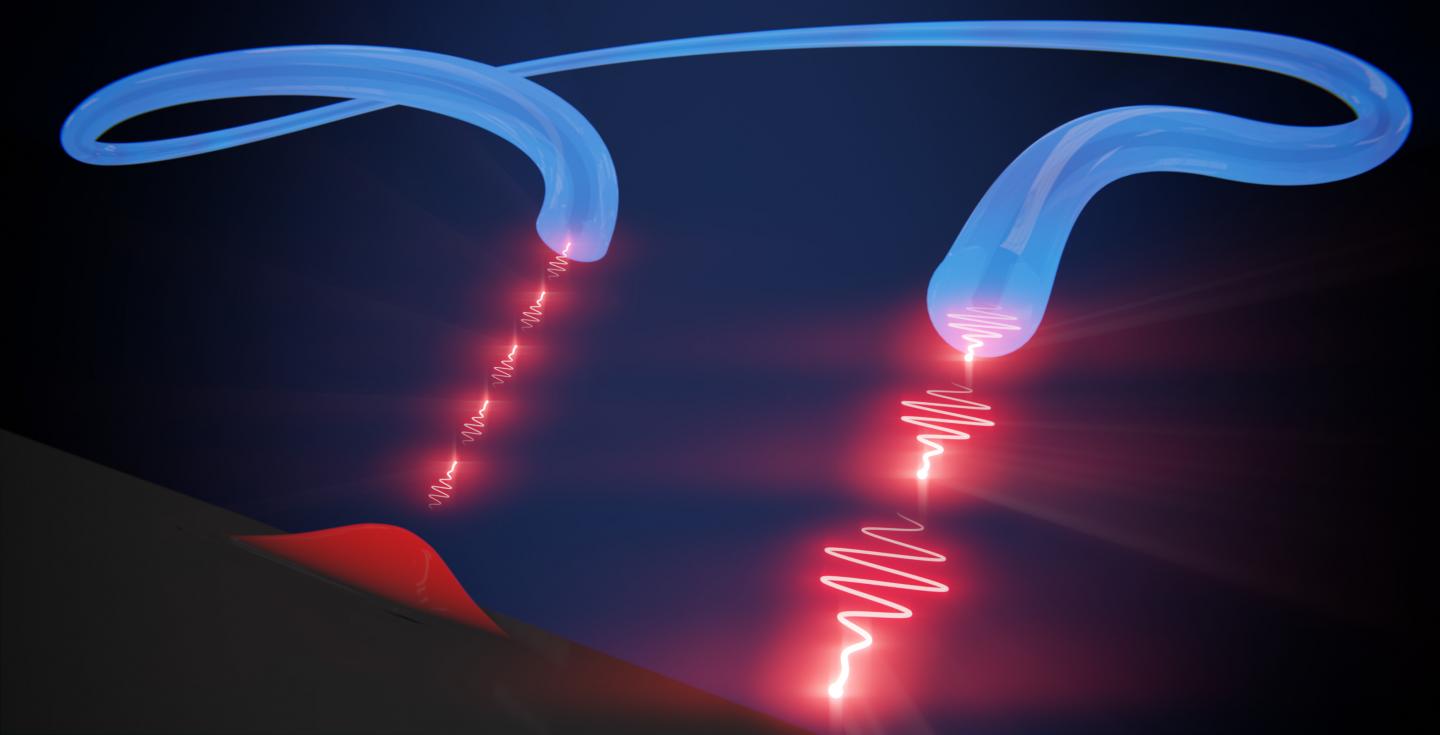
Researchers at the University of Basel and Ruhr University Bochum have developed a source of single photons that can produce billions of these quantum particles per second. With its record-breaking efficiency, the photon source represents a new and powerful building-block for quantum technologies.

Quantum cryptography promises absolutely secure communications. A key component here are strings of single photons. Information can be stored in the quantum states of these light particles and transmitted over long distances. In the future, remote quantum processors will communicate with each other via single photons. And perhaps the processor itself will use photons as quantum bits for computing.

A basic prerequisite for such applications, however, is an efficient source of single photons. A research team led by Professor Richard Warburton, Natasha Tomm and Dr. Alisa Javadi from the University of Basel, together with colleagues from Bochum, now reports in the journal Nature Nanotechnology on the development of a single-photon source that significantly surpasses previously known systems in terms of efficiency.

“Funnel” guides light particles

Each photon is created by exciting a single “artificial atom” (a quantum dot) inside a semiconductor. Usually, these photons leave the quantum dot in all possible directions and thus a large fraction is lost. In the photon source now presented, the researchers have solved this problem by positioning the quantum dot inside a “funnel” to send all photons in a specific direction.

The “funnel” is a novel micro-cavity that represents the real innovation of the research team: The micro-cavity captures almost all of the photons and then directs them into an optical fiber. The photons, each about two centimeters long, emerge at the end of an optical fiber.

The efficiency of the entire system – that is, the probability that excitation of the quantum dot actually results in a usable photon – is 57 percent, more than double that of previous single-photon sources. “This is a really special moment,” explains lead author Richard Warburton. “We’ve known for a year or two what’s possible in principle. Now we’ve succeeded in putting our ideas into practice.”

Enormous increase in computing power

The increase in efficiency has significant consequences, Warburton adds: “increasing the efficiency of single photon creation by a factor of two adds up to an overall improvement of a factor of one million for a string of, say, 20 photons. In the future, we’d like to make our single-photon source even better: We’d like to simplify it and pursue some of its myriad applications in quantum cryptography, quantum computing and other technologies.”

###

The project was funded by the Swiss National Science Foundation, the National Center of Competence in Research “Quantum Science and Technology” (NCCR QSIT), and the European Union under the Horizon2020 programme.

Media Contact
Richard Warburton
[email protected]

Related Journal Article

http://dx.doi.org/10.1038/s41565-020-00831-x

Tags: Chemistry/Physics/Materials SciencesTechnology/Engineering/Computer Science
Share13Tweet8Share2ShareShareShare2

Related Posts

blank

Advancing Alkene Chemistry: Homologative Difunctionalization Breakthrough

January 8, 2026
Biocompatible Ligand Enables Safe In-Cell Protein Arylation

Biocompatible Ligand Enables Safe In-Cell Protein Arylation

January 8, 2026

Monovalent Pseudo-Natural Products Boost IDO1 Degradation

January 7, 2026

Catalytic Enantioselective [1,2]-Wittig Rearrangement Breakthrough

January 7, 2026
Please login to join discussion

POPULAR NEWS

  • Enhancing Spiritual Care Education in Nursing Programs

    154 shares
    Share 62 Tweet 39
  • PTSD, Depression, Anxiety in Childhood Cancer Survivors, Parents

    146 shares
    Share 58 Tweet 37
  • Robotic Ureteral Reconstruction: A Novel Approach

    69 shares
    Share 28 Tweet 17
  • Study Reveals Lipid Accumulation in ME/CFS Cells

    48 shares
    Share 19 Tweet 12

About

We bring you the latest biotechnology news from best research centers and universities around the world. Check our website.

Follow us

Recent News

Surgery Type Influences Nutrition Duration in NEC Infants

Skin-Implanted Living Sensor Enables Long-Term Biomarker Tracking

Prenatal Metals, Genes Linked to Birth Size in Taiwan

Subscribe to Blog via Email

Enter your email address to subscribe to this blog and receive notifications of new posts by email.

Join 71 other subscribers
  • Contact Us

Bioengineer.org © Copyright 2023 All Rights Reserved.

Welcome Back!

Login to your account below

Forgotten Password?

Retrieve your password

Please enter your username or email address to reset your password.

Log In
No Result
View All Result
  • Homepages
    • Home Page 1
    • Home Page 2
  • News
  • National
  • Business
  • Health
  • Lifestyle
  • Science

Bioengineer.org © Copyright 2023 All Rights Reserved.