• HOME
  • NEWS
  • EXPLORE
    • CAREER
      • Companies
      • Jobs
    • EVENTS
    • iGEM
      • News
      • Team
    • PHOTOS
    • VIDEO
    • WIKI
  • BLOG
  • COMMUNITY
    • FACEBOOK
    • INSTAGRAM
    • TWITTER
Saturday, February 7, 2026
BIOENGINEER.ORG
No Result
View All Result
  • Login
  • HOME
  • NEWS
  • EXPLORE
    • CAREER
      • Companies
      • Jobs
        • Lecturer
        • PhD Studentship
        • Postdoc
        • Research Assistant
    • EVENTS
    • iGEM
      • News
      • Team
    • PHOTOS
    • VIDEO
    • WIKI
  • BLOG
  • COMMUNITY
    • FACEBOOK
    • INSTAGRAM
    • TWITTER
  • HOME
  • NEWS
  • EXPLORE
    • CAREER
      • Companies
      • Jobs
        • Lecturer
        • PhD Studentship
        • Postdoc
        • Research Assistant
    • EVENTS
    • iGEM
      • News
      • Team
    • PHOTOS
    • VIDEO
    • WIKI
  • BLOG
  • COMMUNITY
    • FACEBOOK
    • INSTAGRAM
    • TWITTER
No Result
View All Result
Bioengineer.org
No Result
View All Result
Home NEWS Science News

Focusing on field analysis

Bioengineer by Bioengineer
January 27, 2021
in Science News
Reading Time: 2 mins read
0
IMAGE
Share on FacebookShare on TwitterShare on LinkedinShare on RedditShare on Telegram

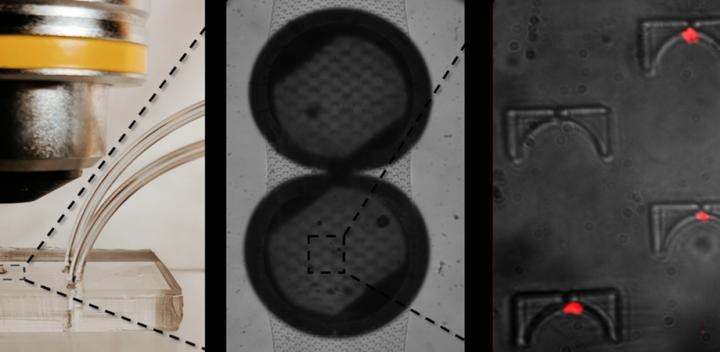
Microscopy systems using customized chips could expand on-site identification of pathogens
IMAGE

Credit: Viri et al.

The development of cost-efficient, portable microscopy units would greatly expand their use in remote field locations and in places with fewer resources, potentially leading to easier on-site analysis of contaminants such as E. coli in water sources as well as other practical applications.

Current microscopy systems, like those used to image micro-organisms, are expensive because they are optimized for maximum resolution and minimal deformation of the images the systems produce. But some situations do not require such optimization–for instance, simply detecting the presence of pathogens in water. One potential approach to developing a low-cost portable microscopy system is to use transparent microspheres in combination with affordable low-magnification objective lenses to increase image resolution and sensitivity.

A group of researchers from Ecole Polytechnique Federale de Lausanne (EPFL) in Switzerland published a study on such an assembly composed of barium titanate spheres that are partially embedded in thin polymeric membranes. The result of their work, appearing in SPIE’s new Journal of Optical Microsystems, is a proposed method to fabricate microfluidic chips using the assembly for enhanced detection of bacteria. Such customized chips with fluidic and optical components already integrated have many benefits when combined with portable low-end imagers for analyses at remote sites or in resource-limited regions.

“Cost reduction and portability are of benefit to the proliferation of analytical devices, especially in limited-resource contexts, and the integration of affordable micro-optical elements directly onto microfluidic chips can highly contribute to this,” said Martin Gijs, a professor at EPFL and an author of the published work.

The assembly’s ability to enhance bacteria detection paves the way for other applications friendly to use at remote sites. Additionally, the researchers revealed an opportunity to customize specific functional microfluidic elements. Such integrations could bring to fruition applications such as on-site antibiotic testing.

Given falling costs of the components and fabrication methods, the researchers’ proposed fabrication protocol could be adapted easily for a wide variety of microfluidic chips with integrated optical elements. Considered along with the lower cost of low-end imaging systems, the approach could sharply increase the use of such microscopy systems in low-resource locations for on-site analyses.

###

Read the open access paper: Vittorio Viri, Daniel Migliozzi, and Martin A.M. Gijs, “Integration of polymeric membrane/dielectric sphere assemblies in microfluidic chips for enhanced-contrast imaging with low-magnification systems,” J. Opt. Microsys. 1(1), 014001 (2021) doi 10.1117/1.JOM.1.1.014001.

Media Contact
Daneet Steffens
[email protected]

Original Source

https://spie.org/news/focusing-on-field-analysis?SSO=1

Related Journal Article

http://dx.doi.org/10.1117/1.JOM.1.1.014001

Tags: Biomedical/Environmental/Chemical EngineeringBiotechnologyMicrobiologyNanotechnology/MicromachinesOpticsResearch/DevelopmentTechnology/Engineering/Computer Science
Share12Tweet8Share2ShareShareShare2

Related Posts

Inflammasome Protein ASC Drives Pancreatic Cancer Metabolism

February 7, 2026

Phage-Antibiotic Combo Beats Resistant Peritoneal Infection

February 7, 2026

Boosting Remote Healthcare: Stepped-Wedge Trial Insights

February 7, 2026

Barriers and Boosters of Seniors’ Physical Activity in Karachi

February 7, 2026
Please login to join discussion

POPULAR NEWS

  • Robotic Ureteral Reconstruction: A Novel Approach

    Robotic Ureteral Reconstruction: A Novel Approach

    82 shares
    Share 33 Tweet 21
  • Digital Privacy: Health Data Control in Incarceration

    63 shares
    Share 25 Tweet 16
  • Study Reveals Lipid Accumulation in ME/CFS Cells

    57 shares
    Share 23 Tweet 14
  • Breakthrough in RNA Research Accelerates Medical Innovations Timeline

    53 shares
    Share 21 Tweet 13

About

We bring you the latest biotechnology news from best research centers and universities around the world. Check our website.

Follow us

Recent News

Inflammasome Protein ASC Drives Pancreatic Cancer Metabolism

Phage-Antibiotic Combo Beats Resistant Peritoneal Infection

Boosting Remote Healthcare: Stepped-Wedge Trial Insights

Subscribe to Blog via Email

Enter your email address to subscribe to this blog and receive notifications of new posts by email.

Join 73 other subscribers
  • Contact Us

Bioengineer.org © Copyright 2023 All Rights Reserved.

Welcome Back!

Login to your account below

Forgotten Password?

Retrieve your password

Please enter your username or email address to reset your password.

Log In
No Result
View All Result
  • Homepages
    • Home Page 1
    • Home Page 2
  • News
  • National
  • Business
  • Health
  • Lifestyle
  • Science

Bioengineer.org © Copyright 2023 All Rights Reserved.