The spread of quagga mussels across the American Great Lakes has transformed the supply of phosphorus – a key biological nutrient – to the ecosystem, according to research published this week in PNAS
Credit: Swenson College of Science & Engineering
The health of aquatic ecosystems depends on the supply of key nutrients, especially phosphorus. Too much phosphorus results in unwanted eutrophication, and much effort is spent on preventing phosphorus pollution of water bodies. In the World’s largest freshwater ecosystem, the North American Great Lakes, this control may have recently been lost to an invasive species. According to a new study, quagga mussels, which have spread across four of the five Great Lakes, have accumulated large amounts of phosphorus in their biomass, to the degree that their activities now regulate the supply of phosphorus to the ecosystem.
The invaders, native to the Ponto-Caspian region of Eurasia, appeared in the Great Lakes in the late 1980’s and by late 2000’s spread over vast areas of bottom sediments in all the lakes except Lake Superior. Their biological effects on the ecosystem have been well recognized, but effects on the chemical system remained uncertain.
Researchers from the Large Lakes Observatory, University of Minnesota Duluth analyzed the cycling of phosphorus in lakes Michigan, Huron, Erie, and Ontario. They used a mass-balance model, which they calibrated with measurements that the team performed on sediments and mussels at multiple locations in Lakes Michigan and Huron. The results show that the concentrations of phosphorus in the invaded Great Lakes are now regulated by the population dynamics of a single benthic species, the quagga mussel.
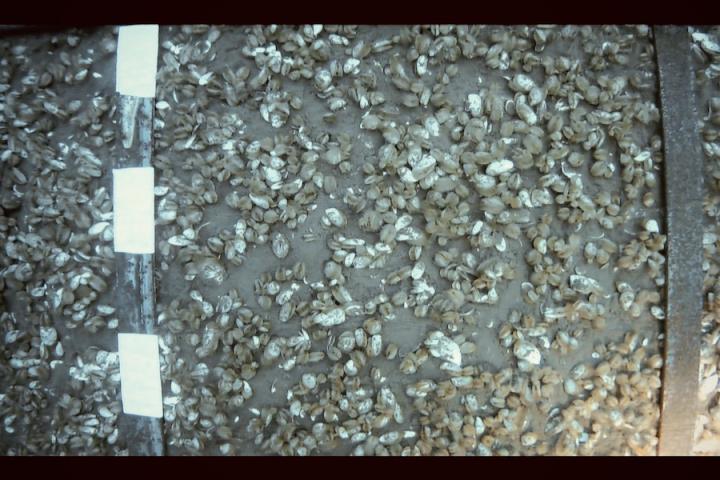
“Quagga mussels are small, hard-shelled organisms that live on the lake floor and filter the water, removing the phytoplankton and other small particles,” explains Ted Ozersky, an Associate Professor of Biology who co-led the study. By now they occupy the lake floor at densities often exceeding 10,000 individuals per square meter (6 mussels per square inch). “In terms of biomass, quagga mussels are the dominant life form in the Great Lakes,” says Sergei Katsev, a Professor at the Large Lakes Observatory who oversaw the geochemical aspects of the research.
By filtering organic particles from the lake water and recycling phosphorus back with their excretions and feces, mussels dramatically alter the natural rates at which phosphorus is exchanged between lake water and sediments. According to the study, the mussels in Lake Michigan are not only removing phosphorus from the water ten times faster than two decades ago, but are also resupplying the water column with eight times the amount of phosphorus that reaches the lake from the entire watershed. This kind of “internal loading” effectively decouples the dynamics of phosphorus from watershed inputs, leaving the system open to poorly predictable fluctuations when mussel populations increase or decrease.
“The mussels have short-circuited the normal pathways of the phosphorus cycling in the lakes,” explains the lead author Jiying Li, formerly a postdoctoral researcher at UMD and presently an Assistant Professor at the Hong Kong University of Science and Technology. “And the productivity in the lakes is now tied to what the mussel populations are doing.”
Growing populations of mussels are capable of absorbing large quantities of phosphorus from the water column, which is partly responsible for the water in the Great Lakes becoming clearer over recent years. In contrast, mortality events are capable of releasing large quantities of phosphorus back into the ecosystem. As a result, phosphorus becomes regulated by the dynamics of mussel populations and may respond only slowly to our efforts to control the runoff of phosphorus from the watershed.
The results of the study, which appears in this week’s PNAS, show that a single invasive species can have dramatic consequences for geochemical cycles even in the world’s largest aquatic ecosystems. According to the authors, this forewarns of similar ecological changes in mussel-invaded lakes across Europe and North America and calls for a new paradigm for managing aquatic ecosystems.
###
The study was funded by the US National Science Foundation grant OCE-1737368.
Media Contact
Brad Robideau
[email protected]
Original Source
https:/