KIT researchers develop biodegradable printed display — publication in the Journal of Materials Chemistry
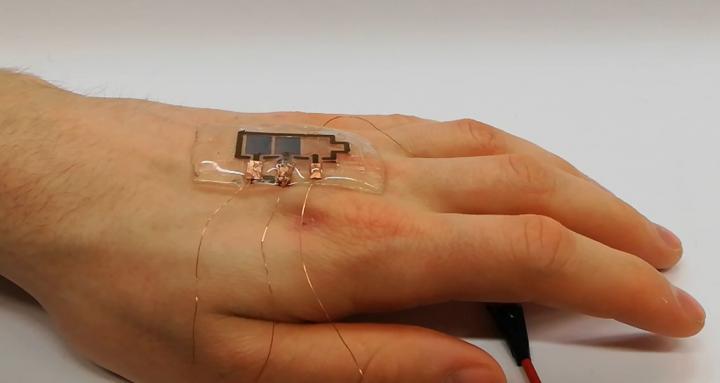
Credit: Manuel Pietsch, KIT
In the next years, increasing use of electronic devices in consumables and new technologies for the internet of things will increase the amount of electronic scrap. To save resources and minimize waste volumes, an eco-friendlier production and more sustainable lifecycle will be needed. Scientists of Karlsruhe Institute of Technology (KIT) have now been the first to produce displays, whose biodegradability has been checked and certified by an independent office. The results are reported in the Journal of Materials Chemistry. (DOI: 10.1039/d0tc04627b)
“For the first time, we have demonstrated that it is possible to produce sustainable displays that are largely based on natural materials with the help of industrially relevant production methods. After use, these displays are no electronic scrap, but can be composted. In combination with recycling and reuse, this might help minimize or completely prevent some of the environmental impacts of electronic scrap,” says Manuel Pietsch, first author of the publication and researcher of KIT’s Light Technology Institute (LTI), who is working at the Heidelberg InnovationLab.
Low Energy Consumption, Simple Component Architecture
Functioning of the display is based on the so-called electrochromic effect of the initial organic material. When voltage is applied, light absorption is modified and the material changes its color. Electrochromic displays have a low energy consumption and simple component architecture compared to commercially available displays, such as LED, LCD, and E-paper. Another advantage is that these displays can be produced by inkjet printing in a customized, inexpensive, and material-efficient way. Moreover, this process is suited for scaling with a high throughput. The materials used mainly are of natural origin or biocompatible. Sealing with gelatine makes the display adhesive and flexible, such that it can be worn directly on the skin.
Use in Medical Diagnostics and Food Packagings
The display is generally suited for short-lifecycle applications in various sectors. In medical diagnostics, for instance, where hygiene plays an important role, sensors and their indicators have to be cleaned or disposed of after use. The newly developed display will not be dumped as electronic scrap, but is compostable. It can also be used for quality monitoring in food packagings, where reuse is not permitted. Digital printing allows the displays to be adapted to persons or complex shapes without any expensive modification of the process. This reduces the consumption of resources.
“As far as we know, this is the first demonstration of a biodegradable display produced by inkjet printing. It will pave the way to sustainable innovations for other electronic components and to the production of eco-friendlier electronics,” says Gerardo Hernandez-Sosa, Head of LTI’s Printed Electronics Group at the Heidelberg InnovationLab.
###
Original Publication:
Manuel Pietsch, Stefan Schlisske, Martin Held, Noah Strobel, Alexander Wieczorek, Gerardo Hernandez-Sosa: Biodegradable inkjet-printed electrochromic display for sustainable short-lifecycle electronics. Journal of Materials Chemistry, DOI: 10.1039/d0tc04627b
https:/
Press contact:
Regina Link, Press Officer, Phone: +49 721 608-41158, Email: [email protected]
Being “The Research University in the Helmholtz Association”, KIT creates and imparts knowledge for the society and the environment. It is the objective to make significant contributions to the global challenges in the fields of energy, mobility, and information. For this, about 9,300 employees cooperate in a broad range of disciplines in natural sciences, engineering sciences, economics, and the humanities and social sciences. KIT prepares its 24,400 students for responsible tasks in society, industry, and science by offering research-based study programs. Innovation efforts at KIT build a bridge between important scientific findings and their application for the benefit of society, economic prosperity, and the preservation of our natural basis of life. KIT is one of the German universities of excellence.
Media Contact
Monika Landgraf
[email protected]
Original Source
https:/