Carnivore conservation can be improved by recognizing the divergences between scientific and Indigenous and Local Knowledge
Credit: ANDRÉ BRAGA JUNQUEIRA
Divergences between scientific and Indigenous and Local Knowledge can provide a better understanding of why local pastoralists may be willing, or not, to participate in conservation initiatives for carnivores, a study from University of Helsinki suggests.
Carnivore conservation has historically been based primarily on scientific knowledge using a wide range of sampling methods, such as camera trapping and track surveys. However, the estimates of these common ecological sampling methods can be quite uncertain and can depend on accessibility and geology, which is the case of many remote areas, such as Sibiloi National Park in Northern Kenya. For this reason, the inclusion of local communities that share land with carnivore species has been encouraged to enhance conservation.
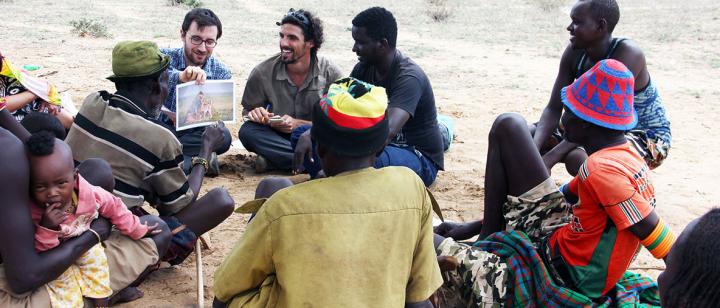
“I remember at the beginning of the project, many local pastoralists told me that they see cheetahs running at full speed. However, despite their accurate descriptions, I was very sceptical about it, as I did not have any image from my camera traps. A year later, I got a photograph of a cheetah holding a grant gazelle. On that day, I recognized that local pastoralists were correct all along. I acknowledged the importance of complementing scientific knowledge with Indigenous and Local Knowledge of local pastoralists that share their day-by-day lives next to those carnivores,” describes Miquel Torrents-Ticó, a PhD student from the Faculty of Biological and Environmental Sciences at the University of Helsinki, and the lead author of the study.
Indigenous and Local Knowledge is held by the local community and handed down through generations of continuous interactions with their environment. Traditionally, there has been a tendency to compare Indigenous and Local Knowledge with scientific knowledge looking especially for convergences to enhance wildlife management. However, there are also divergences between scientific and Indigenous and Local Knowledge that have been less studied because they can indicate stakeholders’ conflicts and can create challenges in effectively implementing conservation actions.
“The idea of this study was to complement information derived from camera trapping, track surveys and semi-structured interviews of local pastoralists acknowledging the divergences and explaining the unknown status of carnivores of the remote area of Sibiloi,” explains Miquel Torrents-Ticó.
Biodiversity loss of carnivores in Sibiloi is dramatic
Although in the past, Sibiloi National Park in Northern Kenya, had a rich mammalian fauna, nowadays, large animals have decreased sharply. Surprisingly, researchers know very little of this process of biodiversity loss due to Sibiloi’ isolated location, and it is not clear which species remain and how threatened they are.
“Many local Daasanach remember with joy the time when as children they used to see lions, leopards and cheetahs in Sibiloi,” says Torrents-Ticó. “However, our study shows a new reality of Sibiloi with some carnivore species already gone, such as lions, and many others present in very low numbers, such as cheetahs and striped hyaenas.”
In view of these results, the authors call for an urgent need for conservation actions before Sibiloi reaches a dramatic point of no return, where all carnivores will be extinct from the area.
The potential of complementation: Inclusive conservation with space for divergences
This study highlights that carnivores abundances obtained by complementing scientific and Indigenous and Local Knowledge can diverge, which can provide a wider picture of human-carnivores relationships and conservation contexts. For instance, carnivore species that have a high impact on local pastoralists’ livelihoods and safety can be perceived as being more abundant by local pastoralists, even if the abundances obtained from ecological scientific methods are low.
“Divergences between scientific and Indigenous and Local Knowledge due to high perceptions of risk and damage should be considered in order to take into account local pastoralists views, and in this way, make conservation more inclusive,” emphasizes Torrents-Ticó.
###
Media Contact
Miquel Torrents-Tico
[email protected]
Original Source
https:/
Related Journal Article
http://dx.