• HOME
  • NEWS
  • EXPLORE
    • CAREER
      • Companies
      • Jobs
    • EVENTS
    • iGEM
      • News
      • Team
    • PHOTOS
    • VIDEO
    • WIKI
  • BLOG
  • COMMUNITY
    • FACEBOOK
    • INSTAGRAM
    • TWITTER
Saturday, February 7, 2026
BIOENGINEER.ORG
No Result
View All Result
  • Login
  • HOME
  • NEWS
  • EXPLORE
    • CAREER
      • Companies
      • Jobs
        • Lecturer
        • PhD Studentship
        • Postdoc
        • Research Assistant
    • EVENTS
    • iGEM
      • News
      • Team
    • PHOTOS
    • VIDEO
    • WIKI
  • BLOG
  • COMMUNITY
    • FACEBOOK
    • INSTAGRAM
    • TWITTER
  • HOME
  • NEWS
  • EXPLORE
    • CAREER
      • Companies
      • Jobs
        • Lecturer
        • PhD Studentship
        • Postdoc
        • Research Assistant
    • EVENTS
    • iGEM
      • News
      • Team
    • PHOTOS
    • VIDEO
    • WIKI
  • BLOG
  • COMMUNITY
    • FACEBOOK
    • INSTAGRAM
    • TWITTER
No Result
View All Result
Bioengineer.org
No Result
View All Result
Home NEWS Science News

New process more efficiently recycles excess CO2 into fuel, study finds

Bioengineer by Bioengineer
January 11, 2021
in Science News
Reading Time: 2 mins read
0
IMAGE
Share on FacebookShare on TwitterShare on LinkedinShare on RedditShare on Telegram

IMAGE

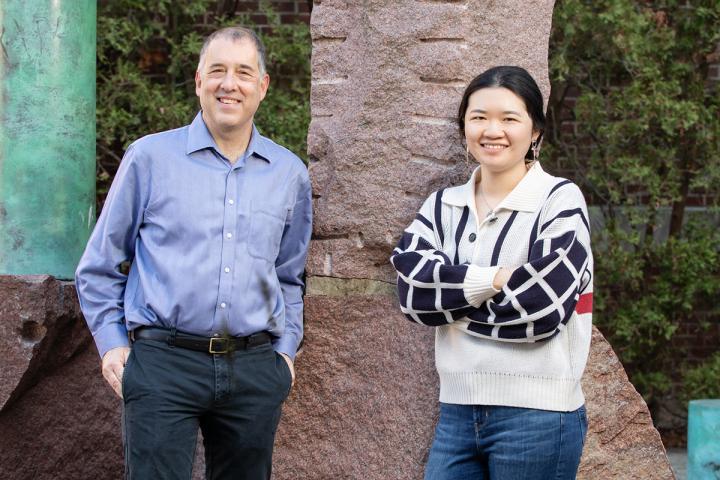
Credit: Photo by L. Brian Stauffer

CHAMPAIGN, Ill. — For years, researchers have worked to repurpose excess atmospheric carbon dioxide into new chemicals, fuels and other products traditionally made from hydrocarbons harvested from fossil fuels. The recent push to mitigate the climactic effects of greenhouse gases in the atmosphere has chemists on their toes to find the most efficient means possible. A new study introduces an electrochemical reaction, enhanced by polymers, to improve CO2-to-ethylene conversion efficiency over previous attempts.

The results of the study led by University of Illinois Urbana-Champaign chemistry professor Andrew Gewirth and graduate student Xinyi (Stephanie) Chen are published in the journal Natural Catalysis.

Allowing CO2 gas to flow through a reaction chamber fitted with copper electrodes and an electrolyte solution is the most common method researchers use to convert CO2 to useful carbon-containing chemicals, the study reports.

“Copper metal is highly selective toward the type of carbon that forms ethylene,” Gewirth said. “Different electrode materials will produce different chemicals like carbon monoxide instead of ethylene, or a mix of other carbon chemicals. What we have done in this study is to design a new kind of copper electrode that produces almost entirely ethylene.”

Previous studies have used other metals and molecular coatings on the electrode to help direct the CO2-reduction reactions, the study reports. However, these coatings are not stable, often break down during the reaction process and fall away from the electrodes.
“What we did differently in this study was to combine the copper ions and polymers into a solution, then apply that solution to an electrode, entraining the polymer into the copper,” Chen said.

In the lab, the team found that the new polymer-entrained electrodes were less likely to break down and produced more stable chemical intermediates, resulting in more efficient ethylene production. “We were able to convert CO2 to ethylene at a rate of up to 87%, depending on the electrolyte used,” Chen said. “That is up from previous reports of conversion rates of about 80% using other types of electrodes.”

“With the development of economic sources of electricity, combined with the increased interest in CO2-reduction technology, we see great potential for commercialization of this process,” Gewirth said.

###

The International Institute for Carbon Neutral Energy Research, Shell’s New Energy Research and Technology and the National Science Foundation supported this research.

Gewirth also is affiliated with the Materials Research Laboratory at Illinois.

Editor’s notes:

To reach Andrew Gewirth,
call 217-333-8329;
email [email protected]

The paper “Electrochemical CO2-to-ethylene conversion on
polyamine-incorporated Cu electrodes” is available online and from the U. of I. News Bureau. DOI: 10.1038/s41929-020-00547-0

Media Contact
Lois Yoksoulian
[email protected]

Original Source

https://blogs.illinois.edu/view/6367/1339203732

Related Journal Article

http://dx.doi.org/10.1038/s41929-020-00547-0

Tags: Chemistry/Physics/Materials SciencesEnergy/Fuel (non-petroleum)Industrial Engineering/ChemistryPolymer Chemistry
Share12Tweet8Share2ShareShareShare2

Related Posts

Phage-Antibiotic Combo Beats Resistant Peritoneal Infection

February 7, 2026

Boosting Remote Healthcare: Stepped-Wedge Trial Insights

February 7, 2026

Barriers and Boosters of Seniors’ Physical Activity in Karachi

February 7, 2026

Evaluating Pediatric Emergency Care Quality in Ethiopia

February 7, 2026
Please login to join discussion

POPULAR NEWS

  • Robotic Ureteral Reconstruction: A Novel Approach

    Robotic Ureteral Reconstruction: A Novel Approach

    82 shares
    Share 33 Tweet 21
  • Digital Privacy: Health Data Control in Incarceration

    63 shares
    Share 25 Tweet 16
  • Study Reveals Lipid Accumulation in ME/CFS Cells

    57 shares
    Share 23 Tweet 14
  • Breakthrough in RNA Research Accelerates Medical Innovations Timeline

    53 shares
    Share 21 Tweet 13

About

We bring you the latest biotechnology news from best research centers and universities around the world. Check our website.

Follow us

Recent News

Phage-Antibiotic Combo Beats Resistant Peritoneal Infection

Boosting Remote Healthcare: Stepped-Wedge Trial Insights

Barriers and Boosters of Seniors’ Physical Activity in Karachi

Subscribe to Blog via Email

Enter your email address to subscribe to this blog and receive notifications of new posts by email.

Join 73 other subscribers
  • Contact Us

Bioengineer.org © Copyright 2023 All Rights Reserved.

Welcome Back!

Login to your account below

Forgotten Password?

Retrieve your password

Please enter your username or email address to reset your password.

Log In
No Result
View All Result
  • Homepages
    • Home Page 1
    • Home Page 2
  • News
  • National
  • Business
  • Health
  • Lifestyle
  • Science

Bioengineer.org © Copyright 2023 All Rights Reserved.