• HOME
  • NEWS
  • EXPLORE
    • CAREER
      • Companies
      • Jobs
    • EVENTS
    • iGEM
      • News
      • Team
    • PHOTOS
    • VIDEO
    • WIKI
  • BLOG
  • COMMUNITY
    • FACEBOOK
    • INSTAGRAM
    • TWITTER
Saturday, February 7, 2026
BIOENGINEER.ORG
No Result
View All Result
  • Login
  • HOME
  • NEWS
  • EXPLORE
    • CAREER
      • Companies
      • Jobs
        • Lecturer
        • PhD Studentship
        • Postdoc
        • Research Assistant
    • EVENTS
    • iGEM
      • News
      • Team
    • PHOTOS
    • VIDEO
    • WIKI
  • BLOG
  • COMMUNITY
    • FACEBOOK
    • INSTAGRAM
    • TWITTER
  • HOME
  • NEWS
  • EXPLORE
    • CAREER
      • Companies
      • Jobs
        • Lecturer
        • PhD Studentship
        • Postdoc
        • Research Assistant
    • EVENTS
    • iGEM
      • News
      • Team
    • PHOTOS
    • VIDEO
    • WIKI
  • BLOG
  • COMMUNITY
    • FACEBOOK
    • INSTAGRAM
    • TWITTER
No Result
View All Result
Bioengineer.org
No Result
View All Result
Home NEWS Science News

Stem cells use a piston-like engine to ‘drive’ to their destinations

Bioengineer by Bioengineer
January 11, 2021
in Science News
Reading Time: 2 mins read
0
IMAGE
Share on FacebookShare on TwitterShare on LinkedinShare on RedditShare on Telegram

Researchers have discovered the surprising propulsion system that enables these regenerative cells to migrate through surrounding tissue to repair damage.
IMAGE

Credit: Hong-pyo Lee

Our bodies often dispatch stem cells to mend or replace biological damage, but how these repair agents make their way through dense tissue to arrive at the scene had been a mystery. “How stem cells squeeze through tissue openings a hundred to a thousand times smaller than themselves had been a perplexing question,” says Ovijit Chaudhuri, professor of mechanical engineering.

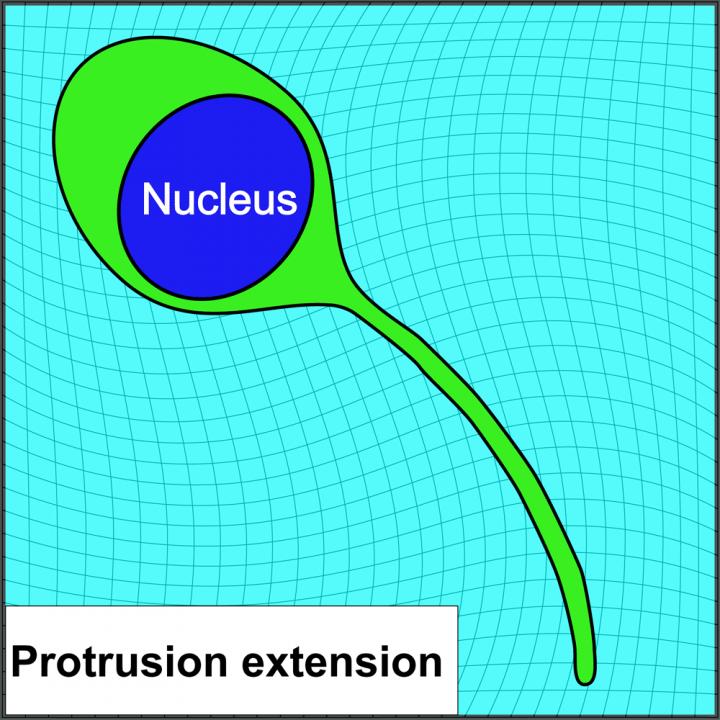
In an article published in the Jan. 8 edition of Science Advances, Chaudhuri and colleagues reveal that stem cells use their nucleus – a large, stiff organelle within the cell – as a means of propulsion.

Their discovery was surprising because scientists had thought cells would have particular difficulty forcing this big, stiff lump through tiny pores in surrounding tissue. Instead, they found that bone-marrow derived stem cells use the physical force generated by the nucleus to help bore through biological obstacles to reach fractures and help initiate healing. “Our finding presents a completely new understanding of how cells utilize the nucleus to generate mechanical force,” says Hong-Pyo Lee, the study’s first author, who recently graduated as a PhD student in mechanical engineering.

To arrive at this finding, the researchers extracted stem cells from bone marrow and used hydrogels to mimic the tissues that compose their biological environments. The researchers found that stem cells propel their nucleus into a needle-like protrusion that penetrates the physical barriers inside the body. The nucleus moves into the protrusion and, through a complex biochemical mechanism, inflates the protrusion like a balloon, creating an opening in the tissue wide enough for the entire stem cell to migrate through. The piston-like behavior of the nucleus, Chaudhuri says, is reminiscent of the action of a mechanical piston within the internal combustion engine of a car.

Their insight could help guide the design of biomaterial implants that would use stem cells for regenerative medicine. Chaudhuri notes that other stem cells, immune cells and cancer cells also migrate through surrounding tissue, suggesting fruitful areas for future research into whether these cells use the same propulsion system, knowledge that might be turned to therapeutic advantage.

“This is a beautiful example of how the principles of mechanical engineering can help us understand cellular behavior that affects health,” he says.

###

Ovijit Chaudhuri is an associate professor of mechanical engineering, member of Stanford Bio-X and faculty fellow of Stanford ChEM-H. Hong-Pyo Lee is co-founder of MEDIC Life Sciences. Other authors include Julie Chang and Kolade Adebowale of Stanford University, and Professor Vivek Shenoy and Dr. Farid Alisafaei of the University of Pennsylvania.

The work was funded by a CAREER award from the National Science Foundation to Chaudhuri.

Media Contact
Tom Abate
[email protected]

Related Journal Article

http://dx.doi.org/10.1126/sciadv.abd4058

Tags: BiologyBiotechnologyCell Biology
Share12Tweet8Share2ShareShareShare2

Related Posts

Evaluating Pediatric Emergency Care Quality in Ethiopia

February 7, 2026

TPMT Expression Predictions Linked to Azathioprine Side Effects

February 7, 2026

Improving Dementia Care with Enhanced Activity Kits

February 7, 2026

Decoding Prostate Cancer Origins via snFLARE-seq, mxFRIZNGRND

February 7, 2026
Please login to join discussion

POPULAR NEWS

  • Robotic Ureteral Reconstruction: A Novel Approach

    Robotic Ureteral Reconstruction: A Novel Approach

    82 shares
    Share 33 Tweet 21
  • Digital Privacy: Health Data Control in Incarceration

    63 shares
    Share 25 Tweet 16
  • Study Reveals Lipid Accumulation in ME/CFS Cells

    57 shares
    Share 23 Tweet 14
  • Breakthrough in RNA Research Accelerates Medical Innovations Timeline

    53 shares
    Share 21 Tweet 13

About

We bring you the latest biotechnology news from best research centers and universities around the world. Check our website.

Follow us

Recent News

Evaluating Pediatric Emergency Care Quality in Ethiopia

TPMT Expression Predictions Linked to Azathioprine Side Effects

Improving Dementia Care with Enhanced Activity Kits

Subscribe to Blog via Email

Success! An email was just sent to confirm your subscription. Please find the email now and click 'Confirm' to start subscribing.

Join 73 other subscribers
  • Contact Us

Bioengineer.org © Copyright 2023 All Rights Reserved.

Welcome Back!

Login to your account below

Forgotten Password?

Retrieve your password

Please enter your username or email address to reset your password.

Log In
No Result
View All Result
  • Homepages
    • Home Page 1
    • Home Page 2
  • News
  • National
  • Business
  • Health
  • Lifestyle
  • Science

Bioengineer.org © Copyright 2023 All Rights Reserved.