Materials scientist from the University of Jena, Germany receives renewed support from the European Research Council
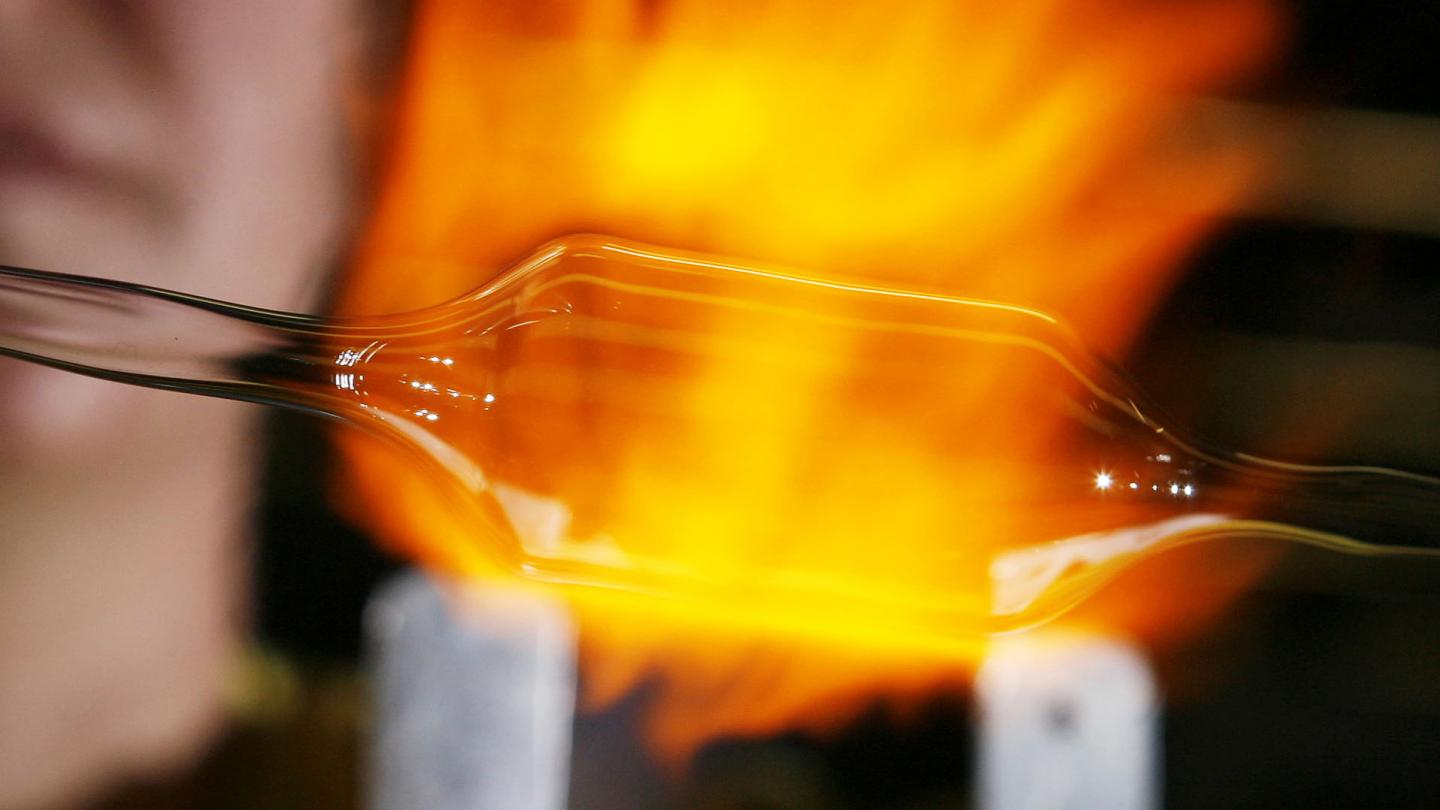
Credit: Jens Meyer/University of Jena
A materials scientist at Friedrich Schiller University Jena, Germany has been awarded a prestigious “ERC Proof of Concept Grant” from the European Research Council to further develop and refine a process that enables thermal toughening of very thin glass.
For decades, the process of thermal tempering has played a major role in increasing the strength of glass and thus guaranteeing greater durability. With this technique, conventional glass sheets are strengthened in a simple and highly efficient way. This has made it possible to manufacture numerous glass products that are taken for granted today. Thermally strengthened glass can be found covering solar modules, as safety glazing or even in shower partitions. As another example, the well-established process enables the production of automotive windows that break into small granular pieces in a controlled manner in the event of an accident or other damage, thus protecting people from injuries caused by sharp-edged shards of glass.
However, thermal tempering is subject to a range of technological limitations. In particular, it can only be used for glass products with a certain minimum thickness. For glass sheets or substrates, this is about two millimetres. Nowadays, however, much thinner glass often plays an important role in modern glass products. Thin-walled glasses not only enable significant savings in material and weight but they can also be bent or even rolled. Material scientists at Friedrich Schiller University Jena have now refined a process for this purpose that could remove the limitations on thermal strengthening of glass with thicknesses in the millimetre range and thus make the process applicable to completely new types of glass products.
Gradient creates tension
“To thermally temper the glass, it is usually first heated to over 600 degrees Celsius and then rapidly cooled – usually by blowing cold air on it,” explains Prof. Lothar Wondraczek, who is leading the project at the Chair of Glass Chemistry. “This creates a significant difference in the cooling rate between the surface and the interior of the glass body.” This gradient subsequently leads to a permanent surface compressive stress, which is opposed by a tensile stress in the interior. The interaction between the two stresses produces the special properties of thermally toughened glass.
The decisive factor for the process is how quickly the heat can be extracted from the heated glass via its surface. This in turn depends on two factors: the thermal conductivity of the glass and the heat transfer coefficient – the speed at which the heat is released into the environment. While the thermal conductivity is directly linked to the chemical composition of the material and cannot be changed without moving away from conventional glass chemistries, it is definitely possible to influence how quickly the glass cools.
Faster cooling of thin glass types
It was precisely this parameter that the materials scientists in Jena focused on to make thermal strengthening applicable to thin glass. “If you use air to cool glass that is less than two millimetres thick, the heat is usually distributed internally just as quickly as it is dissipated. In consequence, there is no gradient and thus no stress,” explains Wondraczek. “For this reason, we developed a tempering process in which the glass is not tempered in air but in a liquid coolant.” One challenge was to find suitable coolants that are already liquid at near room temperature, but do not evaporate at temperatures well above 800 degrees Celsius.
This allows the thermal tempering process to be extended to particularly thin glass as well as to unconventionally shaped glass. “In preliminary studies, we have been able to show that the process is also widely applicable,” says Wondraczek. “Therefore, we now want to put it into practice.” On the one hand, this process could replace more complex, expensive, and environmentally harmful methods for improving the strength of thin glass types. On the other hand, the use of glass as a material could be expanded, for example in electrical engineering or also for simple everyday objects such as certain typed of packaging, medical injectors or drinking straws.
###
Media Contact
Prof. Dr-Ing. Lothar Wondraczek
[email protected]
Original Source
https:/