• HOME
  • NEWS
  • EXPLORE
    • CAREER
      • Companies
      • Jobs
    • EVENTS
    • iGEM
      • News
      • Team
    • PHOTOS
    • VIDEO
    • WIKI
  • BLOG
  • COMMUNITY
    • FACEBOOK
    • INSTAGRAM
    • TWITTER
Saturday, February 7, 2026
BIOENGINEER.ORG
No Result
View All Result
  • Login
  • HOME
  • NEWS
  • EXPLORE
    • CAREER
      • Companies
      • Jobs
        • Lecturer
        • PhD Studentship
        • Postdoc
        • Research Assistant
    • EVENTS
    • iGEM
      • News
      • Team
    • PHOTOS
    • VIDEO
    • WIKI
  • BLOG
  • COMMUNITY
    • FACEBOOK
    • INSTAGRAM
    • TWITTER
  • HOME
  • NEWS
  • EXPLORE
    • CAREER
      • Companies
      • Jobs
        • Lecturer
        • PhD Studentship
        • Postdoc
        • Research Assistant
    • EVENTS
    • iGEM
      • News
      • Team
    • PHOTOS
    • VIDEO
    • WIKI
  • BLOG
  • COMMUNITY
    • FACEBOOK
    • INSTAGRAM
    • TWITTER
No Result
View All Result
Bioengineer.org
No Result
View All Result
Home NEWS Science News

Semper floats! Marines use sensor buoys to better understand ocean battlespace

Bioengineer by Bioengineer
December 22, 2020
in Science News
Reading Time: 2 mins read
0
IMAGE
Share on FacebookShare on TwitterShare on LinkedinShare on RedditShare on Telegram

IMAGE

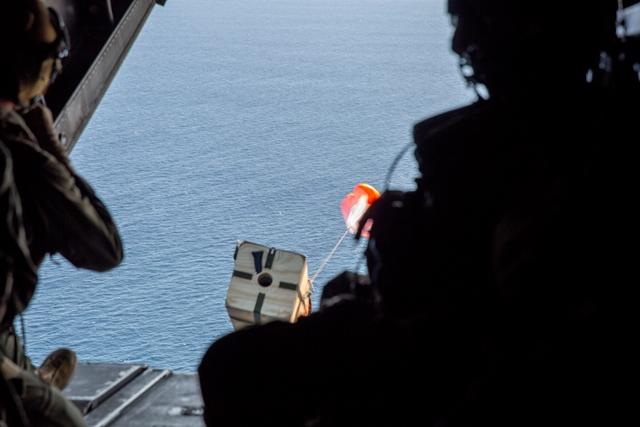
Credit: (U.S. Marine Corps photo by Lance Cpl. Juan Anaya)

ARLINGTON, Va.–Flying several thousand feet above the Pacific Ocean, an air crew and a scientist from Woods Hole Oceanographic Institution tossed cylindrical floats from a U.S. Marine Corps MV-22 Osprey aircraft. Packed with data-gathering sensors to measure underwater conditions, the floats fell fast before orange parachutes opened to ease splashdown.

The action marked the first time such sensor-laden profiling floats, also called buoys, were deployed from a Marine Corps aircraft. This will increase naval knowledge of the ocean battlespace–including the littorals (areas of water close to shoreline), which are crucial to expeditionary and amphibious operations.

The Office of Naval Research (ONR) sponsored the effort, which involved Woods Hole and the Naval Oceanographic Office (NAVO) and occurred during this year’s Trident Warrior, a large-scale fleet exercise conducted by the Navy and Marine Corps to test technology and tactics.

NAVO collects global oceanographic and meteorological data to create ocean-prediction models to support naval operations.

“Deployment of these floats creates a more vivid picture of how the ocean and atmosphere interact, including wind speed and water temperature and salinity,” said Dr. Scott Harper, a program officer in ONR’s Ocean Battlespace and Expeditionary Access Department. “They’re critical for compiling an abundance of data for the most up-to-date prediction models.”

When dropped, the floats–which contain sophisticated scientific instruments–sink to a predetermined depth, rise to the surface, transmit data via satellite to NAVO and descend again. They do this repeatedly over multiple months.

Dr. Steven Jayne, a Woods Hole senior scientist, oversaw the float deployment, which originally was supposed to occur during this summer’s Rim of the Pacific exercise–RIMPAC–the world’s largest international maritime warfare exercise. Unfortunately, because of the COVID-19 pandemic, RIMPAC dramatically scaled down its scope, and Jayne and his team had to wait until Trident Warrior in the fall to conduct their research.

Traditionally, oceanographic sensor floats are deployed in deeper water from naval ships or aircraft like C-130s or P-3s. But greater naval focus on the littorals in recent years sparked discussions about using Marine Corps assets like the Osprey.

“Ospreys go wherever Marines go,” said Jayne. “Using them for sensor deployment expands both the versatility of naval oceanographic tools and the expeditionary capabilities of the Marine Corps.”

The sensor floats will drift for several months and provide real-time data to NAVO, which is working with the Naval Research Laboratory to create ocean-prediction models for the Navy and Marine Corps.

In addition to the littorals, ONR sponsors Jayne’s research using sensor floats for hurricane forecasting and studying polar conditions.

###

Media Contact
David Smalley
[email protected]

Original Source

https://www.onr.navy.mil/Media-Center/Press-Releases/2020/ONR-Trident-Warrior-Sensor-Buoys

Tags: Atmospheric ChemistryAtmospheric ScienceComputer ScienceOceanographyResearch/DevelopmentTemperature-Dependent PhenomenaWeather/Storms
Share12Tweet8Share2ShareShareShare2

Related Posts

Personalized Guide to Understanding and Reducing Chemicals

February 7, 2026

Inflammasome Protein ASC Drives Pancreatic Cancer Metabolism

February 7, 2026

Phage-Antibiotic Combo Beats Resistant Peritoneal Infection

February 7, 2026

Boosting Remote Healthcare: Stepped-Wedge Trial Insights

February 7, 2026
Please login to join discussion

POPULAR NEWS

  • Robotic Ureteral Reconstruction: A Novel Approach

    Robotic Ureteral Reconstruction: A Novel Approach

    82 shares
    Share 33 Tweet 21
  • Digital Privacy: Health Data Control in Incarceration

    63 shares
    Share 25 Tweet 16
  • Study Reveals Lipid Accumulation in ME/CFS Cells

    57 shares
    Share 23 Tweet 14
  • Breakthrough in RNA Research Accelerates Medical Innovations Timeline

    53 shares
    Share 21 Tweet 13

About

We bring you the latest biotechnology news from best research centers and universities around the world. Check our website.

Follow us

Recent News

Personalized Guide to Understanding and Reducing Chemicals

Inflammasome Protein ASC Drives Pancreatic Cancer Metabolism

Phage-Antibiotic Combo Beats Resistant Peritoneal Infection

Subscribe to Blog via Email

Enter your email address to subscribe to this blog and receive notifications of new posts by email.

Join 73 other subscribers
  • Contact Us

Bioengineer.org © Copyright 2023 All Rights Reserved.

Welcome Back!

Login to your account below

Forgotten Password?

Retrieve your password

Please enter your username or email address to reset your password.

Log In
No Result
View All Result
  • Homepages
    • Home Page 1
    • Home Page 2
  • News
  • National
  • Business
  • Health
  • Lifestyle
  • Science

Bioengineer.org © Copyright 2023 All Rights Reserved.