Credit: RUDN University
A team of scientists from RUDN University and the Dokuchyaev Soil Science Institute developed a method for identifying the color of soil at different depths and the structure of soil profile using ground-penetrating radar. With this methodology, scientists can identify the chemical composition of the soil and classify it for potential use in construction, agriculture, or mining without digging soil sections. The results of the study were published in the Eurasian Soil Science journal.
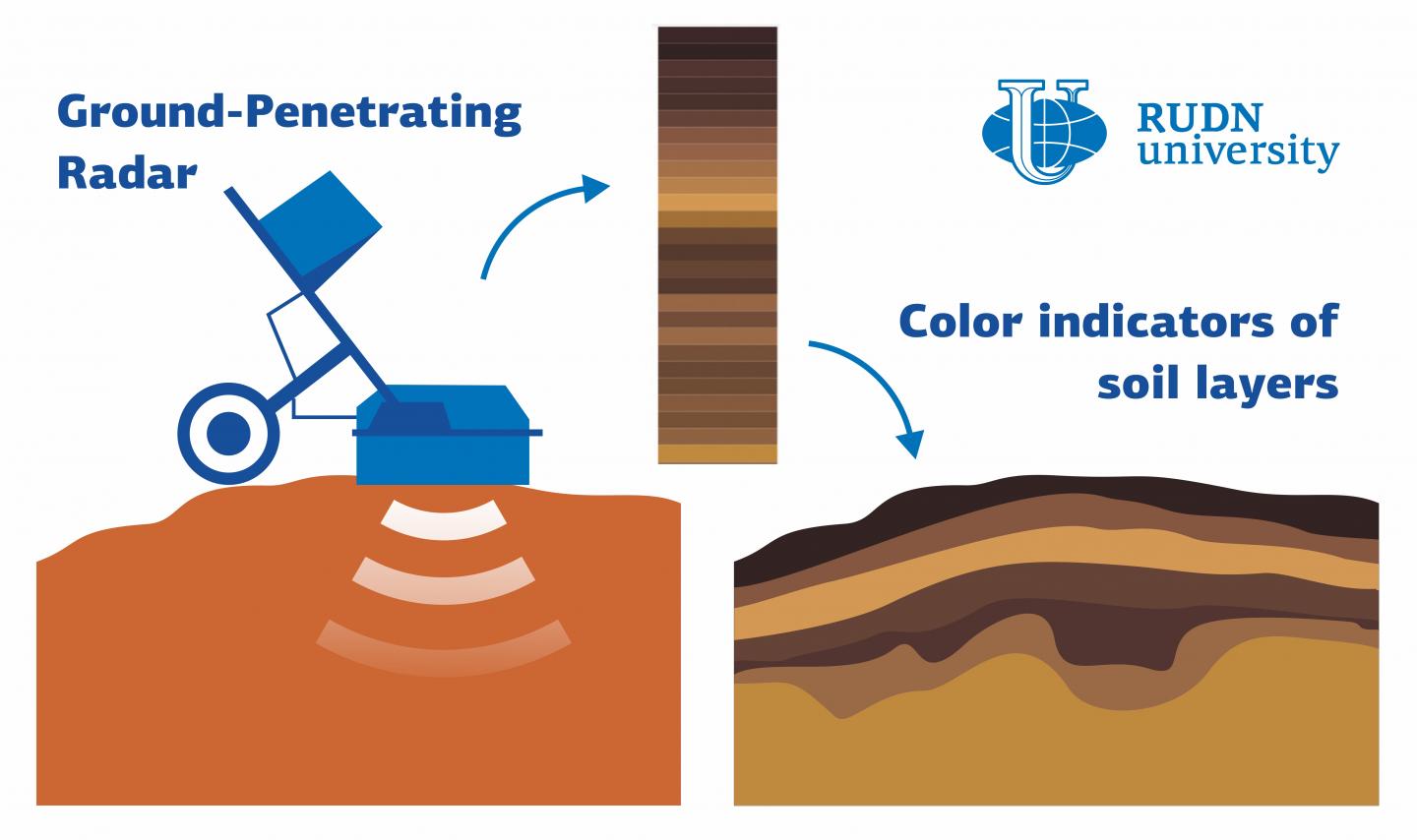
Color is one of the main indicators of soil properties. Based on it, a specialist can identify the type of soil, humus content, soil density, humidity, salinity, and so on. For example, black soil is rich in humus, and soils with increased iron content usually have a reddish hue. To analyze the color of the soil, scientists have to dig a soil section which is quite a labor-intensive process. A team of scientists from RUDN University together with their colleagues from the Dokuchyaev Soil Science Institute suggested using ground-penetrating radar to determine the color of the soil at different depths. A GPR sends electromagnetic waves to the soil and registers a reflected signal.
“Color is one of the main properties of soils that has been used for their classification for a long time. That is why many names of soils are associated with color. Moreover, color is an integral indicator of many other characteristics of soils. Theoretically, this parameter could be measured with GPR. We wanted to confirm a correlation between the colors of soil layers and GPR profiling data,” said Prof. Igor Savin, an Academician of the Russian Academy of Sciences and a Ph.D. in Agricultural Sciences from the Faculty of Ecology, RUDN University.
The team conducted an experiment in Kamennaya Steppe (Voronezh Region) because this area is known for a large variety of soil types and conditions. The scientists chose seven sites and probed the soils there with ground-penetrating radar. They also took 30 soil samples from each site: one from each 10 cm deep layer down to the depth of 3 m. The samples were dried and ground to identify the color. To do so, the team analyzed their reflective capacity that was averaged to three wavelength ranges: red (610-700 nm), green (520-540 nm), and blue (450-475 nm). After that, the team compared the radar readings with the colors of soil samples and developed a correlation model. The colors calculated with the use of the model matched the actual ones in 80% of cases. Therefore, the new method can be used to determine soil color on other sites in the territory of the study without digging soil sections.
Currently, the model is only applicable to the territory of Kamennaya Steppe because it was calibrated based on the samples collected there. In the future, the team hopes to adapt it to other areas.
“Our models cannot be used in territories with different soil covering. However, it is not a disadvantage, but rather a peculiarity of our method. To secure modeling accuracy, the model should include information about soil colors that are typical for the area of the study. In the initial stages, control soil sections would still have to be made using traditional methods. However, as soon as we accumulate enough field data, we would be able to eliminate this step, and no digging would be required to identify soil color at any depth,” added Prof. Igor Savin from RUDN University.
###
Media Contact
Valeriya Antonova
[email protected]
Related Journal Article
http://dx.