• HOME
  • NEWS
  • EXPLORE
    • CAREER
      • Companies
      • Jobs
    • EVENTS
    • iGEM
      • News
      • Team
    • PHOTOS
    • VIDEO
    • WIKI
  • BLOG
  • COMMUNITY
    • FACEBOOK
    • INSTAGRAM
    • TWITTER
Thursday, July 2, 2026
BIOENGINEER.ORG
No Result
View All Result
  • Login
  • HOME
  • NEWS
  • EXPLORE
    • CAREER
      • Companies
      • Jobs
        • Lecturer
        • PhD Studentship
        • Postdoc
        • Research Assistant
    • EVENTS
    • iGEM
      • News
      • Team
    • PHOTOS
    • VIDEO
    • WIKI
  • BLOG
  • COMMUNITY
    • FACEBOOK
    • INSTAGRAM
    • TWITTER
  • HOME
  • NEWS
  • EXPLORE
    • CAREER
      • Companies
      • Jobs
        • Lecturer
        • PhD Studentship
        • Postdoc
        • Research Assistant
    • EVENTS
    • iGEM
      • News
      • Team
    • PHOTOS
    • VIDEO
    • WIKI
  • BLOG
  • COMMUNITY
    • FACEBOOK
    • INSTAGRAM
    • TWITTER
No Result
View All Result
Bioengineer.org
No Result
View All Result
Home NEWS Science News Chemistry

Controlling cardiac waves with light to better understand abnormally rapid heart rhythms

Bioengineer by Bioengineer
December 22, 2020
in Chemistry
Reading Time: 3 mins read
0
IMAGE
Share on FacebookShare on TwitterShare on LinkedinShare on RedditShare on Telegram

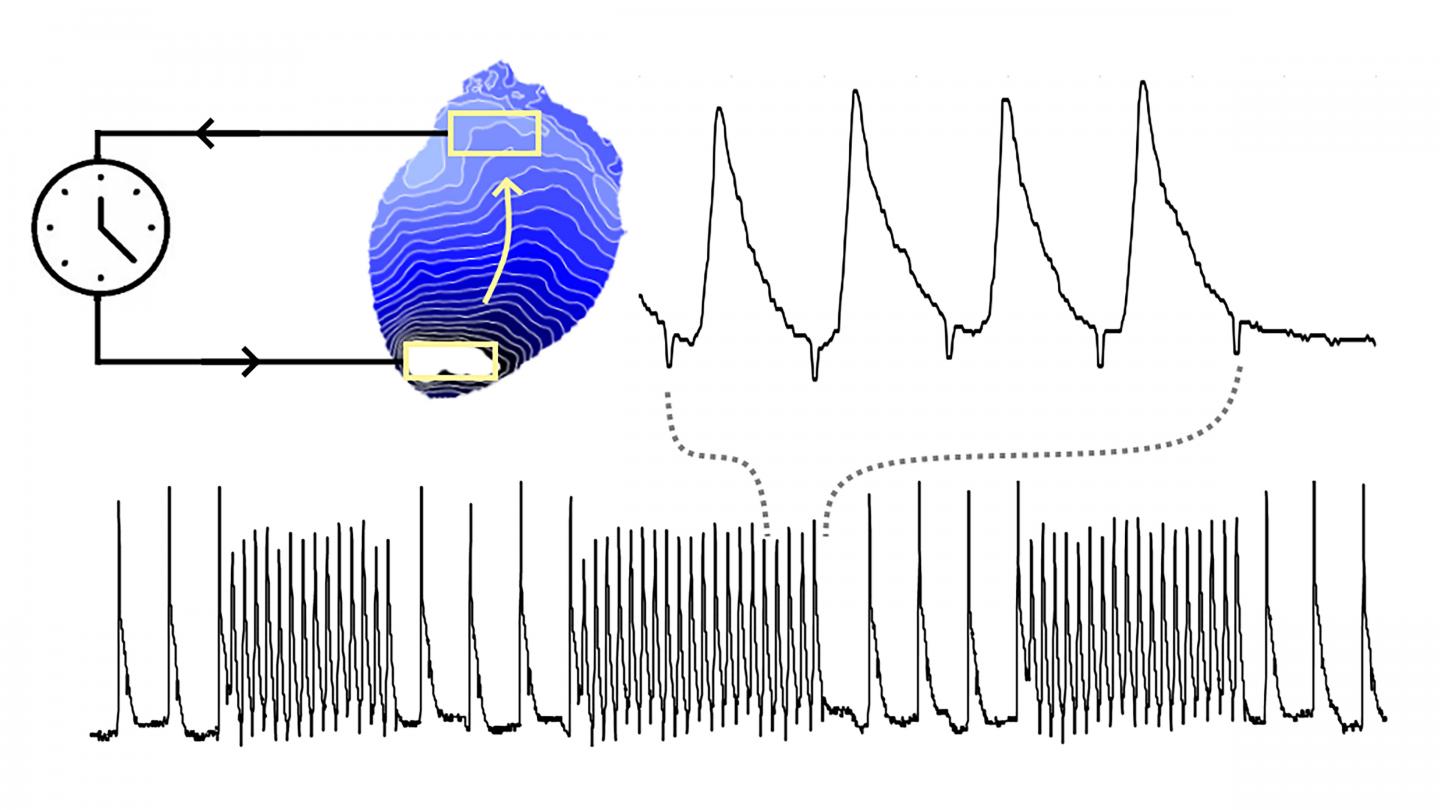
Investigation of abnormally rapid heart rhythms in mice illustrates that the heart has intrinsic mechanisms that exist that lead to the self-termination of such rapid rhythms
IMAGE

Controllable…
view more 

WASHINGTON, December 22, 2020 — Over 300,000 people die each year in the U.S. due to sudden cardiac death. In many cases, sudden cardiac death is caused by abnormally rapid heart rhythms called tachycardias, which means the heart cannot pump adequate blood to the body.

In Chaos, by AIP Publishing, researchers use mice to study tachycardias and find there are intrinsic mechanisms that exist in heart tissue that they hypothesize lead to the self-termination of rapid cardiac rhythm.

“A tachycardia is a heartbeat continuously activating the heart, like a toy train endlessly going around a circular track,” said co-author Leon Glass.

The researchers modeled tachycardias in a mouse heart by detecting the wave in one part of the heart and stimulating another part at a fixed time later. They discovered that small changes in the delay lead to either endless circulation or self-termination of the cardiac waves.

During the circulation of the wave and before the termination, there was often an alternation of wave characteristics, such as one cycle proceeding faster and the next being slower. The researchers used optogenetics, a set of tools that allows them to stimulate and control cardiac waves with light, rather than by standard methods of electrical stimulation.

Alternating dynamics, called alternans, in the heart have been associated in the past with initiation of tachycardias. Consequently, efforts have been made to eliminate or reduce alternans.

“Paradoxically, we find that alternans can also facilitate self-termination of tachycardia and might be beneficial,” said co-author Gil Bub.

The optical, real-time feedback control system can be used for a wide variety of innovative experiments beyond this specific research.

“We could extend the work to study control of other geometries of abnormal cardiac wave propagation such as spiral waves. It can also be applied to the nervous system where there are abnormal bursting rhythms such as epilepsy,” said co-author Leonardo Sacconi.

The team plans to build on this research in several ways, including carrying out similar experiments in cardiac cell culture and investigating how drugs impact the stability of tachycardias, characterizing the molecular and ionic mechanisms facilitating self-termination of the tachycardia, and modifying the magnitude of the alternans to analyze its role in the self-termination of tachycardia.

###

The article, “Universal mechanisms for self-termination of rapid cardiac rhythm,” is authored by Leon Glass, Valentina Biasci, Leonardo Sacconi, Eric N. Cytrynbaum, Daniël A. Pijnappels, Tim De Coster, Alvin Shrier, and Gil Bub. The article will appear in Chaos on Dec. 22, 2020 (DOI: 10.1063/5.0033813). After that date, it can be accessed at https://aip.scitation.org/doi/10.1063/5.0033813.

ABOUT THE JOURNAL

Chaos is devoted to increasing the understanding of nonlinear phenomena in all areas of science and engineering and describing their manifestations in a manner comprehensible to researchers from a broad spectrum of disciplines. See https://aip.scitation.org/journal/cha.

Media Contact
Larry Frum
[email protected]

Related Journal Article

http://dx.doi.org/10.1063/5.0033813

Tags: BiologyCardiologyChemistry/Physics/Materials SciencesMedicine/Health
Share13Tweet8Share2ShareShareShare2

Related Posts

Graz University of Technology Deciphers the Structural Secrets of MOF Thin Films — Chemistry

Graz University of Technology Deciphers the Structural Secrets of MOF Thin Films

July 2, 2026
Breaking Thermodynamic Limits: Wavelength-Driven Catalysis Advances Ammonia Synthesis — Chemistry

Breaking Thermodynamic Limits: Wavelength-Driven Catalysis Advances Ammonia Synthesis

July 2, 2026

From Quantum Mechanics to AI-Powered Materials Discovery: MARVEL Marks 12 Years of Transforming Computational Science

July 2, 2026

Djire Recognized with National Award for Outstanding Contributions in Research and Teaching

July 2, 2026
Please login to join discussion

POPULAR NEWS

  • Detection of EDCs in Breast Milk and Infant Urine Up to Six Months Highlights Early Exposure Risks

    77 shares
    Share 31 Tweet 19
  • Saying Goodbye to PGY-6: Pediatric Fellowship Realities

    103 shares
    Share 41 Tweet 26
  • New Drug Candidate Developed at McMaster Shows Potential for Treating Brain Cancer

    58 shares
    Share 23 Tweet 15
  • KTU Researchers Explore Ultrasound’s Role in Enhancing Blood Flow Beyond Diagnostics

    53 shares
    Share 21 Tweet 13

About

BIOENGINEER.ORG

We bring you the latest biotechnology news from best research centers and universities around the world. Check our website.

Follow us

Recent News

Steatosis Drives Liver Metastasis Diversity in CRC

Unlocking the Mysteries of Alzheimer’s Disease

Pensoft Introduces New Peer-Reviewed Journal of Regeneration to Advance Restorative Biology Across Species

Subscribe to Blog via Email

Enter your email address to subscribe to this blog and receive notifications of new posts by email.

Join 83 other subscribers
  • Contact Us

Bioengineer.org © Copyright 2023 All Rights Reserved.

Welcome Back!

Login to your account below

Forgotten Password?

Retrieve your password

Please enter your username or email address to reset your password.

Log In
No Result
View All Result
  • Homepages
    • Home Page 1
    • Home Page 2
  • News
  • National
  • Business
  • Health
  • Lifestyle
  • Science

Bioengineer.org © Copyright 2023 All Rights Reserved.