• HOME
  • NEWS
  • EXPLORE
    • CAREER
      • Companies
      • Jobs
    • EVENTS
    • iGEM
      • News
      • Team
    • PHOTOS
    • VIDEO
    • WIKI
  • BLOG
  • COMMUNITY
    • FACEBOOK
    • INSTAGRAM
    • TWITTER
Saturday, February 7, 2026
BIOENGINEER.ORG
No Result
View All Result
  • Login
  • HOME
  • NEWS
  • EXPLORE
    • CAREER
      • Companies
      • Jobs
        • Lecturer
        • PhD Studentship
        • Postdoc
        • Research Assistant
    • EVENTS
    • iGEM
      • News
      • Team
    • PHOTOS
    • VIDEO
    • WIKI
  • BLOG
  • COMMUNITY
    • FACEBOOK
    • INSTAGRAM
    • TWITTER
  • HOME
  • NEWS
  • EXPLORE
    • CAREER
      • Companies
      • Jobs
        • Lecturer
        • PhD Studentship
        • Postdoc
        • Research Assistant
    • EVENTS
    • iGEM
      • News
      • Team
    • PHOTOS
    • VIDEO
    • WIKI
  • BLOG
  • COMMUNITY
    • FACEBOOK
    • INSTAGRAM
    • TWITTER
No Result
View All Result
Bioengineer.org
No Result
View All Result
Home NEWS Science News Biology

Chemical composition of wild potato relative contributes to its resistance to pathogen

Bioengineer by Bioengineer
December 21, 2020
in Biology
Reading Time: 2 mins read
0
IMAGE
Share on FacebookShare on TwitterShare on LinkedinShare on RedditShare on Telegram

IMAGE

Credit: Janak R. Joshi, Linxing Yao, Amy O. Charkowski, and Adam L. Heuberger

Potato is the most consumed vegetable crop worldwide. However, despite its importance, potato production is severely affected by high susceptibility to a wide range of microbial pathogens, such as bacteria from the genus Pectobacterium, which cause various devastating diseases in potato and produce important economic losses.

Even though resistance to Pectobacterium species is limited within cultivated potato varieties, it is known that a potato wild relative (S. chacoense) is resistant to them; however, until recently, the underlying mechanisms of this phenomenon remained unknown.

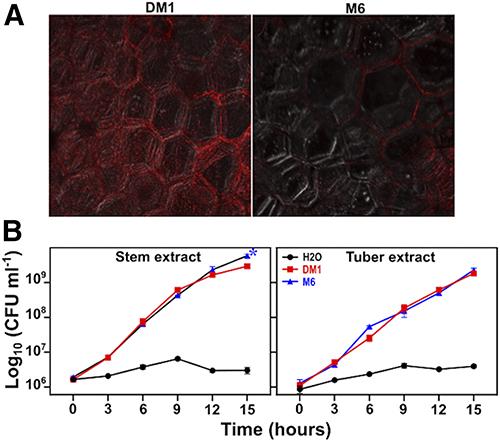
In a recent study published in the Molecular Plant-Microbe Interactions (MPMI) journal, scientists from Colorado State University (CSU) revealed that metabolites from S. chacoense contribute to disease resistance by altering the pathogenic behavior of Pectobacterium brasiliense, rather than inhibiting its growth or killing it.

“We tested if chemicals extracted from the wild potato affect the behavior of the bacterium and found that these inhibited their ability to produce the enzymes that degrade plant cell walls. The chemicals also intercepted their ability to communicate with each other. To use a battle analogy, the wild potato plant chemicals intercepted the bacteria’s missiles, they cut off their radio communications, and together this encouraged the bacteria to remain friendly neighbors,” explained Adam Heuberger, a CSU Associate Professor involved in the research.

“This wild potato is also resistant to insects, viruses, and fungi. The question is always why, and then how, we can translate this information to improve society. There is much to learn by studying wild relatives of food and ornamental plants,” Heuberger added.

###

For more information about this research, read “Metabolites from Wild Potato Inhibit Virulence Factors of the Soft Rot and Blackleg Pathogen Pectobacterium brasiliense” published in MPMI in November.

Media Contact
Juan S. Ramirez-Prado
[email protected]

Related Journal Article

http://dx.doi.org/10.1094/MPMI-08-20-0224-R

Tags: Agricultural Production/EconomicsAgricultureBiologyCell BiologyFood/Food ScienceMicrobiologyMolecular BiologyPlant Sciences
Share12Tweet8Share2ShareShareShare2

Related Posts

Florida Cane Toad: Complex Spread and Selective Evolution

Florida Cane Toad: Complex Spread and Selective Evolution

February 7, 2026
New Study Uncovers Mechanism Behind Burn Pit Particulate Matter–Induced Lung Inflammation

New Study Uncovers Mechanism Behind Burn Pit Particulate Matter–Induced Lung Inflammation

February 6, 2026

DeepBlastoid: Advancing Automated and Efficient Evaluation of Human Blastoids with Deep Learning

February 6, 2026

Navigating the Gut: The Role of Formic Acid in the Microbiome

February 6, 2026
Please login to join discussion

POPULAR NEWS

  • Robotic Ureteral Reconstruction: A Novel Approach

    Robotic Ureteral Reconstruction: A Novel Approach

    82 shares
    Share 33 Tweet 21
  • Digital Privacy: Health Data Control in Incarceration

    63 shares
    Share 25 Tweet 16
  • Study Reveals Lipid Accumulation in ME/CFS Cells

    57 shares
    Share 23 Tweet 14
  • Breakthrough in RNA Research Accelerates Medical Innovations Timeline

    53 shares
    Share 21 Tweet 13

About

We bring you the latest biotechnology news from best research centers and universities around the world. Check our website.

Follow us

Recent News

Phage-Antibiotic Combo Beats Resistant Peritoneal Infection

Boosting Remote Healthcare: Stepped-Wedge Trial Insights

Barriers and Boosters of Seniors’ Physical Activity in Karachi

Subscribe to Blog via Email

Enter your email address to subscribe to this blog and receive notifications of new posts by email.

Join 73 other subscribers
  • Contact Us

Bioengineer.org © Copyright 2023 All Rights Reserved.

Welcome Back!

Login to your account below

Forgotten Password?

Retrieve your password

Please enter your username or email address to reset your password.

Log In
No Result
View All Result
  • Homepages
    • Home Page 1
    • Home Page 2
  • News
  • National
  • Business
  • Health
  • Lifestyle
  • Science

Bioengineer.org © Copyright 2023 All Rights Reserved.