Research in the Journal of Dairy Science® examines the potential benefits of training with an automated milking system phantom to reduce stress for animals and farm employees
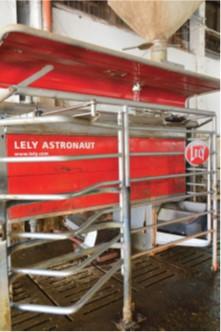
Credit: Lely Industries NV, Maassluis, the Netherlands
Philadelphia, December 17, 2020 – A new study appearing in the Journal of Dairy Science indicates that heifers that participated in a training program using a phantom before introduction to an automated milking system (AMS) visited the actual AMS more frequently, thereby potentially increasing milk yield. Acclimating the herd to an unfamiliar milking robot in advance is a potential solution to decrease stress for animals and farm employees.
“Overall, training on the phantom provided the animals with the necessary amount of experience to perform well with the actual milking robot and to achieve a higher number of voluntary milking visits,” said Almuth Einspanier, PhD, Institute of Physiological Chemistry, Leipzig University, Leipzig, Germany. “Therefore, training on an AMS phantom is a good alternative to a training program directly at the AMS, with some important advantages, and can be an important contribution to improving animal welfare in dairy farming.”
Since their market launch 28 years ago, AMS have been gaining popularity as a way to increase daily milk yield through increased milking frequency and allow cows to decide individually when to be milked. These benefits, however, depend in large part on the animals’ acceptance of the AMS and on them visiting it voluntarily and without human assistance for milking.
The authors of this study, from Leipzig University, Martin Luther University Halle-Wittenberg, Agricultural Society Ruppendorf AG, and MAP Meißener Agrarprodukte AG, randomly assigned 77 Holstein-Friesian heifers to either a control group or phantom group. The phantom group was given free access to the phantom for four weeks before calving so that they could explore it and be positively conditioned by feeding concentrate; the control group had no contact with the phantom or the AMS before the first milking at the AMS. Fecal cortisol concentrations and rumination times of the animals were measured to assess their stress level.
The heifers trained on the phantom showed a significantly higher number of milking visits, leading to the conclusion that they were familiar with the AMS and therefore entered the milking robot more often. In addition, the proportion of trained heifers that had to be driven into the AMS was significantly lower than in the control group, indicating that they accepted the AMS readily and were in a better position to implement regular and voluntary milking visits.
Although the study had hypothesized that animals that had previously been trained on a phantom would undergo less stress on an actual milking robot, the fecal cortisol concentrations did not significantly increase when they were introduced into the AMS, and there was no significant difference between the two experimental groups. In addition, the results of the study suggest that training on a phantom had no significant effect on rumination time or lactation performance.
This study further illustrated training on a phantom offers the possibility of facilitating the start into early lactation for the heifers.
Professor Einspanier added, “The increased number of milking visits and the reduced proportion of animals that had to be fetched into the AMS for milking indicate that training on the phantom prepares the animals well for being milked in the AMS.”
###
Media Contact
Eileen Leahy
[email protected]
Related Journal Article
http://dx.