Rainfall patterns remained largely unaffected despite dramatic climate changes
Credit: McGill University
It’s known that the primary cause of the mass extinction of dinosaurs, about 66 million years ago, was a meteorite impact. But the exact mechanisms that linked the meteorite impact to mass extinction remain unclear, though climactic changes are thought to have played a part.
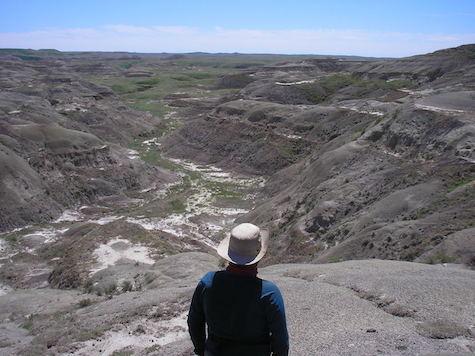
To understand how the mass extinction and associated climate changes affected specific ecosystems, a team of McGill scientists has analyzed the microscopic remains of plants from this period, found in the sediment of rivers in southern Saskatchewan. In a recent article in Palaeogeography, Palaeoclimatology, Palaeoecology they show that in this area, local plant communities and ecosystems experienced a long-term shift towards fewer aquatic plants and an increase in terrestrial plants, including trees such as birches and elms. The researchers speculate that this increase was due to the extinction of large plant-eating dinosaurs. They also found, unexpectedly, that changes in rainfall patterns during the extinction event were relatively minor and short-lived.
“This could be important as we look to the future of global warming, where many scientists have predicted that changes in precipitation could have big impacts on humans and ecosystems,” says Peter Douglas from McGill’s Department of Earth and Planetary Scientists and senior author on the paper. “At other times of major climate change in Earth’s history we typically do see evidence for such changes. The absence of such a signal during the most recent mass extinction event is intriguing.”
Douglas adds, “Surprisingly, scientists know more about what happened in the oceans at the end-Cretaceous extinction than on land. By clarifying the environmental changes occurring during this period, we narrowed down the factors that are likely to have caused the disappearance of dinosaurs. The research also provides an important analogue for environmental changes humans are causing to the planet, and the potential for future mass extinction.”
###
To read “Changes in terrestrial ecosystems across the Cretaceous-Paleogene boundary in western Canada inferred from plant wax lipid distributions and isotopic measurements” by Robert D. Bourque, Peter M.J. Douglas, Hans C.E. Larsson, in Palaeogeography, Palaeoclimatology, Palaeoecology
doi.org/10.1016/j.palaeo.2020.110081
The research was supported by: NSERC Discovery Grant, funding from the Delise Alison Award which was provided through the Redpath Museum, and the Eric Mountjoy Fellowship.
About McGill University
Founded in Montreal, Quebec, in 1821, McGill University is Canada’s top ranked medical doctoral university. McGill is consistently ranked as one of the top universities, both nationally and internationally. It is a world-renowned institution of higher learning with research activities spanning two campuses, 11 faculties, 13 professional schools, 300 programs of study and over 40,000 students, including more than 10,200 graduate students. McGill attracts students from over 150 countries around the world, its 12,800 international students making up 31% of the student body. Over half of McGill students claim a first language other than English, including approximately 19% of our students who say French is their mother tongue.
Contact
Katherine Gombay
McGill Media Relations Office
1-514-717-2289
[email protected]
http://www.
http://twitter.
Media Contact
Katherine Gombay
[email protected]
Original Source
https:/
Related Journal Article
http://dx.