• HOME
  • NEWS
  • EXPLORE
    • CAREER
      • Companies
      • Jobs
    • EVENTS
    • iGEM
      • News
      • Team
    • PHOTOS
    • VIDEO
    • WIKI
  • BLOG
  • COMMUNITY
    • FACEBOOK
    • INSTAGRAM
    • TWITTER
Thursday, March 26, 2026
BIOENGINEER.ORG
No Result
View All Result
  • Login
  • HOME
  • NEWS
  • EXPLORE
    • CAREER
      • Companies
      • Jobs
        • Lecturer
        • PhD Studentship
        • Postdoc
        • Research Assistant
    • EVENTS
    • iGEM
      • News
      • Team
    • PHOTOS
    • VIDEO
    • WIKI
  • BLOG
  • COMMUNITY
    • FACEBOOK
    • INSTAGRAM
    • TWITTER
  • HOME
  • NEWS
  • EXPLORE
    • CAREER
      • Companies
      • Jobs
        • Lecturer
        • PhD Studentship
        • Postdoc
        • Research Assistant
    • EVENTS
    • iGEM
      • News
      • Team
    • PHOTOS
    • VIDEO
    • WIKI
  • BLOG
  • COMMUNITY
    • FACEBOOK
    • INSTAGRAM
    • TWITTER
No Result
View All Result
Bioengineer.org
No Result
View All Result
Home NEWS Science News Chemistry

Researchers develop new combined process for 3D printing

Bioengineer by Bioengineer
December 16, 2020
in Chemistry
Reading Time: 3 mins read
0
IMAGE
Share on FacebookShare on TwitterShare on LinkedinShare on RedditShare on Telegram

IMAGE

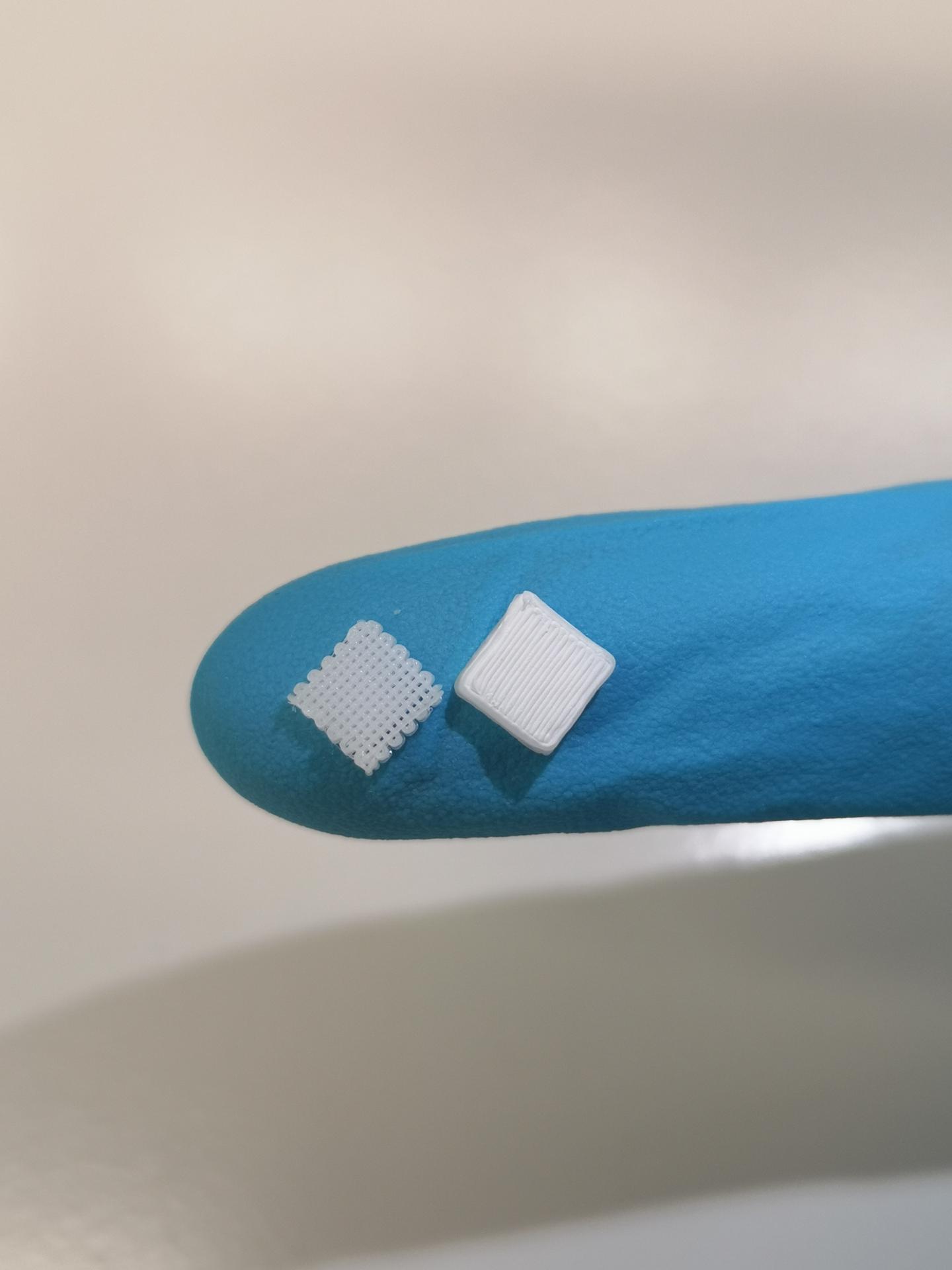
Credit: Harald Rupp / Uni Halle

Chemists at Martin Luther University Halle-Wittenberg (MLU) have developed a way to integrate liquids directly into materials during the 3D printing process. This allows, for example, active medical agents to be incorporated into pharmaceutical products or luminous liquids to be integrated into materials, which allow monitoring of damage. The study was published in “Advanced Materials Technologies”.

3D printing is now widely used for a range of applications. Generally, however, the method is limited to materials which are liquefied through heat and become solid after printing. If the finished product is to contain liquid components, these are usually added afterwards. This is time-consuming and costly. “The future lies in more complex methods that combine several production steps,” says Professor Wolfgang Binder from the Institute of Chemistry at MLU. “That is why we were looking for a way to integrate liquids directly into the material during the printing process.”

To this endeavour, Binder and his colleague Harald Rupp combined common 3D printing processes with traditional printing methods such as those used in inkjet or laser printers. Liquids are added drop by drop at the desired location during the extrusion of the basic material. This allows them to be integrated directly and into the material in a targeted manner.

The chemists have been able to show that their method works through two examples. First, they integrated an active liquid substance into a biodegradable material. “We were able to prove that the active ingredient was not affected by the printing process and remained active,” explains Binder. In the pharmaceutical industry, such materials are used as drug depots which can be slowly broken down by the body. They can be used after operations, for example, to prevent inflammation. This new process could facilitate their production.

Secondly, the scientists integrated a luminous liquid into a plastic material. When the material becomes damaged, the liquid leaks out and indicates where the damage has occurred. “You could imprint something like this into a small part of a product that is exposed to particularly high levels of stress,” says Binder. For example, in parts of cars or aircraft that are under a lot of strain. According to Binder, damage to plastic materials has so far been difficult to detect – unlike damage to metals, where X-rays can expose micro-cracks. The new approach could therefore increase safety.

The combined process is also conceivable for many other areas of application, says the chemist. The team soon plans to use the method to print parts of batteries. “Larger quantities cannot be produced in the laboratory with our setup,” Binder explains. In order to produce industrial quantities, the process must be further developed outside the university.

###

The research was supported by the Leistungszentrum “System- und Biotechnologie”, the Deutsche Forschungsgemeinschaft (DFG, German Research Foundation) and by the EU as part of the “Horizon 2020” programme.

Media Contact
Ronja Münch
[email protected]

Original Source

https://pressemitteilungen.pr.uni-halle.de/index.php?modus=pmanzeige&pm_id=5161

Related Journal Article

http://dx.doi.org/10.1002/admt.202000509

Tags: Chemistry/Physics/Materials SciencesMaterialsPharmaceutical/Combinatorial ChemistryPolymer Chemistry
Share12Tweet8Share2ShareShareShare2

Related Posts

Isolated H2-Reduced Clusters Boost CO2-to-Methanol Catalysis

Isolated H2-Reduced Clusters Boost CO2-to-Methanol Catalysis

March 25, 2026
blank

Physicists Identify Electronic Drivers Behind Flat Band Quantum Materials

March 21, 2026

Würzburg Chemistry Professor Claudia Höbartner Receives Prestigious Honor

March 20, 2026

Scientists Reveal How Magnets Control Metamaterial Behavior

March 20, 2026
Please login to join discussion

POPULAR NEWS

  • blank

    Revolutionary AI Model Enhances Precision in Detecting Food Contamination

    96 shares
    Share 38 Tweet 24
  • Imagine a Social Media Feed That Challenges Your Views Instead of Reinforcing Them

    1003 shares
    Share 397 Tweet 248
  • Uncovering Functions of Cavernous Malformation Proteins in Organoids

    54 shares
    Share 22 Tweet 14
  • Promising Outcomes from First Clinical Trials of Gene Regulation in Epilepsy

    51 shares
    Share 20 Tweet 13

About

We bring you the latest biotechnology news from best research centers and universities around the world. Check our website.

Follow us

Recent News

In-Sensor Cryptography Links Physical Process to Digital Identity

Can Psychosocial Factors Influence Cancer Risk?

Depression Factors in Elderly: Pre vs. Post-COVID Analysis

Subscribe to Blog via Email

Enter your email address to subscribe to this blog and receive notifications of new posts by email.

Join 78 other subscribers
  • Contact Us

Bioengineer.org © Copyright 2023 All Rights Reserved.

Welcome Back!

Login to your account below

Forgotten Password?

Retrieve your password

Please enter your username or email address to reset your password.

Log In
No Result
View All Result
  • Homepages
    • Home Page 1
    • Home Page 2
  • News
  • National
  • Business
  • Health
  • Lifestyle
  • Science

Bioengineer.org © Copyright 2023 All Rights Reserved.