• HOME
  • NEWS
  • EXPLORE
    • CAREER
      • Companies
      • Jobs
    • EVENTS
    • iGEM
      • News
      • Team
    • PHOTOS
    • VIDEO
    • WIKI
  • BLOG
  • COMMUNITY
    • FACEBOOK
    • INSTAGRAM
    • TWITTER
Wednesday, May 20, 2026
BIOENGINEER.ORG
No Result
View All Result
  • Login
  • HOME
  • NEWS
  • EXPLORE
    • CAREER
      • Companies
      • Jobs
        • Lecturer
        • PhD Studentship
        • Postdoc
        • Research Assistant
    • EVENTS
    • iGEM
      • News
      • Team
    • PHOTOS
    • VIDEO
    • WIKI
  • BLOG
  • COMMUNITY
    • FACEBOOK
    • INSTAGRAM
    • TWITTER
  • HOME
  • NEWS
  • EXPLORE
    • CAREER
      • Companies
      • Jobs
        • Lecturer
        • PhD Studentship
        • Postdoc
        • Research Assistant
    • EVENTS
    • iGEM
      • News
      • Team
    • PHOTOS
    • VIDEO
    • WIKI
  • BLOG
  • COMMUNITY
    • FACEBOOK
    • INSTAGRAM
    • TWITTER
No Result
View All Result
Bioengineer.org
No Result
View All Result
Home NEWS Science News Chemistry

Semiconductor material analysis made possible with artificial intelligence

Bioengineer by Bioengineer
December 16, 2020
in Chemistry
Reading Time: 2 mins read
0
IMAGE
Share on FacebookShare on TwitterShare on LinkedinShare on RedditShare on Telegram

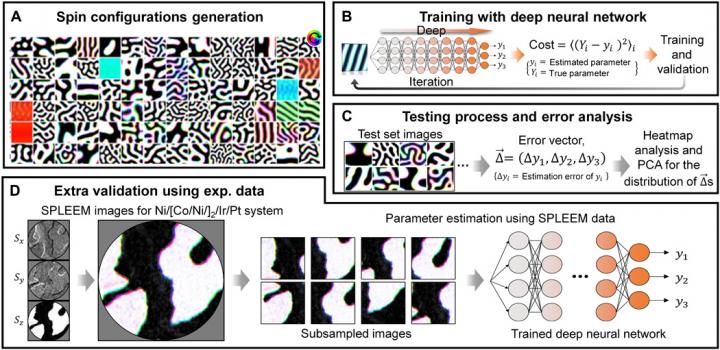
Instant analysis of magnetic Hamiltonian parameters through electron microscopy. Research on magnetic Hamiltonian parameters using deep learning techniques by KIST-Kyung Hee University collaborative research team
IMAGE

Credit: Korea Institute of Science and Technology(KIST)

Studies on spintronics, which deal with the intrinsic spin of electrons and the field of electronic engineering, are actively conducted to address the limitation of integration level of silicon semiconductors currently in use and to develop ultra-low-power and high-performance next-generation semiconductors. Magnetic materials are one of the most commonly used materials to develop spintronics devices such as magneto-resistive random-access memory (MRAM). Therefore, it is essential to accuratly identify various properties of the magnetic materials, such as thermal stability, dynamic behaviors, and the ground state configuration, through the analysis of the magnetic Hamiltonian and its parameters.

Previously, the magnetic Hamiltonian parameters were directly measured through various experiments in order to acquire more accurate and deeper understanding of the properties of magnetic materials, and such processes required extensive amount of time and resources.

To overcome these limitations, researchers in South Korea have developed an artificial intelligence (AI) system that can analyze magnetic systems in an instant. The Korea Institute of Science and Technology (KIST) reported that the collaborative research team led by Dr. Heeyong Kwon and Dr. Junwoo Choi from Spin Convergence Research Center and Professor Changyeon Won from Kyung Hee University developed a technique for estimating magnetic Hamiltonian parameters from spin structure images using AI techniques.

They consturcted a deep neural network structure and trained it with machine learning algorithms and existing magnetic domain images. As a result, the magnetic Hamiltonian parameters could be estimated in real-time by inputting spin structure images obtained from electron microscope. Further, when compared with the experimentally investigated parameter values, the estimation errors of the AI system were less than 1%, indicating high estimation accuracy. According to the team, the developed AI system is capable of completing material parameter estimation process that previously took up to tens of hours in an instant by using deep learning techniques.

“We presented a novel approach on how AI technologies can be implemented to analyze the properties of magnetic systems,” Dr. Hee-young Kwon at KIST said. “We expect that new methods for studying physical systems using such AI technologies will be able to reduce the gap between experimental and theoretical aspects, and will further lead to expanding a new research field called convergence of AI technology and fundamental science research.”

###

This study was carried out with a grant from the Ministry of Science and ICT (MSIT), as part of the Institutional R&D Program of KIST, and Basic Science Research Program funded by the Ministry of Education . The findings were reported in the latest edition of the international journal, ‘Science Advances‘(IF: 13.11, Top 4.93% in the field of JCR).

Media Contact
Do-Hyun Kim
[email protected]

Related Journal Article

http://dx.doi.org/10.1126/sciadv.abb0872

Tags: Chemistry/Physics/Materials SciencesTechnology/Engineering/Computer Science
Share13Tweet8Share2ShareShareShare2

Related Posts

Scientists Observe Massive Light-Conversion Effect in Chiral Carbon Nanotubes — Chemistry

Scientists Observe Massive Light-Conversion Effect in Chiral Carbon Nanotubes

May 19, 2026
TransEuroOGS Project to Connect Optical Ground Stations Across Europe — Chemistry

TransEuroOGS Project to Connect Optical Ground Stations Across Europe

May 19, 2026

Decarbonizing the Grid: The Essential First Step to Capturing Carbon from the Environment

May 19, 2026

Overcoming Mid-Infrared Interconnection Challenges: Durable Bonding Technique for High-Power Optics Using Liquid-Like Chalcogenide Glass

May 19, 2026
Please login to join discussion

POPULAR NEWS

  • blank

    New Study Reveals Plants Can Detect the Sound of Rain

    732 shares
    Share 292 Tweet 183
  • Research Indicates Potential Connection Between Prenatal Medication Exposure and Elevated Autism Risk

    846 shares
    Share 338 Tweet 212
  • ESMO 2025: mRNA COVID Vaccines Enhance Efficacy of Cancer Immunotherapy

    263 shares
    Share 105 Tweet 66
  • Breastmilk Balances E. coli and Beneficial Bacteria in Infant Gut Microbiomes

    58 shares
    Share 23 Tweet 15

About

We bring you the latest biotechnology news from best research centers and universities around the world. Check our website.

Follow us

Recent News

Rethinking Childcare: More Hours Aren’t Better

Copper Homeostasis and Cuproptosis in Orthopedics

Lab Fish Circadian Rhythms Misaligned with Natural Cycles

Subscribe to Blog via Email

Enter your email address to subscribe to this blog and receive notifications of new posts by email.

Join 82 other subscribers
  • Contact Us

Bioengineer.org © Copyright 2023 All Rights Reserved.

Welcome Back!

Login to your account below

Forgotten Password?

Retrieve your password

Please enter your username or email address to reset your password.

Log In
No Result
View All Result
  • Homepages
    • Home Page 1
    • Home Page 2
  • News
  • National
  • Business
  • Health
  • Lifestyle
  • Science

Bioengineer.org © Copyright 2023 All Rights Reserved.