• HOME
  • NEWS
  • EXPLORE
    • CAREER
      • Companies
      • Jobs
    • EVENTS
    • iGEM
      • News
      • Team
    • PHOTOS
    • VIDEO
    • WIKI
  • BLOG
  • COMMUNITY
    • FACEBOOK
    • INSTAGRAM
    • TWITTER
Tuesday, July 7, 2026
BIOENGINEER.ORG
No Result
View All Result
  • Login
  • HOME
  • NEWS
  • EXPLORE
    • CAREER
      • Companies
      • Jobs
        • Lecturer
        • PhD Studentship
        • Postdoc
        • Research Assistant
    • EVENTS
    • iGEM
      • News
      • Team
    • PHOTOS
    • VIDEO
    • WIKI
  • BLOG
  • COMMUNITY
    • FACEBOOK
    • INSTAGRAM
    • TWITTER
  • HOME
  • NEWS
  • EXPLORE
    • CAREER
      • Companies
      • Jobs
        • Lecturer
        • PhD Studentship
        • Postdoc
        • Research Assistant
    • EVENTS
    • iGEM
      • News
      • Team
    • PHOTOS
    • VIDEO
    • WIKI
  • BLOG
  • COMMUNITY
    • FACEBOOK
    • INSTAGRAM
    • TWITTER
No Result
View All Result
Bioengineer.org
No Result
View All Result
Home NEWS Science News Chemistry

Scientists look to meteorites for inspiration to achieve critical element-free magnet

Bioengineer by Bioengineer
December 10, 2020
in Chemistry
Reading Time: 3 mins read
0
IMAGE
Share on FacebookShare on TwitterShare on LinkedinShare on RedditShare on Telegram

IMAGE

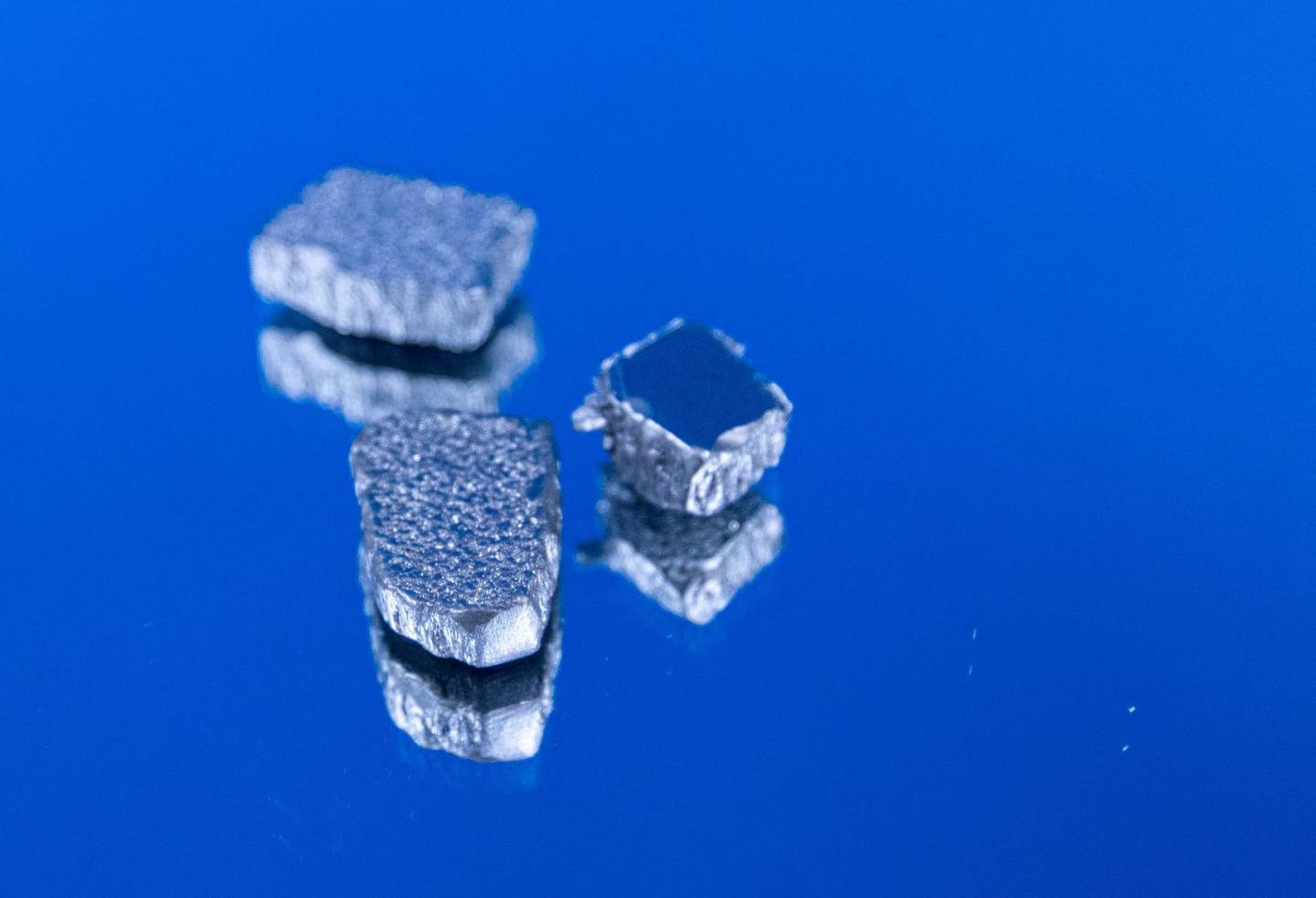
Credit: photo credit: U.S. Department of Energy Ames Laboratory

The U.S. Department of Energy’s (DOE’s) Critical Materials Institute has developed a low-cost, high performance permanent magnet by drawing inspiration from an out-of-this-world source: iron-nickel alloys in meteorites. The magnet rivals widely used “Alnico” magnets in magnetic strength and has the potential to fill a strong demand for rare-earth- and cobalt-free magnets in the market.

Here on earth, the strongest permanent magnets are ones containing the rare earth element neodymium – NdFeB magnets. Next strongest are Samarium-Cobalt, or SmCo magnets. Before rare-earth magnets were developed in the 1970s, the strongest magnets were made of aluminum-nickel-cobalt, or Alnico, which are still in wide use today in applications ranging from electric motors to consumer electronics.

The problem with these strong but earthly man-made permanent magnets is that they contain critical elements– rare earths in the case of NdFeB and SmCo, and cobalt in the case of SmCo and Alnico– ones that are in high demand for many technologies and for which manufacturers pay a premium for a sometimes unreliable supply.

“The iron-nickel magnetic alloys found in meteors are rare-earth and cobalt-free, but are highly ordered and take millions of years to produce through natural means,” said Vitalij Pecharsky, scientist at U.S. DOE’s Ames Laboratory and CMI. “Our team — Oleksandr Dolotko, Ihor Hlova, Shalabh Gupta, and Anis Biswas – developed a method to produce the magnetic qualities of iron-nickel alloys that already perform on the level of Alnico, but in a much faster fashion.”

The method introduces a large number of defects into an iron and nickel alloy. It is then placed in reaction with ammonia, which results in a chemically ordered precursor iron-nickel-nitrogen, or FeNiN. The next step extracts the nitrogen from the material, without disturbing the order of the remaining iron and nickel.

Pecharsky said the ammonia process is scalable and reliably yields the precursor material at about 98 percent. The end product has energy density of 6 MG-Oe, which makes it comparable to Alnico magnets, and room for further improvements is substantial.

“There is a market demand for magnets that fill the gap in technical applications between the higher end, strongest rare-earth permanent magnets, and lower-strength options,” said Pecharsky. “We see this gaining wide adoption in that gap magnet space.”

The Critical Materials Institute is a Department of Energy Innovation Hub led by the U.S. Department of Energy’s Ames Laboratory and supported by the Office of Energy Efficiency and Renewable Energy’s Advanced Manufacturing Office, which supports early-stage applied research to advance innovation in U.S. manufacturing and promote American economic growth and energy security. CMI seeks ways to eliminate and reduce reliance on rare-earth metals and other materials subject to supply chain disruptions.

Ames Laboratory is a U.S. Department of Energy Office of Science national laboratory operated by Iowa State University. Ames Laboratory creates innovative materials, technologies and energy solutions. We use our expertise, unique capabilities and interdisciplinary collaborations to solve global problems.

DOE’s Office of Science is the single largest supporter of basic research in the physical sciences in the United States, and is working to address some of the most pressing challenges of our time. For more information, please visit science.energy.gov.

###

Media Contact
Laura Millsaps
[email protected]

Original Source

https://www.ameslab.gov/news/scientists-look-to-meteorites-for-inspiration-to-achieve-critical-element-free-permanent

Tags: Chemistry/Physics/Materials SciencesMaterials
Share12Tweet8Share2ShareShareShare2

Related Posts

Salt adaptation linked to higher disease risk, Mizzou study finds

Salt adaptation linked to higher disease risk, Mizzou study finds

July 6, 2026
Intelligent Microgrid Management Promises Lower Household Energy Bills and Reduced Diesel Emissions — Chemistry

Intelligent Microgrid Management Promises Lower Household Energy Bills and Reduced Diesel Emissions

July 4, 2026

Graz University of Technology Deciphers the Structural Secrets of MOF Thin Films

July 2, 2026

Breaking Thermodynamic Limits: Wavelength-Driven Catalysis Advances Ammonia Synthesis

July 2, 2026
Please login to join discussion

POPULAR NEWS

  • Detection of EDCs in Breast Milk and Infant Urine Up to Six Months Highlights Early Exposure Risks

    77 shares
    Share 31 Tweet 19
  • New Drug Candidate Developed at McMaster Shows Potential for Treating Brain Cancer

    58 shares
    Share 23 Tweet 15
  • Saying Goodbye to PGY-6: Pediatric Fellowship Realities

    103 shares
    Share 41 Tweet 26
  • KTU Researchers Explore Ultrasound’s Role in Enhancing Blood Flow Beyond Diagnostics

    53 shares
    Share 21 Tweet 13

About

We bring you the latest biotechnology news from best research centers and universities around the world. Check our website.

Follow us

Recent News

Flame retardant BDE-209 targets molecularly linked to ulcerative colitis

Ultra-high frequency particle impacts mimic rockbursts to shatter hard rock

Kidney transplant outcomes in older adults studied by German researchers

Subscribe to Blog via Email

Enter your email address to subscribe to this blog and receive notifications of new posts by email.

Join 83 other subscribers
  • Contact Us

Bioengineer.org © Copyright 2023 All Rights Reserved.

Welcome Back!

Login to your account below

Forgotten Password?

Retrieve your password

Please enter your username or email address to reset your password.

Log In
No Result
View All Result
  • Homepages
    • Home Page 1
    • Home Page 2
  • News
  • National
  • Business
  • Health
  • Lifestyle
  • Science

Bioengineer.org © Copyright 2023 All Rights Reserved.