HZDR team develops component for neuromorphic computer
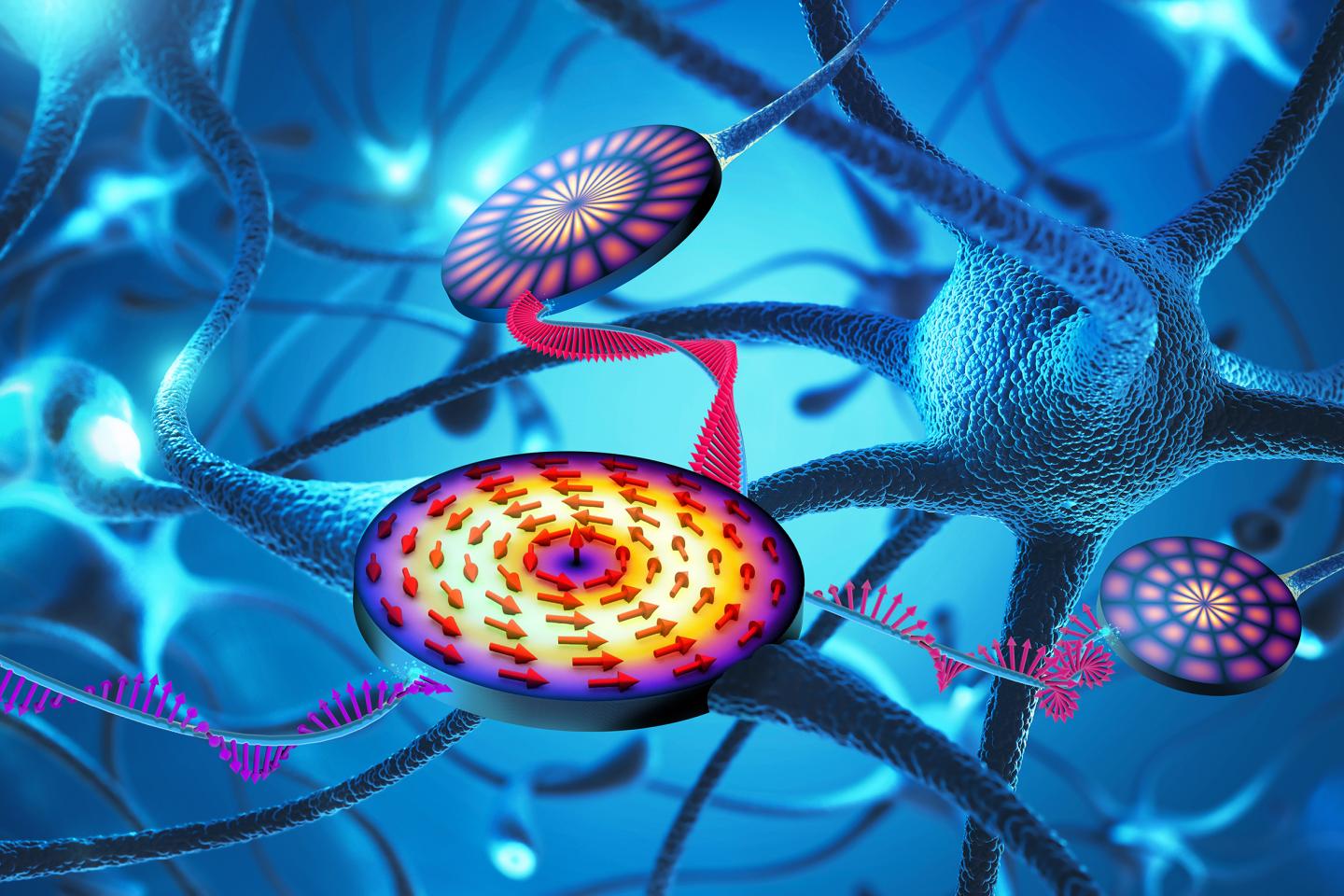
Credit: HZDR/Sahneweiß/H. Schultheiß
Neural networks are some of the most important tools in artificial intelligence (AI): they mimic the operation of the human brain and can reliably recognize texts, language and images, to name but a few. So far, they run on traditional processors in the form of adaptive software, but experts are working on an alternative concept, the “neuromorphic computer”. In this case, the brain’s switching points – the neurons – are not simulated by software but reconstructed in hardware components. A team of researchers at the Helmholtz-Zentrum Dresden-Rossendorf (HZDR) has now demonstrated a new approach to such hardware – targeted magnetic waves that are generated and divided in micrometer-sized wafers. Looking to the future, this could mean that optimization tasks and pattern recognition could be completed faster and more energy efficiently. The researchers have presented their results in the journal Physical Review Letters (DOI: 10.1103/PhysRevLett.125.207203).
The team based its investigations on a tiny disc of the magnetic material iron nickel, with a diameter just a few micrometers wide. A gold ring is placed around this disc: When an alternating current in the gigahertz range flows through it, it emits microwaves that excite so-called spin waves in the disc. “The electrons in the iron nickel exhibit a spin, a sort of whirling on the spot rather like a spinning top,” Helmut Schultheiß, head of the Emmy Noether Group “Magnonics” at HZDR, explains. “We use the microwave impulses to throw the electron top slightly off course.” The electrons then pass on this disturbance to their respective neighbors – which causes a spin wave to shoot through the material. Information can be transported highly efficiently in this way without having to move the electrons themselves, which is what occurs in today’s computer chips.
Back in 2019, the Schultheiß group discovered something remarkable: under certain circumstances, the spin wave generated in the magnetic vortex can be split into two waves, each with a reduced frequency. “So-called non-linear effects are responsible for this,” explains Schultheiß’s colleague Lukas Körber. “They are only activated when the irradiated microwave power crosses a certain threshold.” Such behavior suggests spin waves as promising candidates for artificial neurons because there is an amazing parallel with the workings of the brain: these neurons also only fire when a certain stimulus threshold has been crossed.
Microwave decoy
At first, however, the scientists were unable to control the division of the spin wave very precisely. Körber explains why: “When we sent the microwave into the disc, there was a time lag before the spin wave divided into two new waves. And this was difficult to control.” So, the team had to think up a way around the problem, which they have now described in the Physical Review Letters: In addition to the gold ring, a small magnetic strip is attached close to the magnetic wafer. A short microwave signal generates a spin wave in this strip which can interact with the spin wave in the wafer and thus act as a kind of decoy. The spin wave in the strip causes the wave in the wafer to divide faster. “A very short additional signal is sufficient to make the split happen faster,” Körber explains. “This means we can now trigger the process and control the time lag.”
Which also means that, in principle, it has been proven that spin wave wafers are suitable for artificial hardware neurons – they switch similarly to nerve cells in the brain and can be directly controlled. “The next thing we want to do is build a small network with our spin wave neurons,” Helmut Schultheiß announces. “This neuromorphic network should then perform simple tasks such as recognizing straightforward patterns.”
Facial recognition and traffic optimization
Pattern recognition is one of the major applications of AI. Facial recognition on a smartphone, for instance, obviates the necessity for a password. In order for it to work, a neural network must be trained in advance, which involves huge computing power and massive amounts of data. Smartphone manufacturers transfer this network to a special chip that is then integrated in the cell phone. But the chip has a weakness. It is not adaptive, so cannot recognize faces wearing a Covid mask, for example.
A neuromorphic computer, on the other hand, could also deal with situations like this: in contrast to conventional chips, its components are not hard wired but function like nerve cells in the brain. “Because of this, a neuromorphic computer could process big volumes of data at once, just like a human – and very energy efficiently at that,” Schultheiß enthuses. Apart from pattern recognition, the new type of computer could also prove useful in another economically relevant field: for optimization tasks such as high-precision smartphone route planners.
###
Publications:
L. Körber, K. Schultheiss, T. Hula, R. Verba, J. Fassbender, A. Kákay, H. Schultheiss: Nonlocal stimulation of three-magnon splitting in a magnetic vortex, in Physical Review Letters, 2020 (DOI: 10.1103/PhysRevLett.125.207203)
K. Schultheiss, R. Verba, F. Wehrmann, K. Wagner, L. Körber, T. Hula, T. Hache, A. Kákay, A. A. Awad, V. Tiberkevich, A. N. Slavin, J. Fassbender, H. Schultheiss: Excitation of whispering gallery magnons in a magnetic vortex, in Physical Review Letters, 2019 (DOI: 10.1103/PhysRevLett.122.097202)
Additional information:
Dr. Helmut Schultheiß
Institute of Ion Beam Physics and Materials Research at HZDR
Phone: +49 351 260-3243 | Email: h.schultheiss@hzdr.de
Media contact:
Simon Schmitt | Science editor
Phone: +49 351 260-3400 | Email: s.schmitt@hzdr.de
Helmholtz-Zentrum Dresden-Rossendorf | Bautzner Landstr. 400 | 01328 Dresden / Germany | http://www.
The Helmholtz-Zentrum Dresden-Rossendorf (HZDR) performs – as an independent German research center – research in the fields of energy, health, and matter. We focus on answering the following questions:
- How can energy and resources be utilized in an efficient, safe, and sustainable way?
- How can malignant tumors be more precisely visualized, characterized, and more effectively treated?
- How do matter and materials behave under the influence of strong fields and in smallest dimensions?
To help answer these research questions, HZDR operates large-scale facilities, which are also used by visiting researchers: the Ion Beam Center, the High-Magnetic Field Laboratory Dresden, and the ELBE Center for High-Power Radiation Sources.
HZDR is a member of the Helmholtz Association and has six sites (Dresden, Freiberg, Grenoble, Görlitz, Leipzig, Schenefeld near Hamburg) with almost 1,200 members of staff, of whom about 500 are scientists, including 170 Ph.D. candidates.
Media Contact
Simon Schmitt
s.schmitt@hzdr.de
Original Source
https:/
Related Journal Article
http://dx.