Credit: Department of Organic Biomaterials,TMDU
Tokyo Medical and Dental University (TMDU) researchers report a cross-linker for dental cement that breaks down under UV light, making treatments easier to reverse.
Tokyo – Everyone who has had tooth cavities filled knows that the best dental materials stay where the dentist puts them. The adhesion of currently available dental materials to tooth surfaces continues to improve, but what about short-term treatments that are not supposed to adhere indefinitely? TMDU researchers have developed a method of making dental materials easier to remove; their findings are published in ACS Applied Polymer Materials.
The continual improvement of long-lasting caries treatments can be regarded a triumph of dental material research. However, there are dental procedures that require non-permanent adhesion to the tooth surface, such as the fixing of orthodontic brackets. Removing adhered materials after such procedures generally requires mechanical detachment that can damage tooth enamel.
Efforts to improve removal processes have produced materials that are weakened by triggers, such as heat or electric currents. However, approved sources of these stimuli are not readily available in standard dental clinics. The researchers therefore focused on UV light-responsive materials that can be triggered by the UV sources widely used by dentists to cure resin cements and composites.
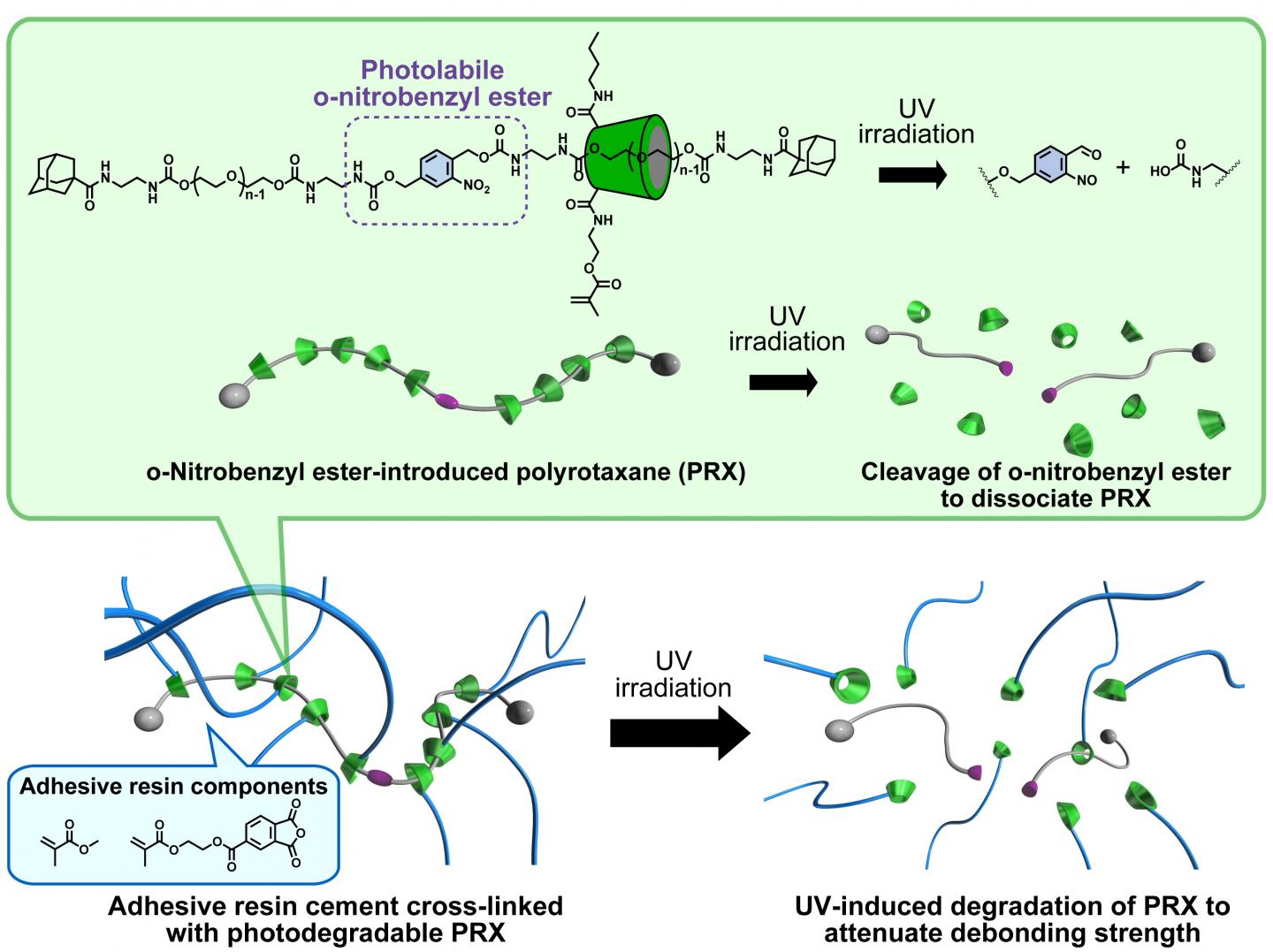
The toughness of many dental cements is a result of mixing them with a cross-linker that locks the cement molecules to each other to form a stable network. The researchers have introduced a chemical ‘switch’ into a new cross-linker that opens when UV light is shined on it.
“The cross-linker structure resembles rings threaded onto a piece of string with bulky stoppers at each end,” study lead author Atsushi Tamura explains. “We have added a section to the string–an o-nitrobenzyl ester group–that breaks under UV light causing the rings to slide off. This has a significant effect on the stability of the cement material the cross-linker is holding in place.”
The researchers used their cross-linker to stabilize a commercially available resin cement that was used to stick two polymer blocks together, or to attach a polymer block to a bovine tooth. After shining UV light on the cross-linked cement for just 2 minutes, the cement showed a significant reduction in adhesion strength in both tests, meaning separation of the bonded materials was easier following UV treatment.
“We are very encouraged by the initial findings using our cross-linker,” study corresponding author Nobuhiko Yui explains. “Although the UV wavelength used to disrupt the material was not clinically appropriate in this case, we intend to develop the chemistry of our internal switch so that it can provide a facile and readily accessible method of removing adhesives in the clinic.”
The article, “Light-Embrittled Dental Resin Cements Containing Photodegradable Polyrotaxane Cross-Linkers for Attenuating Debonding Strength”, was published in ACS Applied Polymer Materials (DOI: https:/
At the same time, the article was selected to be featured as ACS (American Chemical Society) Editors’ Choice (on 25th November, 2020) based on recommendations by ca. 70 ACS journals’ editors due to its potential for broad public interest, an honor given to only one article from the entire ACS portfolio each day of the year.
###
Media Contact
Nobuhiko YUI
[email protected]
Original Source
http://www.
Related Journal Article
http://dx.