• HOME
  • NEWS
  • EXPLORE
    • CAREER
      • Companies
      • Jobs
    • EVENTS
    • iGEM
      • News
      • Team
    • PHOTOS
    • VIDEO
    • WIKI
  • BLOG
  • COMMUNITY
    • FACEBOOK
    • INSTAGRAM
    • TWITTER
Saturday, June 27, 2026
BIOENGINEER.ORG
No Result
View All Result
  • Login
  • HOME
  • NEWS
  • EXPLORE
    • CAREER
      • Companies
      • Jobs
        • Lecturer
        • PhD Studentship
        • Postdoc
        • Research Assistant
    • EVENTS
    • iGEM
      • News
      • Team
    • PHOTOS
    • VIDEO
    • WIKI
  • BLOG
  • COMMUNITY
    • FACEBOOK
    • INSTAGRAM
    • TWITTER
  • HOME
  • NEWS
  • EXPLORE
    • CAREER
      • Companies
      • Jobs
        • Lecturer
        • PhD Studentship
        • Postdoc
        • Research Assistant
    • EVENTS
    • iGEM
      • News
      • Team
    • PHOTOS
    • VIDEO
    • WIKI
  • BLOG
  • COMMUNITY
    • FACEBOOK
    • INSTAGRAM
    • TWITTER
No Result
View All Result
Bioengineer.org
No Result
View All Result
Home NEWS Science News Chemistry

A French team has improved the measurement of a fundamental physical constant

Bioengineer by Bioengineer
December 2, 2020
in Chemistry
Reading Time: 2 mins read
0
IMAGE
Share on FacebookShare on TwitterShare on LinkedinShare on RedditShare on Telegram

IMAGE

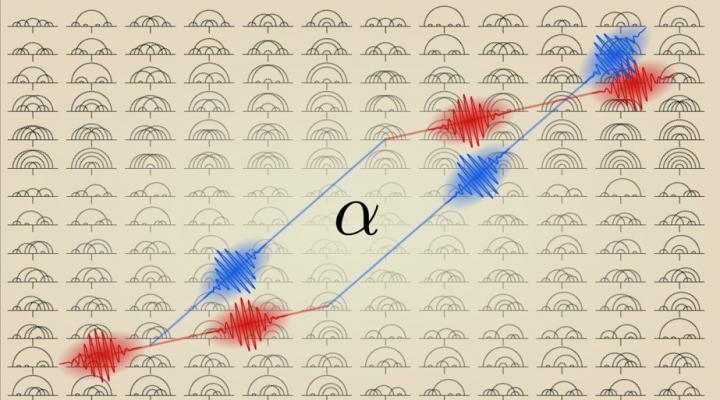
Credit: Pierre Cladé, Saïda Guellati-Khélifa et Tatsumi Aoyama

The validation and application of theories in physics require the measurement of universal values known as fundamental constants. A team of French researchers* has just conducted the most accurate measurement to date of the fine-structure constant, which characterizes the strength of interaction between light and charged elementary particles, such as electrons. This value has just been determined with an accuracy of 11 significant digits; improving the precision of the previous measurement by a factor of 3.** The scientists achieved such precision by enhancing their experimental set-up, in an effort to reduce inaccuracies and to control effects that can create perturbations of the measurement. The experiment involves cold rubidium atoms with a temperature approaching absolute zero. When they absorb photons, these atoms recoil at a velocity that depends on their mass. The highly precise measurement of this phenomenon helps to improve the knowledge of the fine-structure constant. These results, which will appear in Nature on 3 December, open new prospects for testing the Standard Model’s theoretical predictions.*** The use of more accurate constants can help to answer fundamental questions, such as the origin of dark matter in the Universe.

###

*- The physicists are working at the Kastler Brossel Laboratory (CNRS/Sorbonne Université/ENS Paris/Collège de France) and the National Conservatory of Arts and Crafts (CNAM).

**- The new value of the fine-structure constant is α-1= 137.035999206 (with a relative precision of 81 parts-per-trillion).

***- The Standard Model of particle physics studies the elementary components of matter.

Media Contact
Francois Maginiot
[email protected]

Related Journal Article

http://dx.doi.org/10.1038/s41586-020-2964-7

Tags: Atomic/Molecular/Particle PhysicsChemistry/Physics/Materials Sciences
Share12Tweet8Share2ShareShareShare2

Related Posts

AI and Physics Collaborate to Design Advanced Hydrogen Storage Materials

June 25, 2026

International Team Including Dresden Scientists Develops Novel Designer Proteins for Advanced Study of Living Tissue

June 25, 2026

New Study Uncovers Key Factors Driving Water Chemistry in Nanoscale Environments

June 25, 2026

Plasma Technology Extends Catalyst Lifespan in Hydrogen Production

June 24, 2026
Please login to join discussion

POPULAR NEWS

  • Saying Goodbye to PGY-6: Pediatric Fellowship Realities

    103 shares
    Share 41 Tweet 26
  • Multi-Hospital Study Reveals Long Covid Burden Is Twice as High as Current Estimates

    92 shares
    Share 36 Tweet 23
  • Detection of EDCs in Breast Milk and Infant Urine Up to Six Months Highlights Early Exposure Risks

    77 shares
    Share 31 Tweet 19
  • New Drug Candidate Developed at McMaster Shows Potential for Treating Brain Cancer

    58 shares
    Share 23 Tweet 15

About

We bring you the latest biotechnology news from best research centers and universities around the world. Check our website.

Follow us

Recent News

Tracking Lanthanide-Labeled Microplastics in Plants

POSTECH Researchers Slash Cost of Reconstituted Cell-Free Systems by 95%

AI and Physics Collaborate to Design Advanced Hydrogen Storage Materials

Subscribe to Blog via Email

Success! An email was just sent to confirm your subscription. Please find the email now and click 'Confirm' to start subscribing.

Join 82 other subscribers
  • Contact Us

Bioengineer.org © Copyright 2023 All Rights Reserved.

Welcome Back!

Login to your account below

Forgotten Password?

Retrieve your password

Please enter your username or email address to reset your password.

Log In
No Result
View All Result
  • Homepages
    • Home Page 1
    • Home Page 2
  • News
  • National
  • Business
  • Health
  • Lifestyle
  • Science

Bioengineer.org © Copyright 2023 All Rights Reserved.