• HOME
  • NEWS
  • EXPLORE
    • CAREER
      • Companies
      • Jobs
    • EVENTS
    • iGEM
      • News
      • Team
    • PHOTOS
    • VIDEO
    • WIKI
  • BLOG
  • COMMUNITY
    • FACEBOOK
    • INSTAGRAM
    • TWITTER
Saturday, February 7, 2026
BIOENGINEER.ORG
No Result
View All Result
  • Login
  • HOME
  • NEWS
  • EXPLORE
    • CAREER
      • Companies
      • Jobs
        • Lecturer
        • PhD Studentship
        • Postdoc
        • Research Assistant
    • EVENTS
    • iGEM
      • News
      • Team
    • PHOTOS
    • VIDEO
    • WIKI
  • BLOG
  • COMMUNITY
    • FACEBOOK
    • INSTAGRAM
    • TWITTER
  • HOME
  • NEWS
  • EXPLORE
    • CAREER
      • Companies
      • Jobs
        • Lecturer
        • PhD Studentship
        • Postdoc
        • Research Assistant
    • EVENTS
    • iGEM
      • News
      • Team
    • PHOTOS
    • VIDEO
    • WIKI
  • BLOG
  • COMMUNITY
    • FACEBOOK
    • INSTAGRAM
    • TWITTER
No Result
View All Result
Bioengineer.org
No Result
View All Result
Home NEWS Science News Chemistry

Natural three-dimensional nonlinear photonic crystal

Bioengineer by Bioengineer
December 2, 2020
in Chemistry
Reading Time: 2 mins read
0
IMAGE
Share on FacebookShare on TwitterShare on LinkedinShare on RedditShare on Telegram

IMAGE

Credit: by Chang Li, Xuping Wang, Yang Wu, Fei Liang, Feifei Wang, Xiangyong Zhao, Haohai Yu, Huaijin Zhang

Nonlinear photonic crystals (NPCs) are transparent materials that have a spatially uniform linear susceptibility, yet a periodically modulated quadratic nonlinear susceptibility. These engineered materials are used extensively for studying nonlinear wave dynamics and in many scientific and industrial applications. Over the past two decades, there has been a continuous effort to find a technique that will enable the construction of three-dimensional (3D) NPCs. Such capability will enable many new schemes of manipulation and control of nonlinear optical interactions.

Till now, only two artificial 3D NPCs have been constructed using femtosecond laser poling in ferroelectric LiNbO3 and Ba0.77Ca0.23TiO3 crystal. However, both nonlinear crystals only feature up-down ferroelectric domains and no spatially rotating polarization. Therefore, the crystal cutting angle and incident light polarization are still limited to utilize the maximum nonlinear coefficient. The 3D spatial rotation of ferroelectric domains may break the rigid requirement on incident light in common nonlinear photonic crystals, but seems difficult to reach by traditional electric or light poling technique.

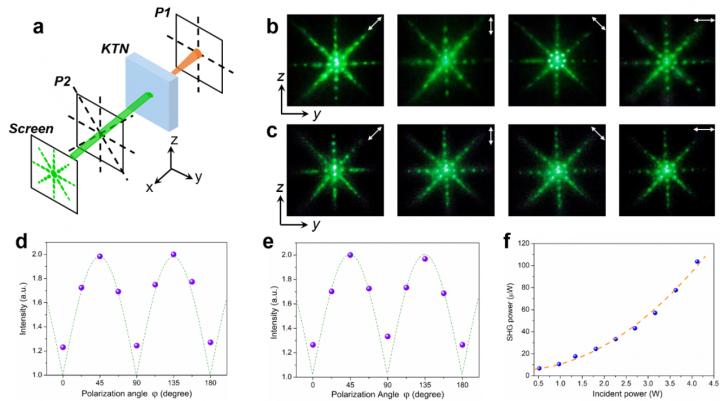
In a new paper published in Light Science & Application, scientists from the State Key Laboratory of Crystal Materials and Institute of Crystal Materials, Shandong University, China, and co-workers showed a natural potassium-tantalate-niobate (KTa0.56Nb0.44O3, KTN) perovskite nonlinear photonic crystal with 3D spontaneous Rubik’s domain structures. It exhibits the near-room-temperature Curie temperature at 40 Celsius degree. The Rubik’s domain structure is composed of 90° and 180° domains with different polarization direction. Hence, the ferroelectric domain structures arranged in KTN crystal would supply rich 3D reciprocal vectors to compensate phase-mismatch along arbitrary direction. Based on this 3D KTN nonlinear photonic crystal, a second harmonic generation with four-fold pattern spot was demonstrated, which is proved to be the superposition of two orthogonal polarization states in different nonlinear diffraction modes.

“KTN crystal contains 3D ferroelectric polarization distributions corresponding to the reconfigured second-order susceptibilities, which can provide rich reciprocal vectors for compensating phase mismatch along an arbitrary direction and polarization of incident light.” they added.

“KTN crystal is easily compatible to laser writing technique, thus suggesting promising opportunities to create hierarchical nonlinear optical modulation. Therefore, this 3D nonlinear photonic crystal in perovskite ferroelectrics would find a wide variety of applications in optical communications, quantum entanglement sources, nonlinear imaging, and on-chip signal processing.”the scientists forecast.

###

Media Contact
Fei Liang
[email protected]

Related Journal Article

http://dx.doi.org/10.1038/s41377-020-00427-z

Tags: Chemistry/Physics/Materials SciencesOptics
Share12Tweet8Share2ShareShareShare2

Related Posts

blank

Breakthrough in Environmental Cleanup: Scientists Develop Solar-Activated Biochar for Faster Remediation

February 7, 2026
blank

Cutting Costs: Making Hydrogen Fuel Cells More Affordable

February 6, 2026

Scientists Develop Hand-Held “Levitating” Time Crystals

February 6, 2026

Observing a Key Green-Energy Catalyst Dissolve Atom by Atom

February 6, 2026
Please login to join discussion

POPULAR NEWS

  • Robotic Ureteral Reconstruction: A Novel Approach

    Robotic Ureteral Reconstruction: A Novel Approach

    82 shares
    Share 33 Tweet 21
  • Digital Privacy: Health Data Control in Incarceration

    63 shares
    Share 25 Tweet 16
  • Study Reveals Lipid Accumulation in ME/CFS Cells

    57 shares
    Share 23 Tweet 14
  • Breakthrough in RNA Research Accelerates Medical Innovations Timeline

    53 shares
    Share 21 Tweet 13

About

We bring you the latest biotechnology news from best research centers and universities around the world. Check our website.

Follow us

Recent News

Evaluating Pediatric Emergency Care Quality in Ethiopia

TPMT Expression Predictions Linked to Azathioprine Side Effects

Improving Dementia Care with Enhanced Activity Kits

Subscribe to Blog via Email

Enter your email address to subscribe to this blog and receive notifications of new posts by email.

Join 73 other subscribers
  • Contact Us

Bioengineer.org © Copyright 2023 All Rights Reserved.

Welcome Back!

Login to your account below

Forgotten Password?

Retrieve your password

Please enter your username or email address to reset your password.

Log In
No Result
View All Result
  • Homepages
    • Home Page 1
    • Home Page 2
  • News
  • National
  • Business
  • Health
  • Lifestyle
  • Science

Bioengineer.org © Copyright 2023 All Rights Reserved.