Opposite data sets only benefit the researchers
Credit: FEFU press office
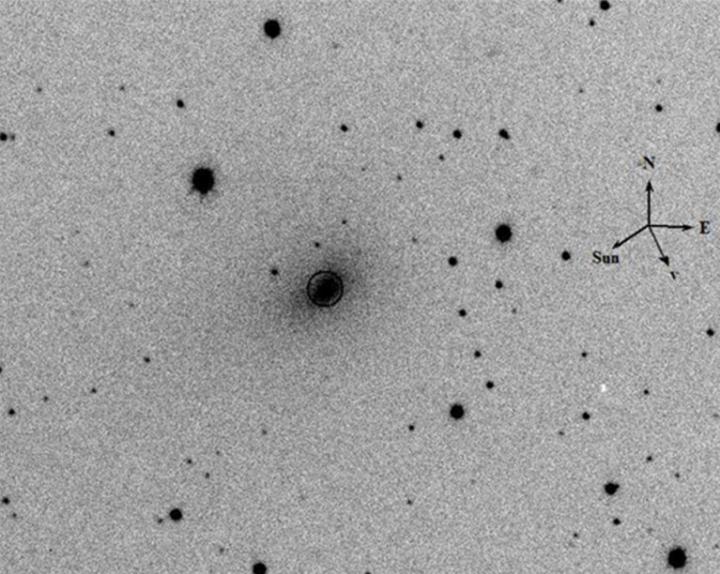
Astrophysicists from Far Eastern Federal University (FEFU) joined the international research team for explaining the difference in the results of observation of the comet 41P/ Tuttle – Giacobini – Kresak. Researchers believe that data obtained by three independent teams are complementary and its complex analysis helps to unravel the mystery of dust chemical composition of comet 41P and other conundrums of the Universe. A related article appears in Astronomy & Astrophysics.
The activity of comets is more complex than it appeared to be, one of the research outcomes says. The chemical composition of a cometary coma (gas-dusty environment of the nucleus) is able to change very rapidly, literally during the day. That is because of the Sun affects the nucleus of a comet approaching.
Researchers all over the Globe try to get data on the chemical composition of comets via analyses of the light refracted by its dust particles. However, the information about the color spectrum of comets differs every time, depending on different observation epochs and different phase angles (angle Earth-comet-Sun).
The present research paper postulates the controversial data sets obtained due to different sets of photometric filters and areas (apertures) of research are steady.
“At least three groups of researchers who observed comet 41P in 2017 came up with different results. The comet color ranged from red to blue. We have explained in detail why this happened”, Anton Kochergin says”, one of the authors of the study, a young scientist at FEFU. “Usually, the final color is normalized by taking into account the different bandwidths of the photometric filters applied. However, in many studies, the color of celestial bodies is interpreted independently of a particular set of photometric filters. We show that this is not valid for all cases. The reason the comet color differs is exactly sets of various photometric filters. In addition, the choice of the size of the calculation area, i.e. aperture, is of great importance. This is a certain radius around the cometary coma in the pictures from observatories, which scientists define as an area of research. Having decided on the aperture, they analyze only the signal inside this field”.
The choice of the aperture determines which processes and results are included in the analysis. For example, a gas from a diatomic carbon molecule (C2): there are parent molecules (called CHON particles in the literature), which become a source of C2 upon photodissociation. This dissociation occurs at a certain distance from the comet’s nucleus, which in turn depends on the comet’s distance from the Sun. With the right aperture chosen, one can exclude most of the signals that C2 molecules give focusing on analyses of the dust component of the coma.
Dr. Kochergin emphasized that the opposite data about the color of the comet, collected by different groups using different sets of photometric filters, only benefits the researchers. It is impossible to give a thorough description of the color (the color is directly related to the chemical composition of the dust of a cometary coma), and the chemical composition after just one observation. It is necessary to observe and determine the characteristics in dynamics. The more measurements made, the more accurate the conclusions are.
“In practice, this allows us to probe into the microphysical properties of cometary dust, and the processes run in a cometary coma. With such information, we will shed light on the evolutionary processes of the Solar system. Many scientific groups around the world are working inside this fundamental area”, explains Anton Kochergin.
Scientists were able to model the results of color measurements of comet 41P, receives almost simultaneously via different photometric filters in different locations. Although the blue color was gained in one case and the red in the other, the researchers found that both results were consistent with the actual behavior of cometary dust particles in coma 41P. One can copy these results via simulating light scattering by dust particles of the pyroxene mineral. Pyroxene is a silicate material that is part of the lunar soil and was also delivered from the asteroid Itokawa and discovered in the comet 81P / Wild 2. Pyroxenes are a part of cometary matter and are well studied in laboratories.
Researchers to further cooperate in observing celestial bodies from different Earth locations. The routine helps to catch up with the object under investigation in case of adverse weather conditions at the location of one of the observatories. This also brings additional data in the case of different sets of filters applied by different teams. In the observation schedule of the international collaborators, all comets and asteroids their gear is capable of tracing.
The present results became possible due to the collaboration of scientists from Astronomical Observatory, Taras Shevchenko National University of Kyiv, Humanitas College, Kyung Hee University (South Korea), Space Science Institute (USA), Astronomical Institute of the Slovak Academy of Sciences, Main Astronomical Observatory of National Academy of Sciences, School of Natural Sciences, Far Eastern Federal University, Ussuriysk Observatory of the Institute of Applied Astronomy of the Russian Academy of Sciences.
Previously, FEFU astrophysicists teamed up with Russian and foreign colleagues to observe the ATLAS comet, which disintegrated when approaching the Sun. They brought up a conclusion that carbon found in the nucleus of the comet would help to determine the age of comets in the Solar system.
###
Media Contact
Alexander Zverev
[email protected]
Related Journal Article
http://dx.