• HOME
  • NEWS
  • EXPLORE
    • CAREER
      • Companies
      • Jobs
    • EVENTS
    • iGEM
      • News
      • Team
    • PHOTOS
    • VIDEO
    • WIKI
  • BLOG
  • COMMUNITY
    • FACEBOOK
    • INSTAGRAM
    • TWITTER
Monday, April 6, 2026
BIOENGINEER.ORG
No Result
View All Result
  • Login
  • HOME
  • NEWS
  • EXPLORE
    • CAREER
      • Companies
      • Jobs
        • Lecturer
        • PhD Studentship
        • Postdoc
        • Research Assistant
    • EVENTS
    • iGEM
      • News
      • Team
    • PHOTOS
    • VIDEO
    • WIKI
  • BLOG
  • COMMUNITY
    • FACEBOOK
    • INSTAGRAM
    • TWITTER
  • HOME
  • NEWS
  • EXPLORE
    • CAREER
      • Companies
      • Jobs
        • Lecturer
        • PhD Studentship
        • Postdoc
        • Research Assistant
    • EVENTS
    • iGEM
      • News
      • Team
    • PHOTOS
    • VIDEO
    • WIKI
  • BLOG
  • COMMUNITY
    • FACEBOOK
    • INSTAGRAM
    • TWITTER
No Result
View All Result
Bioengineer.org
No Result
View All Result
Home NEWS Science News Chemistry

Progress in electronic structure and topology in nickelates superconductors

Bioengineer by Bioengineer
November 25, 2020
in Chemistry
Reading Time: 2 mins read
0
IMAGE
Share on FacebookShare on TwitterShare on LinkedinShare on RedditShare on Telegram

IMAGE

Credit: ©Science China Press

The discovery of high Tc superconductivity in cuprates attracts people to explore superconductivity in nickelates, whose crystal structures are similar to cuprates. Recently, Danfeng Li et al. at Stanford University published an article on Nature, reporting the observed superconductivity in hole-doped nickelates Nd0.8Sr0.2NiO2. Different from cuprates, the parent compound NdNiO2 do not preserve long range magnetic order, which was thought to be responsible for superconductivity in copper oxides. Besides, the ground state of NdNiO2 is metallic. The comment article on Nature said that Li’s work could become a game changer for our understanding of superconductivity in cuprates and cuprate-like systems, perhaps leading to new high-temperature superconductors.”

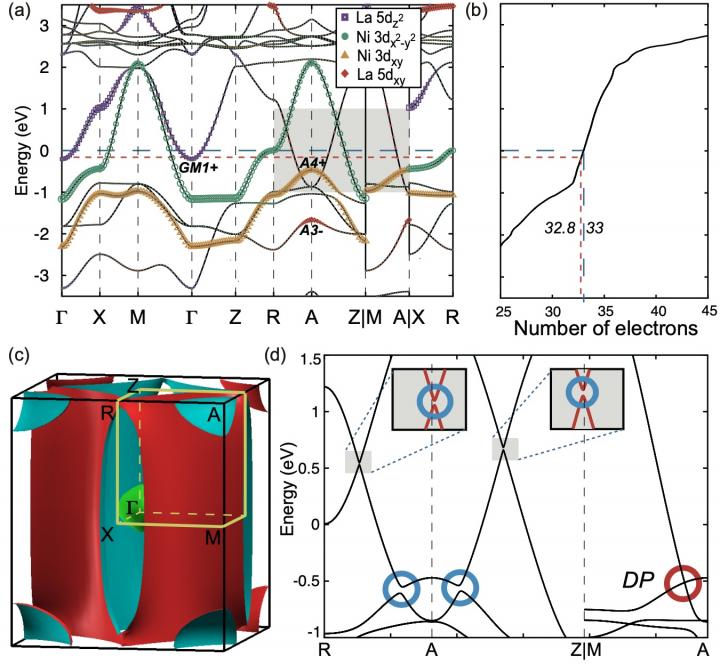
In order to understand the mechanism of nickelates superconductor, scientists at Institute of Physics, Chinese Academy of Science made a carefully analysis on the parent compound NdNiO2, including its electronic band structure, orbital characteristics, Fermi surfaces and band topology by using the first-principles calculations and Gutzwiller variational method. The results show that the electron Fermi pockets are contributed by Ni-3dx2-y2 orbitals, while hole pockets consist of Nd-5d3z2-r2 and Nd-5dxy orbitals (shown in Fig.1). By analyzing elementary band representation in the theory of topological quantum chemistry, authors found that a two-band model can be constructed to reproduce all bands around Fermi level. The two bands originate from two orbitals, including one Ni-3dx2-y2 orbital and one s-like pseudo-orbital located on the vacancy of oxygen atoms. Besides, the authors found that band inversion happens between Ni-3dxy states and conduction bands, resulting a pair of Dirac points along M-A in the Brillouin zone.
In addition, to take the correlation effects of Ni 3d electrons into consideration, the authors performed the DFT + Gutzwiller calculation. The renormalized band structure is given in Fig.2. The results show that the half occupied 3dx2-y2 orbital have the smallest quasiparticle weight (about 0.12); namely, the 3dx2-y2 band width after renormalization is about 1/8 of DFT results. On the other hand, the Dirac points along M-A high symmetry line become closer to the Fermi level due to the band renormalization. In this work authors calculated the electronic structure, discussed topological properties and constructed a two-band model. These results will help people for the study of topology and superconductivity in nickelates.

###

This research received funding from the National Natural Science Foundation of China, Beijing Natural Science Foundation, the Ministry of Science and Technology of China, the Strategic Priority Research Program of Chinese Academy of Sciences and the Beijing Municipal Science and Technology Commission.

See the article:

Jiacheng Gao, Shiyu Peng, Zhijun Wang, Chen Fang, Hongming Weng
Electronic structures and topological properties in nickelates Lnn+1NinO2n+2
Nat.Sci.Rev.
https://doi.org/10.1093/nsr/nwaa218

Media Contact
Zhijun Wang
[email protected]

Related Journal Article

http://dx.doi.org/10.1093/nsr/nwaa218

Tags: Chemistry/Physics/Materials Sciences
Share12Tweet8Share2ShareShareShare2

Related Posts

Quantum Ground State of Rotation Observed for the First Time in Two Dimensions

Quantum Ground State of Rotation Observed for the First Time in Two Dimensions

April 6, 2026
Breakthrough Study Uncovers Secrets of Ocean Chemistry

Breakthrough Study Uncovers Secrets of Ocean Chemistry

April 6, 2026

Overview of Photocatalysts and Biocatalysts in Advancing Artificial Photosynthesis

April 6, 2026

Biochar Enhances Soil Carbon Storage via Microbial Activity, with Effects Differing by Soil Depth

April 3, 2026
Please login to join discussion

POPULAR NEWS

  • blank

    Revolutionary AI Model Enhances Precision in Detecting Food Contamination

    97 shares
    Share 39 Tweet 24
  • Promising Outcomes from First Clinical Trials of Gene Regulation in Epilepsy

    51 shares
    Share 20 Tweet 13
  • Imagine a Social Media Feed That Challenges Your Views Instead of Reinforcing Them

    1009 shares
    Share 399 Tweet 249
  • Popular Anti-Aging Compound Linked to Damage in Corpus Callosum, Study Finds

    44 shares
    Share 18 Tweet 11

About

We bring you the latest biotechnology news from best research centers and universities around the world. Check our website.

Follow us

Recent News

Quantum Ground State of Rotation Observed for the First Time in Two Dimensions

Study Finds Diabetes Drug Metformin May Mimic Exercise Benefits in Prostate Cancer Treatment

Breakthrough Study Uncovers Secrets of Ocean Chemistry

Subscribe to Blog via Email

Enter your email address to subscribe to this blog and receive notifications of new posts by email.

Join 78 other subscribers
  • Contact Us

Bioengineer.org © Copyright 2023 All Rights Reserved.

Welcome Back!

Login to your account below

Forgotten Password?

Retrieve your password

Please enter your username or email address to reset your password.

Log In
No Result
View All Result
  • Homepages
    • Home Page 1
    • Home Page 2
  • News
  • National
  • Business
  • Health
  • Lifestyle
  • Science

Bioengineer.org © Copyright 2023 All Rights Reserved.