• HOME
  • NEWS
  • EXPLORE
    • CAREER
      • Companies
      • Jobs
    • EVENTS
    • iGEM
      • News
      • Team
    • PHOTOS
    • VIDEO
    • WIKI
  • BLOG
  • COMMUNITY
    • FACEBOOK
    • INSTAGRAM
    • TWITTER
Monday, January 12, 2026
BIOENGINEER.ORG
No Result
View All Result
  • Login
  • HOME
  • NEWS
  • EXPLORE
    • CAREER
      • Companies
      • Jobs
        • Lecturer
        • PhD Studentship
        • Postdoc
        • Research Assistant
    • EVENTS
    • iGEM
      • News
      • Team
    • PHOTOS
    • VIDEO
    • WIKI
  • BLOG
  • COMMUNITY
    • FACEBOOK
    • INSTAGRAM
    • TWITTER
  • HOME
  • NEWS
  • EXPLORE
    • CAREER
      • Companies
      • Jobs
        • Lecturer
        • PhD Studentship
        • Postdoc
        • Research Assistant
    • EVENTS
    • iGEM
      • News
      • Team
    • PHOTOS
    • VIDEO
    • WIKI
  • BLOG
  • COMMUNITY
    • FACEBOOK
    • INSTAGRAM
    • TWITTER
No Result
View All Result
Bioengineer.org
No Result
View All Result
Home NEWS Science News Chemistry

Image release: Galaxies in the Perseus Cluster

Bioengineer by Bioengineer
November 12, 2020
in Chemistry
Reading Time: 2 mins read
0
IMAGE
Share on FacebookShare on TwitterShare on LinkedinShare on RedditShare on Telegram

Images show effect of environment on galaxies
IMAGE

Credit: M. Gendron-Marsolais et al.; S. Dagnello, NRAO/AUI/NSF; Sloan Digital Sky Survey.

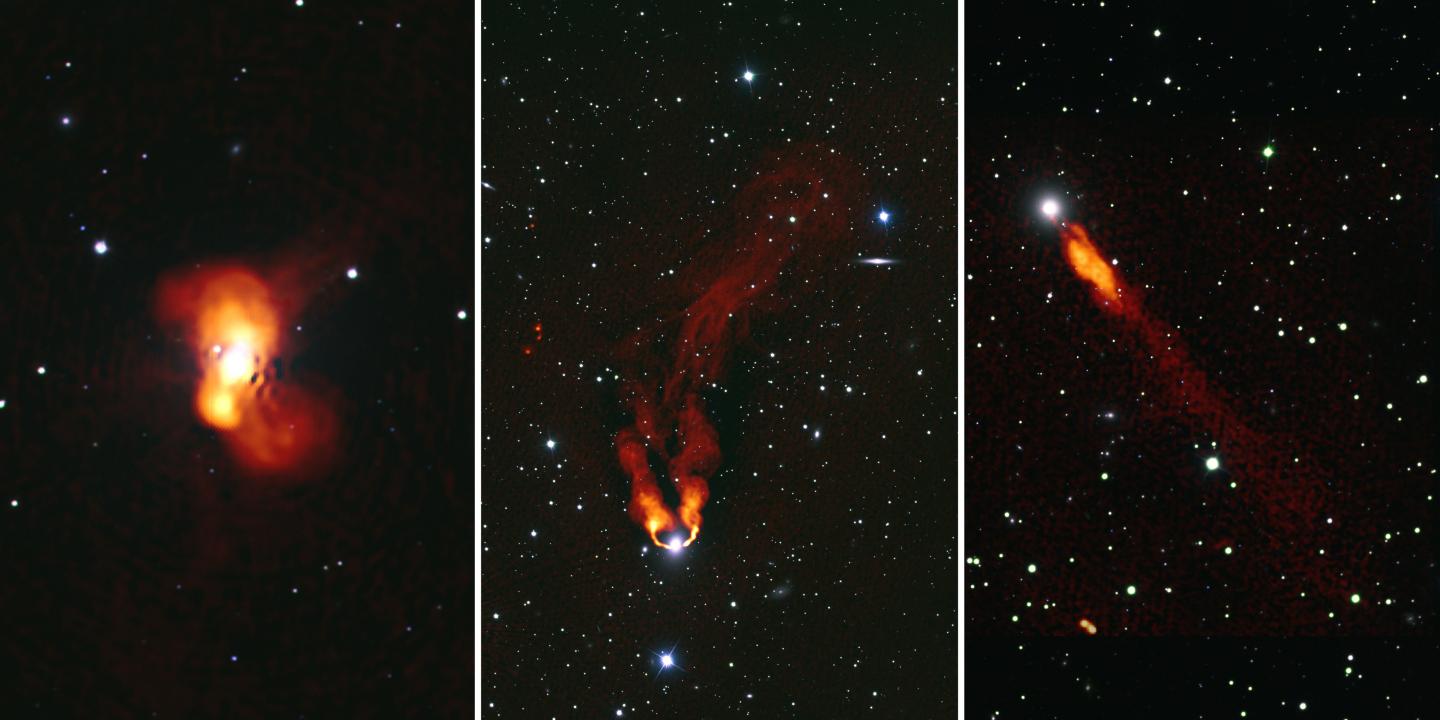
For galaxies, as for people, living in a crowd is different from living alone. Recently, astronomers used the National Science Foundation’s Karl G. Jansky Very Large Array (VLA) to learn how a crowded environment affects galaxies in the Perseus Cluster, a collection of thousands of galaxies some 240 million light-years from Earth.

Left: The giant galaxy NGC 1275, at the core of the cluster, is seen in new detail, including a newly-revealed wealth of complex, filamentary structure in its radio lobes.

Center: The galaxy NGC 1265 shows the effects of its motion through the tenuous material between the galaxies. Its radio jets are bent backward by that interaction, then merge into a single, broad “tail.” The tail then is further bent, possibly by motions within the intergalactic material.

Right: The jets of the galaxy IC 310 are bent backward, similarly to NGC 1265, but appear closer because of the viewing angle from Earth. That angle also allows astronomers to directly observe energetic gamma rays generated near the supermassive black hole at the galaxy’s core.

Such images can help astronomers better understand the complex environment of galaxy clusters, which are the largest gravitationally-bound structures in the universe, and which harbor a variety of still poorly-understood phenomena.

“These images show us previously-unseen structures and details and that helps our effort to determine the nature of these objects,” said Marie-Lou Gendron-Marsolais, an ESO/ALMA Fellow in Santiago, Chile. She and a number of international collaborators are announcing their results in the Monthly Notices of the Royal Astronomical Society.

###

The National Radio Astronomy Observatory is a facility of the National Science Foundation, operated under cooperative agreement by Associated Universities, Inc.

CREDIT: M. Gendron-Marsolais et al.; S. Dagnello, NRAO/AUI/NSF; Sloan Digital Sky Survey.

Media Contact
Dave Finley
[email protected]

Tags: AstronomyAstrophysicsChemistry/Physics/Materials SciencesSpace/Planetary Science
Share12Tweet8Share2ShareShareShare2

Related Posts

blank

Cobalt-Catalyzed Thioester Coupling via Siloxycarbene

January 12, 2026
blank

Advancing Alkene Chemistry: Homologative Difunctionalization Breakthrough

January 8, 2026

Biocompatible Ligand Enables Safe In-Cell Protein Arylation

January 8, 2026

Monovalent Pseudo-Natural Products Boost IDO1 Degradation

January 7, 2026
Please login to join discussion

POPULAR NEWS

  • Enhancing Spiritual Care Education in Nursing Programs

    154 shares
    Share 62 Tweet 39
  • PTSD, Depression, Anxiety in Childhood Cancer Survivors, Parents

    146 shares
    Share 58 Tweet 37
  • Robotic Ureteral Reconstruction: A Novel Approach

    71 shares
    Share 28 Tweet 18
  • Study Reveals Lipid Accumulation in ME/CFS Cells

    51 shares
    Share 20 Tweet 13

About

We bring you the latest biotechnology news from best research centers and universities around the world. Check our website.

Follow us

Recent News

Two Divergent Effectors Control Pm4 Resistance Virulence

Boosting Innovation in Ghana’s Food Processing SMEs

Gene Expression and Growth in Sunit Lambs Analyzed

Subscribe to Blog via Email

Enter your email address to subscribe to this blog and receive notifications of new posts by email.

Join 71 other subscribers
  • Contact Us

Bioengineer.org © Copyright 2023 All Rights Reserved.

Welcome Back!

Login to your account below

Forgotten Password?

Retrieve your password

Please enter your username or email address to reset your password.

Log In
No Result
View All Result
  • Homepages
    • Home Page 1
    • Home Page 2
  • News
  • National
  • Business
  • Health
  • Lifestyle
  • Science

Bioengineer.org © Copyright 2023 All Rights Reserved.