• HOME
  • NEWS
  • EXPLORE
    • CAREER
      • Companies
      • Jobs
    • EVENTS
    • iGEM
      • News
      • Team
    • PHOTOS
    • VIDEO
    • WIKI
  • BLOG
  • COMMUNITY
    • FACEBOOK
    • INSTAGRAM
    • TWITTER
Monday, April 6, 2026
BIOENGINEER.ORG
No Result
View All Result
  • Login
  • HOME
  • NEWS
  • EXPLORE
    • CAREER
      • Companies
      • Jobs
        • Lecturer
        • PhD Studentship
        • Postdoc
        • Research Assistant
    • EVENTS
    • iGEM
      • News
      • Team
    • PHOTOS
    • VIDEO
    • WIKI
  • BLOG
  • COMMUNITY
    • FACEBOOK
    • INSTAGRAM
    • TWITTER
  • HOME
  • NEWS
  • EXPLORE
    • CAREER
      • Companies
      • Jobs
        • Lecturer
        • PhD Studentship
        • Postdoc
        • Research Assistant
    • EVENTS
    • iGEM
      • News
      • Team
    • PHOTOS
    • VIDEO
    • WIKI
  • BLOG
  • COMMUNITY
    • FACEBOOK
    • INSTAGRAM
    • TWITTER
No Result
View All Result
Bioengineer.org
No Result
View All Result
Home NEWS Science News Chemistry

Chemists studied the composition of oils extracted from popular medicinal plants

Bioengineer by Bioengineer
November 12, 2020
in Chemistry
Reading Time: 3 mins read
0
IMAGE
Share on FacebookShare on TwitterShare on LinkedinShare on RedditShare on Telegram

IMAGE

Credit: RUDN University

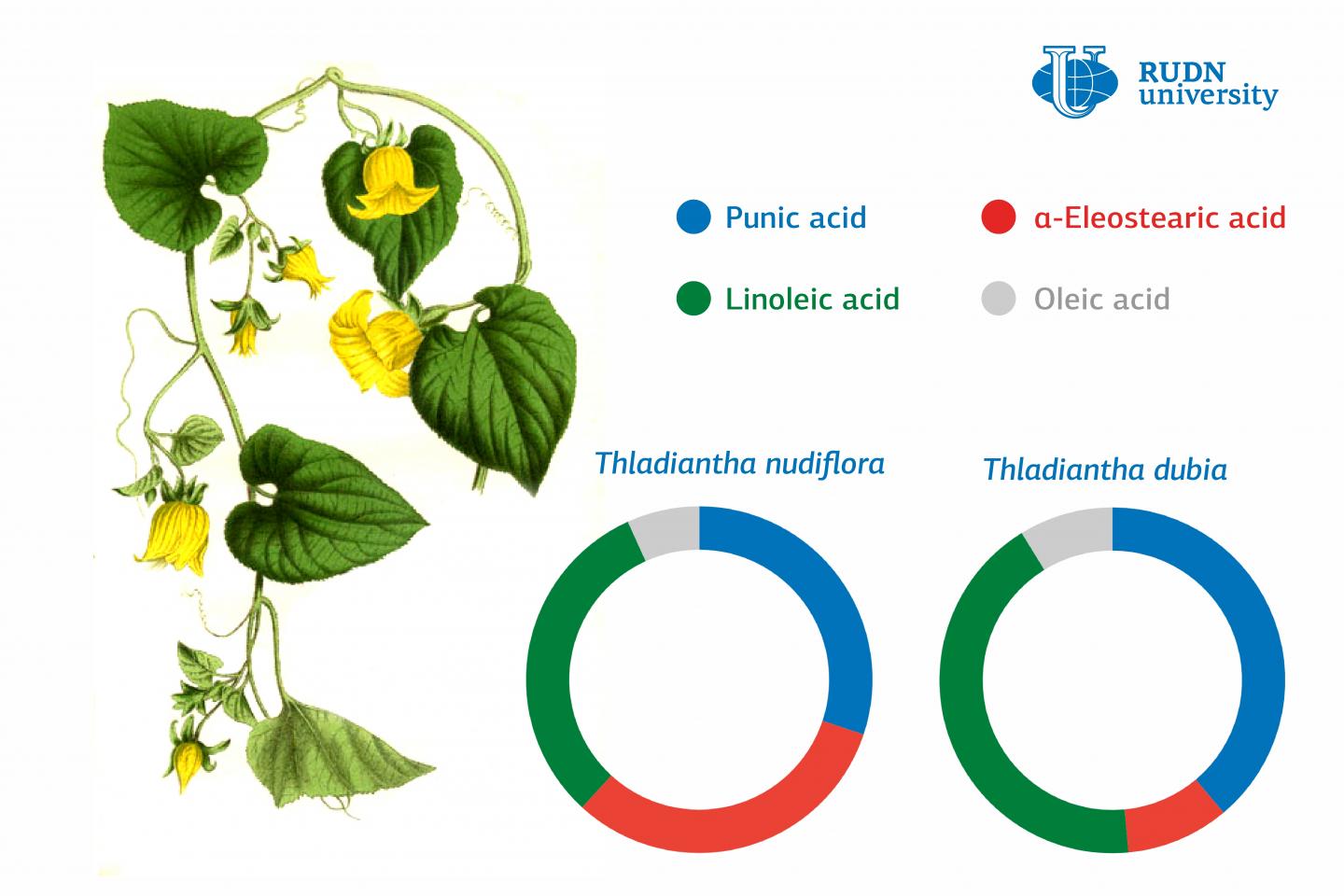
A team of Russian and Vietnamese chemists from RUDN University, Belgorod State University, Ton Duc Thang University, and the Vietnam Academy of Science and Technology were the first to study the composition of oils extracted from two flowering plants of the genus Thladiantha that are popular in traditional Chinese medicine. The team confirmed that the seeds of both plants contain around 40% oils rich in unsaturated fatty acids. The results of the study were published in the Journal of Oleo Science.

Plant oils consist of triglycerides (molecules that contain three acid residues), and the value of any type of oil for nutrition, medicine, and other applications is determined by the type of fatty acid residues its triglycerides contain. Unsaturated conjugated fatty acids with several dibonds between the atoms of carbon have anti-tumor properties and help combat obesity, inflammations, and diabetes. An international team of chemists from RUDN University was the first to identify the fatty acid residue content in the seeds of T. nudiflora and T. dubia, two plants from the genus of tubergourd (Thladiantha). Tubergourds are common in Southeast Asia and are often used as medicinal plants in traditional Chinese medicine. However, until recently the composition of their seed oils remained understudied.

“Triglycerides are the most important components of animal and plant oils. Knowing the quantitative and qualitative parameters of seed oil fats, one can understand the so-called fatty acid composition of the oil that shows whether it is beneficial for human health. This information can be used to identify counterfeit oils,” said Prof. Olga Kovalchukova, a PhD in Chemistry from the Department of General Chemistry at RUDN University.

The team used spectral and chromatographic methods to study the oils and a green technique to separate their components. A 1:3:17 mixture of fats, urea, and ethanol was kept in the freezer at –20? for 12 hours and then filtered. This way the team eliminated saturated fats from the oils.

Based on the study of the extract, the team concluded that valuable oils amounted to 37.1% and 40.3% of the seed weight of T. dubia and T. nudiflora, respectively. The chemists identified 15 types of triglycerides in such oils. Among all acid residues in them, four unsaturated acids prevailed: the volume of punicic acid amounted to 35.6% mole fractions in the T. dubia oil and 27% mole fractions in the T. nudiflora. oil; of linoleic acid–to 40% and 28%, respectively; of oleic acid–to 8% and 6%, respectively. The most interesting discovery was alpha-elaeosteraic acid with 28% content in the T. nudiflora oil. Its molecule contains three conjugated double bonds which make it toxic for some types of cancer.

“We were the first to analyze the quantitative and the qualitative content of fatty acids in tubergourd oils. We also confirmed that saturated and unsaturated fatty acids can be separated in the products of seed oil saponification by using urea crystals at –20?. This is a simple method that helps preserve all valuable unsaturated fatty acids,” added Prof. Olga Kovalchukova.

###

Media Contact
V.V. Antonova
[email protected]

Related Journal Article

http://dx.doi.org/10.5650/jos.ess20075

Tags: Chemistry/Physics/Materials Sciences
Share12Tweet8Share2ShareShareShare2

Related Posts

AI Drives Innovation: Designing Advanced Biochar to Eliminate Antibiotics from Water

AI Drives Innovation: Designing Advanced Biochar to Eliminate Antibiotics from Water

April 6, 2026
Breakthrough Microscopy Unveils Concealed Magnetic Chemistry in Living Organisms

Breakthrough Microscopy Unveils Concealed Magnetic Chemistry in Living Organisms

April 6, 2026

Advances in Zeolite Morphology Control Using Organic Templates

April 6, 2026

Breakthrough Membrane Technology Unlocks Long-Term Battery Gas Analysis, Unveiling Hidden Failure Mechanisms

April 6, 2026
Please login to join discussion

POPULAR NEWS

  • blank

    Revolutionary AI Model Enhances Precision in Detecting Food Contamination

    97 shares
    Share 39 Tweet 24
  • Promising Outcomes from First Clinical Trials of Gene Regulation in Epilepsy

    51 shares
    Share 20 Tweet 13
  • Imagine a Social Media Feed That Challenges Your Views Instead of Reinforcing Them

    1009 shares
    Share 399 Tweet 249
  • Popular Anti-Aging Compound Linked to Damage in Corpus Callosum, Study Finds

    44 shares
    Share 18 Tweet 11

About

We bring you the latest biotechnology news from best research centers and universities around the world. Check our website.

Follow us

Recent News

Scientists Discover Dual Treatment for Lung Cancer and Muscle Wasting

Scientists Discover Blood Biomarker Linked to Cancer Risk in Lynch Syndrome Patients

Unlocking Biochar’s Redox Secrets: A Game Changer for Pollution Cleanup and Energy Recovery

Subscribe to Blog via Email

Enter your email address to subscribe to this blog and receive notifications of new posts by email.

Join 78 other subscribers
  • Contact Us

Bioengineer.org © Copyright 2023 All Rights Reserved.

Welcome Back!

Login to your account below

Forgotten Password?

Retrieve your password

Please enter your username or email address to reset your password.

Log In
No Result
View All Result
  • Homepages
    • Home Page 1
    • Home Page 2
  • News
  • National
  • Business
  • Health
  • Lifestyle
  • Science

Bioengineer.org © Copyright 2023 All Rights Reserved.